
Clepsis
Guenée, 1845
Garden Tortrix Moth (C. peritana), Banded Ivy Tortrix (C. dumicolana)
Species Guides
15- Clepsis anderslaneyii
- Clepsis clemensiana(Clemens' Clepsis Moth)
- Clepsis consimilana(privet tortrix)
- Clepsis danilevskyi
- Clepsis flavidana
- Clepsis fucana
- Clepsis kearfotti
- Clepsis listerana
- Clepsis melaleucanus(Black-patched Clepsis Moth)
Clepsis is a of tortricid moths established by Guenée in 1845. The genus includes several economically significant pest , most notably Clepsis peritana (Garden Tortrix) and Clepsis dumicolana (Banded Ivy Tortrix). Members are characterized by leaf-rolling larval , where caterpillars spin together leaves to create protective shelters. The genus has a broad geographic distribution spanning North America, Europe, and parts of Asia.
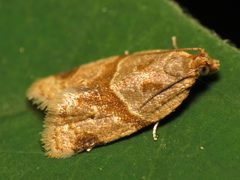
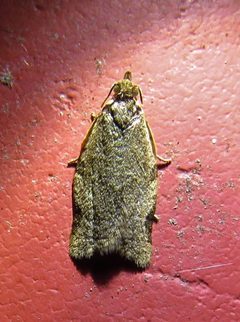

Pronunciation
How to pronounce Clepsis: /ˈklɛp.sɪs/
These audio files are automatically generated. While they are not always 100% accurate, they are a good starting point.
Images
Habitat
vary by . Clepsis dumicolana occurs in urban parks and gardens with ivy (Hedera helix). Clepsis peritana has been observed in cottonwood groves with nearby wetlands in prairie habitats.
Distribution
Widespread across temperate regions. Clepsis dumicolana: Western Europe from Mediterranean Peninsulas north to Denmark and east to Istanbul; established in UK (West/South London, Hertfordshire, Buckinghamshire) since 2014. North American records include Vermont and Colorado. GBIF records indicate presence in Denmark, Norway, and Sweden.
Seasonality
Clepsis dumicolana fly May to October in the UK, with probable two peaking in May/June and September.
Diet
Larvae feed on leaves. Clepsis dumicolana larvae skeletonize ivy leaves (Hedera helix) between spun-together leaves. Specific diet information for most other is not documented in available sources.
Host Associations
- Hedera helix - larval ivy; confirmed for C. dumicolana
Life Cycle
Clepsis dumicolana: are flattened and -like, laid in small batches. Larvae are greyish with black and black prothoracic shield. Pupae are brown with fairly long cremastral projection, found among ivy attached to walls.
Behavior
Clepsis dumicolana is active by day, especially in afternoon, and comes to light. are attracted to pheromonal mixtures of (Z)-11-Tetradecenyl acetate and (E)-11-Tetradecenyl acetate.
Human Relevance
Several are agricultural or horticultural pests. Clepsis peritana is known as the Garden Tortrix. Clepsis dumicolana is an established non-native species in the UK since 2014. The is frequently encountered in citizen science recording events and museum blacklighting surveys.
Similar Taxa
- PlatynotaBoth are tortricid with leaf-rolling larvae; Platynota stultana (Omnivorous Leafroller) often recorded alongside Clepsis at blacklighting stations
- CydiaSimilar size and ; Cydia latiferreana (Filbertworm) co-occurs with Clepsis at light traps but differs in wing pattern and larval preferences
- EpiblemaTortricid with similar small size and wing shape; Epiblema often show more contrasting wing patterns
Sources and further reading
- BugGuide
- Wikipedia
- GBIF taxonomy match
- iNaturalist taxon
- NCBI Taxonomy
- Catalogue of Life
- Blacklighting at the Bohart: They Saw the Light | Bug Squad
- What Will You See at Bohart Museum Open House | Bug Squad
- Oh, What a (Moth) Night! | Bug Squad
- Mark Your Calendar for 'Moth Night' at Bohart Museum: July 30 | Bug Squad
- A Night at the Bohart Museum: Moth Night on Saturday, July 22 | Bug Squad
- Bug Eric: National Moth Week Recap for Colorado Springs
- The Host Range of Clepsis spectrana (Treits.) (Lepidoptera: Tortricidae)
- The genome sequence of the Banded Ivy Tortrix moth, Clepsis dumicolana (Zeller, 1847).