
Zeiraphera
Treitschke, 1829
larch bud moths, spruce bud moths
Species Guides
6- Zeiraphera canadensis(spruce bud moth)
- Zeiraphera claypoleana(Buckeye Petiole Borer Moth)
- Zeiraphera hesperiana(Douglas-fir Bud Moth)
- Zeiraphera improbana(larch needleworm moth)
- Zeiraphera unfortunana(Purple-striped Shootworm Moth)
- Zeiraphera vancouverana
Zeiraphera is a of tortricid moths in the Olethreutinae, comprising approximately 35 described distributed across the Holarctic region. The genus includes economically significant forest pests, notably the larch bud moth (Z. diniana) and spruce bud moth (Z. canadensis), which undergo periodic causing defoliation of coniferous . Several species exhibit complex ecological traits including host race formation, , and long-distance wind-mediated . The genus is characterized by larval feeding on conifer needles and a tendency toward cyclic in certain species.
Pronunciation
How to pronounce Zeiraphera: /ˌzeɪrəˈfɪərə/
These audio files are automatically generated. While they are not always 100% accurate, they are a good starting point.
Identification
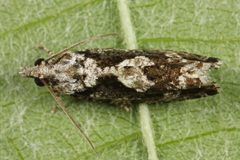
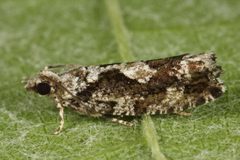
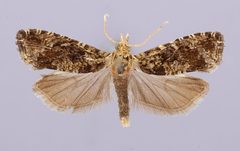
Zeiraphera are small to medium-sized tortricid moths with wingspans typically in the 15-25 mm range. Forewings are generally brownish or greyish with variable banding and markings; some species show distinct costal strigulae. The can be distinguished from related Olethreutinae by genitalia characteristics, particularly the structure of the male valva and female sterigma. Species-level identification often requires examination of genitalia or larval association, as external is frequently convergent. Larvae are typically greenish with darker markings and possess a characteristic tortricid larval habitus with an anal comb.
Images
Habitat
of Zeiraphera are primarily associated with coniferous forests, particularly those dominated by Larix (larch), Picea (spruce), and Pinus (pine). range from subalpine and montane forests to taiga and temperate plantations. Some species show specificity to particular tree age classes: Z. ratzeburgiana is associated with young spruce (3-10 ft height), while Z. fortunana occurs on mature trees (15-25 ft). The has been documented in Arctic tundra habitats during events, though establishment requires presence of host conifers.
Distribution
The Zeiraphera has a Holarctic distribution. In the Palearctic, occur across Europe from the British Isles to Russia, including the European Alps, Scandinavia, and Siberia. Notable records include mass of Z. griseana to Vize Island in the Russian High Arctic (1200 km from source ). In the Nearctic, Z. canadensis is distributed across Canada (New Brunswick, Ontario) and adjacent United States. Asian species are documented from Japan, China (Gansu, Taiwan), and the Russian Far East. GBIF records confirm presence in Denmark, Norway, and Sweden.
Seasonality
periods vary by and latitude. Z. canadensis adults emerge in summer with peak mating around midnight; oviposition occurs at sunset and continues for approximately 3 hours. Z. diniana shows cycles with every 6-8 years in the European Alps. In northern New Brunswick, Z. canadensis larval begins in late May and is usually completed within 10 days, synchronized with white spruce bud burst. requirements for Z. canadensis are satisfied by 15 weeks at 0.5°C.
Diet
Larvae feed on conifer needles. Documented include Larix decidua (European larch), Larix laricina (tamarack), Picea glauca (white spruce), Picea spp. (spruce generally), Pinus contorta (lodgepole pine), and Pinus spp. (pine). Z. canadensis larvae feed inside growing shoots of white spruce. Z. improbana feeds on tamarack. Host race formation has been documented in Z. diniana, with specialized on larch, cembran pine, and spruce showing distinct and morphological characteristics.
Host Associations
- Larix decidua - larval foodplantPrimary for Z. diniana in alpine Europe
- Larix laricina - larval foodplant for Z. improbana in Ontario
- Picea glauca - larval foodplantPrimary for Z. canadensis; larval synchronized with bud burst
- Pinus contorta - larval foodplant for Z. diniana in upland Britain
- Pinus cembra - larval foodplant for cembran pine race of Z. diniana
Life Cycle
undergo embryonic development before can be initiated; Z. canadensis requires 15 weeks at 0.5°C to complete diapause. Larval in Z. canadensis begins in late May, completed within 10 days, with first-instar larvae settling inside growing shoots within 30 minutes and remaining until end of larval development. Larvae drop to ground and remain as for approximately 6 days. occurs in soil or litter. emerge with mating possible the first night; copulation lasts on average 4.3 hours. Pre-oviposition period is 6-7 days. averages 22-33 eggs per female in Z. canadensis. Temperature-dependent development: shortest development times at 28°C; larvae tolerate 32°C (lethal for pupae); temperatures above 30°C lethal for eggs.
Behavior
activity with bimodal pattern: peaks near dawn and dusk. Z. canadensis remain in lower crown during day, moving higher after sunset with flight above associated with oviposition and mating. Males hover adjacent to branches containing females before alighting, then approach to 2-5 cm and remain motionless before mounting, indicating short-range pre-mating communication. Females probe oviposition sites with ovipositor, suggesting use of sensillae for site evaluation. Long-distance wind-mediated documented: Z. griseana transported 1200 km across Arctic Ocean, remaining active for at least 20 days post-arrival. present in Z. diniana races, with males showing differential response to (E)-9-dodecenyl acetate versus (E)-11-tetradecenyl acetate.
Ecological Role
Zeiraphera function as primary consumers in coniferous forest . Periodic , particularly of Z. griseana in the European Alps (6-8 year cycles) and Z. diniana, cause extensive defoliation of larch forests, influencing forest structure and productivity. The cyclic result from interaction of favorable weather, deciduous habit, and high reproductive rate. Larval feeding inside shoots creates microhabitat modification. associations documented: Z. improbana hosts one braconid, one ichneumonid, and three chalcid . Co-occurrence with spruce budworm (Choristoneura fumiferana) noted in white spruce .
Human Relevance
Several Zeiraphera are significant forest pests. Z. diniana (larch bud moth) causes periodic defoliation of larch forests in the European Alps, with historical records of ten major gradations. Z. canadensis (spruce bud moth) is a pest of white spruce in Canada, with potential to cause growth reduction and leader deformation; management strategies including timing of adulticidal sprays have been developed based on reproductive . Z. griseana (grey larch budmoth) defoliates extensive larch forests. Research on in Z. diniana has contributed to understanding of race formation and speciation. models have been developed for Z. canadensis to predict and optimize survey timing.
Similar Taxa
- ChoristoneuraSpruce budworm co-occurring on conifers; Zeiraphera distinguished by larval habit of feeding inside shoots rather than on buds, and by genitalia structure
- EpinotiaRelated Olethreutinae with similar conifer association; Zeiraphera typically larger with different wing pattern elements and genitalia
- CydiaTortricid with some conifer-feeding ; Zeiraphera lacks characteristic Cydia forewing markings and has distinct larval
More Details
Host race formation
Z. diniana exhibits complex race structure with specialized on larch, cembran pine, and spruce showing distinct communication systems and larval color morphs. Hybridization between host races occurs, with F1 males showing dominance of cembran pine pheromone response over larch response.
Climate change implications
Mass of Z. griseana to Vize Island (1000 km north of tree limit) demonstrates capacity for long-distance of Arctic islands. Successful arrival and survival suggests that warming climate may enable establishment of forest insect in previously inaccessible High Arctic .
Phenological synchrony
Z. canadensis shows high degree of phenological synchrony with white spruce bud burst; asynchrony with black, Norway, and red spruce (bud burst 3-15 days later) may explain limited pest status on these .
Sources and further reading
- BugGuide
- Wikipedia
- GBIF taxonomy match
- iNaturalist taxon
- NCBI Taxonomy
- Catalogue of Life
- Carried with the wind: mass migration of Larch Budmoth to the Russian High Arctic | Blog
- Nota Lepidopterologica | Blog - Part 2
- BIOLOGICAL NOTES ON ZEIRAPHERA FORTUNANA KFT. AND RATZEBURGIANA RATZ. (EUCOSMIDAE, LEPID.)
- Diel activity pattern of a nocturnal moth, Zeiraphera canadensis, in nature
- Studien zum Pheromon‐Polymorphismus von Zeiraphera diniana Gn. (Lep., Tortricidae)
- Temperature‐dependent development of Zeiraphera canadensis and simulation of its phenology
- Biology and behavior of a larch bud moth, <em>Zeiraphera</em> sp., in Alaska.
- Role of volatile chemostimuli in the sensory ecology of tsetse flies, Glossina spp., and host races of the larch bud moth, Zeiraphera diniana Guénée
- Zeiraphera griseana Hübner (Lepidoptera: Tortricidae) in the European Alps. A Contribution to the Problem of Cycles
- DEVELOPMENT OF SAMPLING TECHNIQUES FOR THE SPRUCE BUDMOTH, ZEIRAPHERA CANADENSIS MUT. AND FREE. (LEPIDOPTERA: TORTRICIDAE)
- Genetic differentiation in Zeiraphera diniana (Lepidoptera: Tortricidae, the larch budmoth): polymorphism, host races or sibling species?
- NOTES ON THE BIOLOGY OF THE LARCH NEEDLEWORM,ZEIRAPHERA IMPROBANA(LEPIDOPTERA: OLETHREUTIDAE), IN ONTARIO
- LIFE CYCLE AND BEHAVIOR OF THE SPRUCE BUDMOTH,ZEIRAPHERA CANADENSIS(LEPIDOPTERA: OLETHREUTIDAE), IN NEW BRUNSWICK
- REPRODUCTIVE BIOLOGY OF THE SPRUCE BUDMOTH, ZEIRAPHERA CANADENSIS MUT. & FREE. (LEPIDOPTERA: TORTRICIDAE: OLETHREUTINAE), IN NEW BRUNSWICK
- THE PHENOLOGICAL RELATIONSHIP BETWEEN THE LARVAL DEVELOPMENT OF THE SPRUCE BUDMOTH, ZEIRAPHERA CANADENSIS (LEPIDOPTERA: OLETHREUTIDAE), AND WHITE SPRUCE IN NORTHERN NEW BRUNSWICK
- Phenology, polymorphism and insect-plant relationships of the larch budmoth, Zeiraphera diniana (Guenée) (Lepidoptera: Tortricidae), on alternative conifer hosts in Britain