
Spilonota ocellana
(Denis & Schiffermüller, 1775)
bud moth, eye-spotted bud moth
Spilonota ocellana, commonly known as the bud or -spotted bud moth, is a small tortricid moth with a wingspan of 12–17 mm. It has a wide distribution spanning the from North Africa and Europe through Asia to China, Korea, and Japan, with introduced in North America and Madeira. The is , with flying from May to October depending on location. Larvae feed on various deciduous trees and shrubs, and the species is recognized as a pest in apple orchards where it has been studied extensively.
Pronunciation
How to pronounce Spilonota ocellana: /ˌspaɪloʊˈnoʊtə oʊˈsɛlænə/
These audio files are automatically generated. While they are not always 100% accurate, they are a good starting point.
Identification
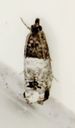
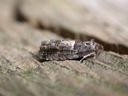
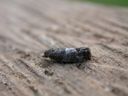
Distinguished from similar tortricids by the combination of whitish forewings with dark fuscous strigulation, the leaden-metallic edged ocellus containing black dashes, and the black-edged triangular praetornal spot. The dark grey basal patch with angulated edge and the dark grey central fascia help separate it from . Genitalia examination may be required for definitive identification in areas where multiple Spilonota occur.
Images
Habitat
Found in various supporting its plants, including deciduous woodlands, hedgerows, and orchards. In agricultural settings, it occurs in apple orchards where it has been documented as a pest. Larvae construct shelters on host trees.
Distribution
: North Africa, Europe (including Austria, Belgium, Britain, Bulgaria, Czechoslovakia, Denmark, Finland, France, Germany, Hungary, Ireland, Italy, Netherlands, Norway, Poland, Portugal, Romania, Spain, Sweden, Switzerland, Yugoslavia), east to Iran, eastern Russia, China (Hebei, Inner Mongolia, Jilin, Zhejiang, Fujian, Hubei, Sichuan, Shaanxi, Gansu, Qinghai), Korea, and Japan. Also present on Madeira. Introduced to North America: Canada and USA (including Wisconsin and Nova Scotia).
Seasonality
fly from May to October depending on location. One per year (). Summer larvae appear shortly after the first of August when begin to hatch.
Diet
Larvae feed on various deciduous trees and shrubs including Quercus (oak), Betula (birch), Sorbus (rowan), and Vaccinium. In orchards, larvae feed on Malus domestica (apple), Prunus (cherry, plum, peach), Pyrus (pear), and Cydonia (quince). Also recorded on Prunus spinosa (blackthorn), Larix (larch), and Alnus (alder).
Host Associations
- Malus domestica - larval food plantmajor orchard
- Prunus - larval food plantincludes cherry, plum, peach
- Pyrus - larval food plantpear
- Cydonia - larval food plantquince
- Quercus - larval food plantoak
- Betula - larval food plantbirch
- Sorbus - larval food plantrowan
- Vaccinium - larval food plant
- Prunus spinosa - larval food plantblackthorn
- Larix - larval food plantlarch; larch-feeding form sometimes distinguished as lariciana
- Alnus - larval food plantalder
- Agathis laticinctus - kills average of 25% of late-instar larvae in Nova Scotia apple orchards
Life Cycle
(one per year). hatch beginning shortly after August 1, producing summer larvae. Larvae construct shelters on trees. occurs in shelters. emerge from May to October depending on location.
Behavior
Larvae exhibit uneven, non-random distribution on trees, with consistently greater densities in upper tree levels compared to lower levels. This spatial pattern introduces in sampling data. Larvae construct shelters on host plants.
Ecological Role
Herbivore on deciduous trees and shrubs. Serves as for including Agathis laticinctus. Subject to nuclear- virus which can cause high mortality under favorable conditions, though typically kills less than 10% of .
Human Relevance
Recognized as a pest in apple orchards in North America, where larval feeding damages fruit trees. Subject to monitoring and management in commercial fruit production. Virus and populations have been studied as potential agents.
Similar Taxa
- Spilonota lechriaspis in same ; may overlap in distribution (North Korea); requires genitalia examination for definitive separation
- Other Spilonota speciesSimilar size and general appearance; identification relies on wing pattern details and genitalia
More Details
Population Dynamics
In Nova Scotia apple orchards, a nuclear- virus was found in the majority of orchards sampled over a nine-year survey. The virus typically killed less than 10% of , though higher mortalities occurred under favorable conditions.
Taxonomic Note
The larch-feeding form was formerly distinguished as lariciana based on somewhat smaller and darker appearance, but is now generally treated as .
Sources and further reading
- BugGuide
- Wikipedia
- GBIF taxonomy match
- iNaturalist taxon
- NCBI Taxonomy
- Catalogue of Life
- Spilonota ocellana . [Distribution map].
- The Influence of a Virus Disease and Parasites on Spilonota ocellana in Apple Orchards
- Sampling and Distribution of Summer Eye-spotted Bud Moth Spilonota ocellana (D. & S.), Larvae and Nests on Apple Trees
- A review of the genus Spilonota Stephens (Lepidoptera: Tortricidae) in North Korea