
Spilonota
Stephens, 1834
Bud moths
Species Guides
1- Spilonota ocellana(bud moth)
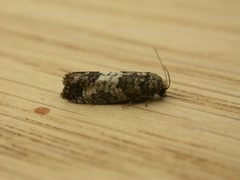
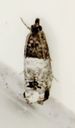
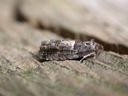
Spilonota is a globally distributed of tortricid moths in the Olethreutinae. The genus contains approximately 35 described , with members recorded across Europe, Asia, North America, and other regions. Several species are significant agricultural pests, particularly of fruit trees. The most extensively studied species, Spilonota ocellana (-spotted bud ), is a well-documented pest of apple and other rosaceous crops.
Pronunciation
How to pronounce Spilonota: /ˌspaɪloʊˈnoʊtə/
These audio files are automatically generated. While they are not always 100% accurate, they are a good starting point.
Images
Distribution
Worldwide distribution with records from Europe (including Austria, Belgium, Britain, Bulgaria, Czechoslovakia, Denmark, Finland, France, Germany, Hungary, Ireland, Italy, Netherlands, Norway, Poland, Portugal, Romania, Spain, Sweden, Switzerland, Yugoslavia), Asia (China, Japan, Korea, Pakistan, Russia), Africa (Madeira), and North America (Canada, USA). Specific distribution varies by ; S. ocellana has the broadest recorded range. North Korean records confirmed for S. lechriaspis and S. ocellana.
Human Relevance
Several Spilonota are agricultural pests of fruit trees. Spilonota ocellana (-spotted bud ) is a documented pest of apple, cherry, peach, pear, plum, and quince. Larval feeding damages buds, shoots, and fruit. The species is subject to programs using nuclear- virus and (e.g., Agathis laticinctus).
Similar Taxa
- EucosmaFormerly included some Spilonota ; S. ocellana was historically placed in Eucosma. Genitalia and wing pattern separate the .
- Other Olethreutinae generaSpilonota are distinguished by characteristic wing patterns including often prominent ocellate or spotted markings, and male genitalia with specific uncus and gnathos structures.
Sources and further reading
- BugGuide
- Wikipedia
- GBIF taxonomy match
- iNaturalist taxon
- NCBI Taxonomy
- Catalogue of Life
- Spilonota ocellana . [Distribution map].
- A review of the genus Spilonota Stephens (Lepidoptera: Tortricidae) in North Korea
- The Influence of a Virus Disease and Parasites on Spilonota ocellana in Apple Orchards
- Sampling and Distribution of Summer Eye-spotted Bud Moth Spilonota ocellana (D. & S.), Larvae and Nests on Apple Trees
- Status, distribution, and population trends of Galápagos Rail Laterallus spilonota and Paint-billed Crake Neocrex erythrops on the Galápagos Islands