
Zeiraphera unfortunana
Powell, 1983
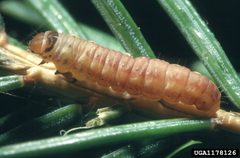
Purple-striped Shootworm Moth, purplestriped shootworm
Zeiraphera unfortunana is a tortricid native to and subarctic regions of North America. The larvae are specialized feeders on coniferous trees, particularly spruce and fir species, where they develop in shoots and buds. The species was described by Powell in 1983 and is one of several Zeiraphera species known as 'budworms' or 'shootworms' due to their larval feeding habits.
Pronunciation
How to pronounce Zeiraphera unfortunana: //ˌzaɪrəˈfɪərə ˌʌnfɔːrˈtʃuːnænə//
These audio files are automatically generated. While they are not always 100% accurate, they are a good starting point.
Identification
The can be distinguished from related Zeiraphera by genitalic characters and subtle wing pattern differences; precise identification typically requires dissection and comparison with described specimens. The 'purple-striped shootworm' refers to larval coloration, though this trait alone is insufficient for species-level identification within the .
Images
Habitat
and subarctic coniferous forests, particularly stands of spruce and fir. Larvae develop within the shoots and buds of trees.
Distribution
North America: Nova Scotia, Ontario to British Columbia, Yukon, Alaska, Michigan, and Minnesota.
Diet
Larvae feed on Picea glauca (white spruce), Picea engelmannii (Engelmann spruce), Picea sitchensis (Sitka spruce), Abies balsamea (balsam fir), Abies lasiocarpa (subalpine fir), and Abies amabilis (Pacific silver fir).
Host Associations
- Picea glauca - larval foodplantwhite spruce
- Picea engelmannii - larval foodplantEngelmann spruce
- Picea sitchensis - larval foodplantSitka spruce
- Abies balsamea - larval foodplantbalsam fir
- Abies lasiocarpa - larval foodplantsubalpine fir
- Abies amabilis - larval foodplantPacific silver fir
Ecological Role
As a herbivore on coniferous trees, larvae may influence shoot growth and bud development. and ecological impacts have not been quantitatively studied.
Human Relevance
The has not been documented as a significant forestry pest, unlike some such as Zeiraphera diniana (Larch Budmoth).
Similar Taxa
- Zeiraphera dinianaSimilar larval habits as a conifer-feeding shootworm, but restricted to larch (Larix) rather than spruce and fir; distinguished by association and genitalic characters.
- Zeiraphera griseanaAnother congeneric shootworm with overlapping geographic range; distinguished by preferences and subtle morphological differences.
More Details
Taxonomic note
The specific epithet 'unfortunana' is unusual and its etymology has not been formally published; it may reflect the difficulty of distinguishing this from .