
Nemapogon
Schrank, 1802
Fungus moths
Species Guides
15- Nemapogon acapnopennella
- Nemapogon angulifasciella(Black-patched Nemapogon)
- Nemapogon auropulvella
- Nemapogon clematella(Barred White Clothes Moth)
- Nemapogon cloacella(Cork Moth)
- Nemapogon defectella
- Nemapogon geniculatella
- Nemapogon granella(European grain worm)
- Nemapogon interstitiella
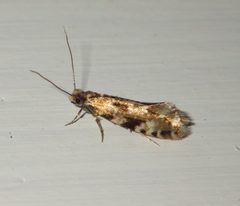
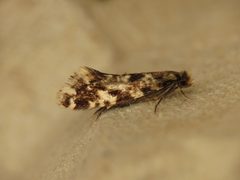
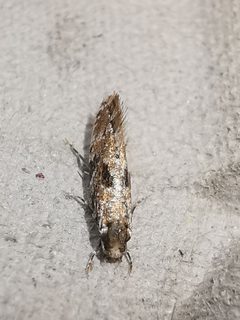
Nemapogon is a of small tineid moths in the Nemapogoninae, comprising approximately 69 described as of 2007. Species occupy woodland where larvae develop within bracket fungi on dead wood. Some species are attracted to light and may occasionally be captured in traps intended for clothes moths. The genus includes species with divergent feeding habits: most are fungivores, while at least one species (N. gersimovi) has been intercepted feeding on stored seeds and grains.
Pronunciation
How to pronounce Nemapogon: //ˌnɛməˈpoʊɡɒn//
These audio files are automatically generated. While they are not always 100% accurate, they are a good starting point.
Identification
Nemapogon are small that may be mistaken for clothes moths (Tineola spp., Tinea spp.) due to similar size and general appearance. Accurate identification to species level requires examination of genitalia and other microscopic features. of some species show light speckling or mottled patterns.
Images
Habitat
Woodland with dead wood and bracket fungi. Larvae develop within fungal fruiting bodies on decaying broadleaved wood, particularly birch.
Distribution
Recorded from Europe (including Denmark, Norway, Sweden), North America (Vermont, USA), and Asia (China). -specific distributions vary: N. koenigi is locally distributed in Britain (widest in England north to Cumbria) with sparse records from Ireland (first recorded 2015, County Antrim).
Seasonality
fly from late spring into summer. Specific periods vary by and latitude.
Diet
Larvae of most feed within bracket fungi on dead wood of broadleaved trees including birch. Nemapogon gersimovi has been intercepted in association with soybeans and is reported to feed on seeds and grains.
Host Associations
- Annulohypoxylon multiforme - larval foodbracket fungus on dead wood
- Fomitopsis betulina - larval foodbracket fungus on dead birch
- dead birch - larval wood substrate for fungal food sources
- broadleaved wood - larval general substrate for fungal food sources
- soybeans - intercepted associationN. gersimovi found in shipment of bulk organic soybeans
Life Cycle
Larvae feed and develop within bracket fungi on dead wood. emerge and fly during late spring and summer. Specific details on -laying, , and stages are not documented in available sources.
Behavior
are attracted to light. Some may occasionally be captured in clothes- traps, leading to misidentification as household pests.
Ecological Role
and fungivore; larvae contribute to decomposition of dead wood through feeding on bracket fungi. Some may function as stored product pests.
Human Relevance
Generally not considered significant household textile pests despite occasional misidentification as clothes moths. Nemapogon gersimovi has been intercepted at ports as a potential agricultural pest due to seed-feeding , with one interception resulting in shipment re-exportation to prevent introduction.
Similar Taxa
- Tineola bisselliellaSimilar size and appearance; clothes moth is a true textile pest while Nemapogon larvae feed on fungi in dead wood
- Tinea pellionellaSimilar size and appearance; case-bearing clothes moth is a textile pest while most Nemapogon are woodland fungivores
Misconceptions
Often called or mistaken for clothes moths, but most Nemapogon are not household textile pests. Larval feeding on fungi in dead wood distinguishes them from true clothes moths that feed on keratinous materials.
More Details
Genome sequencing
Nemapogon koenigi has been sequenced: assembly size 382.95 Mb with 31 chromosomal pseudomolecules including Z ; mitochondrial genome 15.68 kb. Specimens from Wytham Woods, Oxfordshire, UK.
Taxonomic history
The has undergone multiple nomenclatural changes. The name Brosis was first proposed by Hübner in 1806 in an invalid work, then validly erected in 1822 but preoccupied by Billberg's use for what is now Incurvaria. Nematopogon Agassiz, 1847 was an unjustified emendation also preoccupied.
Sources and further reading
- BugGuide
- Wikipedia
- GBIF taxonomy match
- NCBI Taxonomy
- Catalogue of Life
- Nemapogon-0gerasimovi - Entomology Today
- Nemapogon gersimovi Archives - Entomology Today
- Baltimore CBP Agents Stop Invasive Chinese Moth at Seaport
- The genome sequence of the White-speckled Fungus moth, Nemapogon koenigi Capuse, 1967 (Lepidoptera: Tineidae).