
Nemapogon granella
(Linnaeus, 1758)
European grain worm, European grain moth
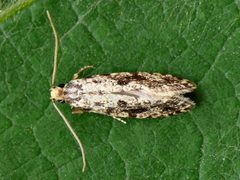
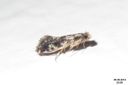
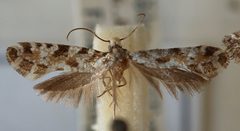
A small tineid with a wingspan of 10–18 mm, native to the western Palearctic but distributed globally through human activity. display irregular black, white, and grey mottling on the forewings with distinctive black spots along the leading edge. Larvae feed on bracket fungi in natural settings and various stored organic materials in human-associated environments. The is the type species of Nemapogon and Nemapogoninae.
Pronunciation
How to pronounce Nemapogon granella: /ˌnɛməˈpoʊɡɒn ɡrəˈnɛlə/
These audio files are automatically generated. While they are not always 100% accurate, they are a good starting point.
Identification
Distinguished from close relatives such as Nemapogon cloacella (cork moth) by the specific pattern of black spots on the forewing leading edge forming a zigzag band. The combination of forewing mottling and yellowish-white tuft aids identification. Accurate separation from similar Nemapogon may require examination of genitalia or molecular methods.
Images
Habitat
In natural settings, associated with decaying wood and bracket fungi. In , found in stored food facilities, warehouses, and dwellings where dry organic materials are stored. Populations tied to human structures can persist year-round in suitable conditions.
Distribution
Native to western Palearctic; widespread but patchily distributed in Europe. Recorded from UK, Belgium, and neighboring countries; apparently absent from Iceland. Introduced established globally including Australia, though many are not stable long-term. distribution essentially worldwide.
Seasonality
most active March to September in UK. Natural follow seasonal pattern; human-associated populations can be encountered year-round.
Diet
Larvae: In wild, bracket fungi (Polyporales) including Laetiporus sulphureus, Polyporus squamosus, Trametes versicolor, Piptoporus betulinus, and Serpula lacrymans. In human-associated settings, dried fruit (Vaccinium), mushrooms, cereal and legume seeds, flour, Helianthus tuberosus stalks, cork, and Claviceps purpurea. Records from Capsicum annuum, Papaver somniferum, Prunus amygdalus amara, and require verification.
Host Associations
- Laetiporus sulphureus - larval foodPolyporaceae
- Polyporus squamosus - larval foodPolyporaceae
- Trametes versicolor - larval foodPolyporaceae
- Piptoporus betulinus - larval foodFomitopsidaceae
- Serpula lacrymans - larval foodBoletales
- Claviceps purpurea - larval food
Behavior
exploit stored organic materials. active during summer months in natural populations; year-round activity possible in heated structures.
Ecological Role
Larvae contribute to decomposition of bracket fungi and rotting wood in natural . In human environments, acts as pest of stored products.
Human Relevance
Pest of stored food products including seeds, flour, dried fruit, and mushrooms. Has been intercepted in international trade, necessitating measures. Damage to wine and champagne corks has been recorded.
Similar Taxa
- Nemapogon cloacellaSimilar forewing mottling pattern; both feed on cork and organic materials. Separation requires careful examination of spot pattern on leading edge.
- Nemapogon gersimoviRelated intercepted in agricultural shipments; similar as pest of seeds and grains.
More Details
Taxonomic significance
Type of Nemapogon and Nemapogoninae. Formerly placed in invalid genera Brosis (junior homonym) and Diaphthirusa (junior objective synonym).
Nomenclatural history
Subject to repeated redescriptions under obsolete names. Gender of specific epithet historically uncertain (-us vs. -a variants).