
Cactoblastis
Ragonot, 1901
Species Guides
1- Cactoblastis cactorum(cactus moth)
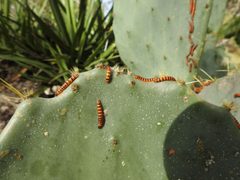
Cactoblastis is a of snout moths (Pyralidae) described by Émile Louis Ragonot in 1901. The genus contains five described native to South America, with C. cactorum being the most extensively studied due to its historical role as a agent. Larvae are specialized internal feeders on cactus cladodes, and the genus is notable for complex collective in caterpillars. C. cactorum was famously introduced to Australia in 1925 to control prickly pear cacti, achieving significant success, though later spreading to threaten native Opuntia species in other regions.
Pronunciation
How to pronounce Cactoblastis: /kæktəʊˈblæstɪs/
These audio files are automatically generated. While they are not always 100% accurate, they are a good starting point.
Identification
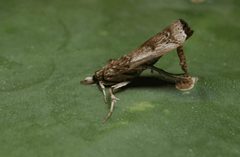
are snout moths (Pyralidae) with typical characteristics including elongated labial palps forming a snout-like projection. Larvae are internal feeders within cactus cladodes, not externally visible until . masses are distinctive: laid in stick-like formations (egg sticks) on cactus surfaces, each containing 60-100 eggs. -level identification requires examination of adult genitalia and wing patterns; C. cactorum specifically associated with Opuntia .
Images
Habitat
Arid and semi-arid regions associated with Opuntia cactus stands. In native range (South America), found in open woodlands and pasturelands with cactus . In introduced ranges, occupies similar where cacti occur. Open woodland populations maintain low- equilibrium with host plants; pasture populations follow different dynamics with woodland populations serving as .
Distribution
Native to South America: Argentina, Peru, and Brazil. C. cactorum introduced to Australia (1925), South Africa, Caribbean islands, and southeastern United States. Within the United States, established in Florida and spreading. Distribution closely tracks presence of Opuntia .
Diet
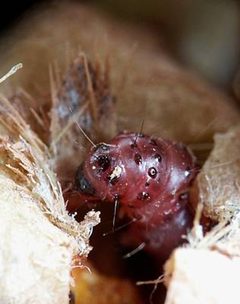
Larvae feed internally on cactus cladode tissue, specifically consuming meristematic tissue. have been observed imbibing mucilage when explosive release floods excavation zones. Strictly associated with Opuntia ; specificity to cactus .
Host Associations
- Opuntia stricta - primary (Australia target)
- Opuntia ficus-indica - experimental ; spineless varieties used in laboratory studies
- Opuntia species - multiple used across different control programs and regions
- Native Opuntia species - threatened in Caribbean and southeastern United States following introduction
Life Cycle
laid in stick-like masses on cactus surfaces; masses contain 60-100 eggs. Hatching asynchronous, requiring approximately 20 hours for full cohort at 50-70% relative humidity. aggregate at egg stick base under silken web, delaying excavation until threshold of ~25 caterpillars reached (~15 hours post-hatch onset). Larvae bore into cladodes, feed internally on meristematic tissue, and periodically return to surface to defecate. occurs within cactus pad. emerge to reproduce.
Behavior
larvae exhibit collectively facilitated : under silken web until threshold numbers permit cooperative excavation of single entrance hole. Strong attraction to volatile chemicals released by chewing conspecifics maintains cohort fidelity to penetration site. Mandibular gland secretions mark pre-excavation arena; application of extract disrupts aggregation and causes independent . When site impenetrable, unfed neonates collectively search for new sites, marking and following persistent trails that allow late-eclosion caterpillars to join. Inside cladode, marked individuals maintain regular defecation cycles at surface (~10 minute intervals). Ovipositing females select large, green, actively photosynthesizing cacti near previously attacked plants.
Ecological Role
herbivore of Opuntia cacti. In native range, maintains low- equilibrium with in open woodlands. As agent, suppresses Opuntia populations; however, in introduced ranges lacking natural enemies, threatens native cactus and dependent . Contagious distribution creates larval overcrowding on some plants while sparing others, preventing extinction of both host plants and insect populations.
Human Relevance
C. cactorum is iconic as a 'poster child' of due to successful Australian program controlling prickly pear (1925 onwards). However, historical accounts often misrepresent this as the first successful agent (vedalia beetle predates it) and exaggerate immediacy/universality of success. Multiple Cactoblastis and were involved in different regional programs. Later spread to Caribbean and southeastern United States created conflict: now threatens native Opuntia species and , including potential impacts on species dependent on cacti (e.g., endangered fauna). Illustrates complex legacy and risks of biological control introductions.
Similar Taxa
- Other Phycitinae moths-level resemblance in ; distinguished by specificity to Opuntia and distinctive stick oviposition
- Other internal-feeding Lepidoptera on cactiLarval overlap; Cactoblastis distinguished by collective , mandibular gland marking, and specific thresholds
Misconceptions
C. cactorum is often incorrectly cited as the first successful agent; the vedalia beetle (Rodolia cardinalis) controlling cottony cushion scale predates it. Its success in Australia is frequently portrayed as more immediate and universal than historical records support. The singular fame of C. cactorum obscures the fact that multiple Cactoblastis and contributed to prickly pear control across different programs.
More Details
Taxonomic composition
The contains five described : C. bucyrus Dyar 1922, C. cactorum (Berg 1885), C. doddi Heinrich 1939, C. mundelli Heinrich 1939, and C. ronnai (Brèthes 1920). Most research and applied use involves C. cactorum specifically.
Social facilitation terminology
The collective of C. cactorum have been formally described as 'socially facilitated' or 'collectively facilitated,' defined as behavior initiated or increased by the presence and actions of other individuals. This represents a rare documented case of social behavior in a non-eusocial insect.
Sources and further reading
- BugGuide
- Wikipedia
- GBIF taxonomy match
- iNaturalist taxon
- NCBI Taxonomy
- Catalogue of Life
- Collectively Facilitated Behavior of the Neonate Caterpillars of Cactoblastis cactorum (Lepidoptera: Pyralidae)
- Understanding the Ghost of Cactoblastis Past: Historical Clarifications on a Poster Child of Classical Biological Control
- Egg clumping, host plant selection and population regulation in Cactoblastis cactorum (Lepidoptera)
- Host Specificity of Cactoblastis cactorum (Lepidoptera: Pyralidae), an Exotic Opuntia -feeding Moth, in Florida
- Distribution and Dispersal of Cactoblastis cactorum (Lepidoptera: Pyralidae), an Exotic Opuntia-Feeding Moth, in Florida