
Cactoblastis cactorum
(Berg, 1885)
cactus moth, South American cactus moth, nopal moth
is a pyralid native to South America that has become globally significant both as a agent and an pest. In its native range, natural and limit growth. The was deliberately introduced to Australia in 1925 for control of invasive Opuntia cacti, achieving dramatic success that inspired further introductions to South Africa, the Caribbean, and elsewhere. Following Caribbean establishment in the 1950s, the moth spread naturally and through human activity to the southeastern United States by 1989, where it now threatens native cactus species and the ornamental cactus industry. The moth exhibits r-selected traits including high , short lifespan, and strong ability.
Pronunciation
How to pronounce Cactoblastis cactorum: /ˌkaktɒˈblæstɪs kækˈtɔːrʊm/
These audio files are automatically generated. While they are not always 100% accurate, they are a good starting point.
Identification
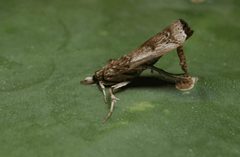
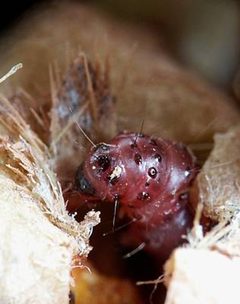
resemble typical pyralid 'snout moths' but require microscopic examination of male genitalia for definitive identification. Forewing banding pattern and overall brownish-gray coloration are characteristic but not unique. Larvae are distinguished by orange coloration with black spots/bands and their exclusive association with Opuntia cacti. The gregarious larval —boring into cactus pads through single entry holes and producing yellowed tissue with fluid ooze and —provides field diagnostic signs. Distinguished from other Cactoblastis by genitalia and, in some , larval morphology associated with different .
Images
Appearance
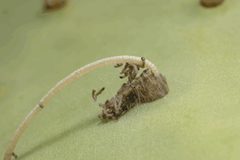
are nondescript brownish-gray with long legs and long . Females possess pronounced labial palps giving a 'snout moth' appearance typical of Pyralidae. Forewings display characteristic banding patterns; hindwings are whitish and semitransparent. Wingspan averages 27–40 mm in females and 23–32 mm in males. Larvae are caterpillars beginning pink-cream in color, gradually becoming orange with distinctive black spots or bands. Definitive identification of adults requires microscopic examination of dissected male genitalia.
Habitat
Native to temperate regions of South America. In introduced ranges, occupies any environment supporting Opuntia cacti including open woodlands, pastures, coastal dunes, and agricultural landscapes. Open woodland maintain stable equilibria with plants; pasture populations follow dynamic 'hide and seek' patterns with woodland . In Florida and the southeastern United States, established in coastal and near-coastal where Opuntia occur naturally or have been planted.
Distribution
Native: Argentina, Paraguay, Uruguay, and southern Brazil. Introduced: Australia (1925), South Africa (1933), Caribbean islands (from 1956), and subsequently throughout the Caribbean basin including Saint Kitts, US Virgin Islands, Haiti, Cuba, Dominican Republic, Bahamas, Cayman Islands, Puerto Rico, and Barbados. In North America: first detected in Florida in 1989, now established along Gulf and Atlantic coasts expanding at approximately 100 miles per year north to South Carolina and west through Louisiana; reached Mexico (Isla Mujeres, Yucatán) by 2006. Projected to continue westward expansion potentially threatening southwestern United States and interior Mexico.
Seasonality
Activity year-round in tropical and subtropical regions. In temperate areas, larval development time varies seasonally: approximately two months within cactus during summer, four months during winter. Multiple per year possible where climate permits; live approximately 9–11 days. Mating occurs before sunrise.
Diet
herbivore feeding exclusively on Opuntia cactus . larvae penetrate cladode and feed internally, consuming all tissue except vascular bundles. Gregarious larvae hollow out cactus pads from within. Laboratory studies indicate low specificity within Cactoblastis, with capable of feeding on multiple Opuntia species. Field observations show host identity influences patterns. Target Opuntia using on , with females responding more strongly to volatile organic compounds from cacti than males.
Host Associations
- Opuntia - -Primary ; multiple attacked including O. ficus-indica and native prickly pear species
- Consolea corallicola - -Critically endangered semaphore cactus in Florida, threatened by invasion
Life Cycle
Females deposit sticks containing 30–50 eggs (up to 50 reported) on cactus spines, cladodes, leaves, or fruit. Eggs hatch asynchronously over 20 hours at 50–70% relative humidity, longer at lower humidity. aggregate at egg stick base under silken web; approximately 25 individuals must collect (about 15 hours post-hatch onset) before collective excavation of single entrance hole into cladode. Larvae feed gregariously inside cactus, periodically returning to surface to defecate at approximately 10-minute intervals. Development takes approximately two months in summer, four months in winter. Mature larvae exit to pupate in cocoons under ground debris at plant base. emerge, mate before sunrise using cues, and females may produce three to four in lifetime. Female longevity averages 9 days, males 11 days; females do not feed as adults, using energy reserves to disperse up to 10 km searching for dense cactus patches.
Behavior
Mating occurs before sunrise with location by scent rather than sight; females release to signal readiness. exhibit strong capacity: females travel up to 10 km to locate patches. larvae display collectively facilitated : asynchronous hatching, threshold before excavation, shared labor in penetrating cactus , and strong to host volatiles from damaged tissue. When cladodes are impenetrable at site, unfed neonates mark and follow persistent trails to new sites, enabling late-hatching individuals to join established cohorts. Larvae collectively imbibe mucilage when flooded from cactus damage. Mandibular gland maintains pre-excavation aggregation; disruption causes independent and failure.
Ecological Role
In native South American range, limited by ants, New World monkeys, , and . In Australia and some introduced ranges, functions as effective agent of Opuntia, maintaining low- equilibrium populations in open woodlands. Prevents plant extinction through contagious distribution (clumping) that creates larval overcrowding on some plants while leaving others unattacked. In invasive range (Caribbean, southeastern United States), lacks natural population controls, causing severe damage to native and economically important cactus populations. Threatens services provided by Opuntia including food for Cyclura iguanas in Bahamas and cochineal dye industry support.
Human Relevance
Deliberately introduced to Australia in 1925 for of prickly pear, achieving celebrated success commemorated by the Cactoblastis Memorial Hall in Boonarga, Queensland (1936)—described as the only building dedicated to an insect—and a monument in Dalby, Queensland (1965). Subsequently introduced to South Africa (1933) and Caribbean (1950s) for similar purposes. In South Africa, unexpectedly damaged spineless Opuntia used as cattle fodder. In Caribbean and United States, became invasive pest threatening native cactus , ornamental cactus industry (valued at $9.5 million in Arizona alone), and traditional uses of nopal in Mexico. Subject of active management including APHIS programs (2009), sterile insect technique research, and exploration of biological control using Bacillus thuringiensis or parasitic .
Similar Taxa
- Other Cactoblastis speciesFour other South American in ; distinguished by genitalia and, in some , larval morphology and associations
- Other Phycitinae moths brownish-gray coloration and banded forewings resemble related pyralids; definitive separation requires microscopic examination of male genitalia
More Details
Population genetics
Four genetically-structured identified in South America that infest different Opuntia and possess different larval ; mechanism driving isolation remains unexplored.
Life history strategy
Exhibits predominantly r-selected traits: small body size, large offspring number per reproductive event (up to 50 ), short lifespan, high mortality, low , and high capacity—characteristics typical of successful .
Control challenges
Chemical largely ineffective due to larval protection within cactus tissue. Physical removal of infested cacti practiced in Louisiana. Sterile insect technique has shown limited success in spreading to affected areas. Proposed biological controls (Bacillus thuringiensis strain BtCc, South American parasitic ) challenges of transgenerational persistence and non-target effects respectively.
Sources and further reading
- BugGuide
- Wikipedia
- GBIF taxonomy match
- NCBI Taxonomy
- Catalogue of Life
- Egg clumping, host plant selection and population regulation in Cactoblastis cactorum (Lepidoptera)
- Collectively Facilitated Behavior of the Neonate Caterpillars of Cactoblastis cactorum (Lepidoptera: Pyralidae)
- Distribution and Dispersal of Cactoblastis cactorum (Lepidoptera: Pyralidae), an Exotic Opuntia-Feeding Moth, in Florida
- Host Specificity of Cactoblastis cactorum (Lepidoptera: Pyralidae), an Exotic Opuntia -feeding Moth, in Florida
- Effects of changes in atmospheric carbon dioxide on the location of hosts by the moth, Cactoblastis cactorum