
Antigastra catalaunalis
(Duponchel, 1833)
Sesame Leafroller, Sesame Pod-borer, Sesame Webworm, Sesame Capsule Borer, Sesame Leaf Webber
Antigastra catalaunalis is a crambid whose larvae are major agricultural pests of sesame (Sesamum indicum). Native to tropical and subtropical regions of Africa and Asia, it has spread globally through human-mediated transport and its own migratory capacity. The has been documented attacking multiple plant including Scrophulariaceae and Pedaliaceae, though sesame remains its economically significant . Laboratory studies indicate a complete of approximately 26.5 days under controlled conditions.
Pronunciation
How to pronounce Antigastra catalaunalis: //ˌæntɪˈɡæstrə ˌkætələˈuːnəlɪs//
These audio files are automatically generated. While they are not always 100% accurate, they are a good starting point.
Identification
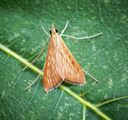
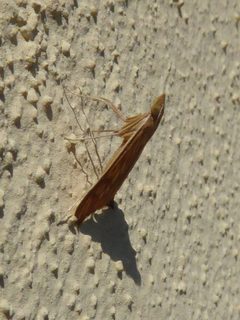
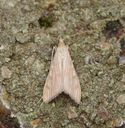
Distinguished from similar crambids by combination of small size (19–22 mm wingspan), pale yellow forewings with ferruginous-veined pattern, and strongly outward-curved second transverse line on upper two-thirds of forewing. The dark fuscous and discal spots, together with whitish cilia having dark fuscous bases, provide additional diagnostic characters. Hindwing coloration—yellow-whitish with ferruginous tinge and grey postmedian costal spot—differs from many .
Images
Habitat
Agricultural systems, particularly sesame fields; also found in natural and semi-natural supporting plants in Scrophulariaceae and Pedaliaceae. Documented in Sudanian savanna zones of West Africa and irrigated sesame production systems in Mexico.
Distribution
Native to tropical and subtropical Africa and Asia; introduced or migratory established in Europe (Britain, France, Spain, Italy, Greece, Portugal, Malta, Belgium), Central and South America (Mexico, Guatemala, Venezuela), and Australia. GBIF records confirm presence in Belgium.
Seasonality
Present throughout the sesame growing season in areas; continuous possible in tropical climates. In Burkina Faso, active during entire cropping campaign.
Diet
Larvae feed on sesame (Sesamum indicum), snapdragons (Antirrhinum ), common toadflax (Linaria vulgaris), trumpetbush (Tecoma species), and other members of Scrophulariaceae and Pedaliaceae.
Host Associations
- Sesamum indicum - primary Economically most important ; larvae attack leaves, flowers, and capsules
- Antirrhinum species -
- Linaria vulgaris - Common toadflax
- Tecoma species - Trumpetbush
- Scrophulariaceae - Multiple within
- Pedaliaceae - Multiple within
Life Cycle
: incubation 2.38 ± 0.54 days. Larva: five instars, length increasing from 1.91–9.53 mm, total larval period 10.50 ± 1.43 days. Pupa: 6 days. : longevity 6–7 days. Total : 26.5 ± 7.78 days under laboratory conditions on sesame variety G. TIL-3. Sex ratio 1:1.
Behavior
Larvae are leaf-rollers and web-formers, tying leaves together with silk. Described as "capsule borer" for habit of boring into sesame capsules. Can cause 100% of plants to exhibit tied leaves under heavy .
Ecological Role
Agricultural pest causing yield losses of 19.46–63.42% in sesame. Serves as for multiple including Bracon (Habrobracon) platynotae, Eiphosoma dentator, Perilampus platigaster species group, Brachymeria annulata, Conura side, Conura maculata, and Goniozus punctaticeps.
Human Relevance
Major economic pest of sesame, an important oilseed crop known as " of oils." Subject to control programs; Biobit and other agents used for management. breeding programs target early-maturing and glabrous (hairless) sesame varieties, which show reduced damage.
Similar Taxa
- Other Antigastra species-level similarity in size and general wing pattern; A. catalaunalis distinguished by specific forewing line curvature and spot configuration
- Other Spilomelinae crambids on sesameShared use and agricultural ; identification requires examination of wing pattern details and genitalia
Sources and further reading
- BugGuide
- Wikipedia
- GBIF taxonomy match
- iNaturalist taxon
- NCBI Taxonomy
- Catalogue of Life
- Antigastra catalaunalis . [Distribution map].
- Effect of biobit on reproduction of Antigastra catalaunalis
- Parasitoid wasps associated with Antigastra catalaunalis (Lepidoptera, Crambidae) in Northern Sinaloa, Mexico
- Host Plant Resistance to Sesamum Leaf Webber and Capsule Borer Antigastra catalaunalis (Duponchel)
- Figure 2 from: Sarazú-Pillado RA, González-Hernández H, Lomeli-Flores JR, Valdez-Carrasco JM, Cortez-Mondaca E, Guzmán-Franco A (2024) Parasitoid wasps associated with Antigastra catalaunalis (Lepidoptera, Crambidae) in Northern Sinaloa, Mexico. Journal of Hymenoptera Research 97: 741-754. https://doi.org/10.3897/jhr.97.127622
- Biology of Sesame Leaf Webber <i>Antigastra catalaunalis</i> Duponchel
- Host plant resistance against sesame leaf webber and capsule borer, Antigastra catalaunalis Duponchel (Pyraustidae: Lepidoptera)
- La pyrale du sésame, Antigastra catalaunalis (Duponchel, 1833), au Burkina Faso : Distribution géographique et incidence sur six variétés de sésame.