
Antigastra
Lederer, 1863
sesame webworm, sesame leaf webber, sesame capsule borer
Species Guides
1- Antigastra catalaunalis(Sesame Leafroller)
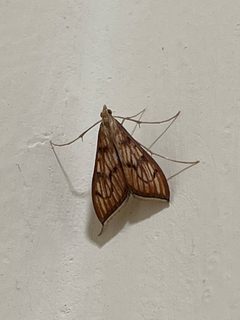
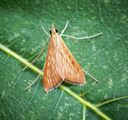
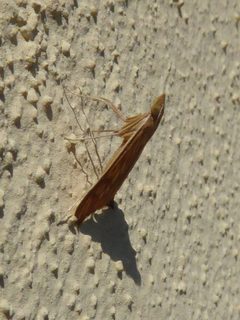
Antigastra is a of crambid (Lepidoptera: Crambidae) established by Lederer in 1863. The genus contains at least three described , with Antigastra catalaunalis being the most economically significant. This species is a major agricultural pest of sesame (Sesamum indicum) across Africa, Asia, Europe, and the Americas, where larvae feed on leaves, flowers, and seed capsules. The genus is placed in the Spilomelinae, a diverse group of grass moths and relatives.
Pronunciation
How to pronounce Antigastra: /ˌæn.təˈɡæs.trə/
These audio files are automatically generated. While they are not always 100% accurate, they are a good starting point.
Identification
Antigastra are small to medium-sized crambid . Antigastra catalaunalis can be recognized by its association with sesame plants; have a wingspan of approximately 15–20 mm with characteristic crambid wing venation and resting posture. Larvae are greenish with dark capsules, reaching 9–10 mm at maturity, and produce silk webbing on plants. Distinguishing Antigastra from related requires examination of genitalia and wing pattern details; the genus is most reliably identified through host association and geographic context in agricultural settings.
Images
Habitat
Agricultural and cultivated environments where sesame (Sesamum indicum) is grown. In West Africa, occurs in both North and South Sudanian zones. Natural associations beyond cultivated sesame are poorly documented.
Distribution
Widespread across tropical and subtropical regions including: Africa (Algeria, Botswana, Canary Islands, Egypt, Ethiopia, Ghana, Guinea, Ivory Coast, Kenya, Libya, Malawi, Mali, Mauritania, Mauritius, Morocco, Mozambique, Niger, Nigeria, Senegal, Seychelles, Socotra Islands, Somalia, South Africa, Sudan, Tanzania, Togo, Tunisia, Uganda, Burkina Faso, Upper Volta, Zaire, Zimbabwe); Asia (Andaman Islands, Burma, Cambodia, China, Cyprus, India, Indonesia, Iran, Iraq, Israel, Japan, Laos, Lebanon, Malaysia, Pakistan, Saudi Arabia, South Yemen, Sri Lanka, Syria, Taiwan, Turkey, Vietnam); Europe (Britain, Corsica, France, Greece, Italy, Malta, Portugal, Sicily, Spain, Yugoslavia); Australasia and Pacific Islands (Australia, Fiji); North America (Mexico); Central America (Guatemala); South America (Venezuela). GBIF records indicate presence in Denmark and Sweden.
Seasonality
In Burkina Faso, present throughout the entire growing season on sesame. Laboratory studies indicate a complete of approximately 26.5 days under controlled conditions.
Diet
Larvae feed on sesame (Sesamum indicum), consuming leaves, flowers, and developing seed capsules.
Host Associations
- Sesamum indicum - primary larval food plant; causes damage to leaves, flowers, and capsules
- Bracon (Habrobracon) platynotae - Braconidae ; first recorded association in Mexico
- Eiphosoma dentator - Ichneumonidae ; first recorded association in Mexico
- Perilampus platigaster species group - Perilampidae ; first recorded association in Mexico
- Brachymeria annulata - Chalcididae ; first recorded association in Mexico
- Conura side - Chalcididae ; first recorded association in Mexico
- Conura maculata - Chalcididae ; first recorded association in Mexico
- Goniozus punctaticeps - Bethylidae ; first recorded association in Mexico
Life Cycle
Complete with five larval instars. : 2.38 days. Larval period: 10.5 days, with length increasing from 1.91 mm to 9.53 mm across instars. Pupal period: 6 days. longevity: 6–7 days. Sex ratio approximately 1:1; males smaller than females. Total : 26.5 days under laboratory conditions on sesame variety G. TIL-3.
Behavior
Larvae produce silk webbing on plants, leading to the "sesame leaf webber." Larvae tie leaves together and bore into flowers and developing seed capsules. Has been observed causing up to 100% of plants with tied leaves and up to 32.83% of capsules perforated in field conditions.
Ecological Role
Agricultural pest of sesame causing yield losses of 19–63% in susceptible varieties. Serves as for diverse including Braconidae, Ichneumonidae, Perilampidae, Chalcididae, and Bethylidae.
Human Relevance
Major economic pest of sesame globally. Control measures include application (including Biobit and chemical combinations) and development of varieties. Early-maturing and glabrous (hairless) sesame varieties show reduced susceptibility, informing breeding programs in West Africa.
Similar Taxa
- Lepidoneura longipalpisAntigastra longipalpis has been transferred to this ; historical confusion in literature
- Other Spilomelinae generaMorphological similarity in external features; accurate identification requires genitalia examination and association data
Sources and further reading
- BugGuide
- Wikipedia
- GBIF taxonomy match
- iNaturalist taxon
- NCBI Taxonomy
- Catalogue of Life
- Antigastra catalaunalis . [Distribution map].
- Effect of biobit on reproduction of Antigastra catalaunalis
- Parasitoid wasps associated with Antigastra catalaunalis (Lepidoptera, Crambidae) in Northern Sinaloa, Mexico
- Host Plant Resistance to Sesamum Leaf Webber and Capsule Borer Antigastra catalaunalis (Duponchel)
- Biology of Sesame Leaf Webber <i>Antigastra catalaunalis</i> Duponchel
- Host plant resistance against sesame leaf webber and capsule borer, Antigastra catalaunalis Duponchel (Pyraustidae: Lepidoptera)
- La pyrale du sésame, Antigastra catalaunalis (Duponchel, 1833), au Burkina Faso : Distribution géographique et incidence sur six variétés de sésame.