
Eiphosoma
Cresson, 1865
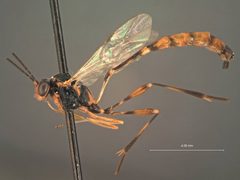
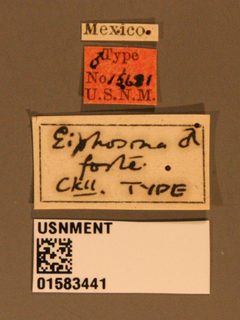
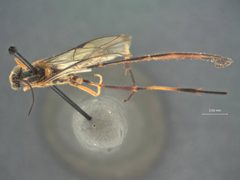
Eiphosoma is a of ichneumonid wasps in the Cremastinae, established by Cresson in 1865. in this genus are larval endoparasitoids primarily associated with noctuid larvae, particularly the fall armyworm (Spodoptera frugiperda). Several species have been investigated as agents for agricultural pests, with E. vitticolle and E. laphygmae receiving particular attention for their potential in . The genus exhibits a New World distribution centered in the Neotropics, with documented species from Cuba, Colombia, Mexico, Brazil, and Rica.
Pronunciation
How to pronounce Eiphosoma: /ˌaɪfoʊˈsoʊmə/
These audio files are automatically generated. While they are not always 100% accurate, they are a good starting point.
Identification
Eiphosoma can be distinguished from other cremastine ichneumonids by morphological features detailed in taxonomic revisions; Cuban species have been assigned to species-groups defined by Gauld (2000) for Mesoamerican fauna. E. nigroandinum and E. merceae from Colombia share characteristics that define a newly established species-group. Species-level identification requires examination of morphological characters and reference to published keys, such as the key to Cuban species provided by Fernández & Sánchez (2007).
Images
Habitat
Agricultural and agroecosystem environments, particularly maize-growing regions and diverse, weedy agricultural systems. E. laphygmae establishes more successfully in diverse, weedy systems compared to simplified . Mass-rearing programs for utilize controlled laboratory conditions (24.5 ± 1.0°C; 76.0 ± 10.0% RH; 12:12 L:D ).
Distribution
New World distribution centered in the Neotropics. E. laphygmae: North-East Mexico to São Paulo State, Brazil. E. vitticolle: expanded distribution includes northwestern Andes of Colombia. Cuban archipelago: at least three (E. bioeco, E. dearmasi, E. nelitae). Additional records from Rica and Florida (USA).
Seasonality
Activity synchronized with early larval instars of noctuids; six-day window defined for E. vitticolle targeting instars I–III of Spodoptera frugiperda. Augmentative releases recommended during early larval peaks based on -trap monitoring and phenological models.
Diet
females feed on and protein sources; maize pollen and honey supplementation significantly optimizes reproductive parameters. Larvae develop as endoparasitoids within hemocoel, feeding on host tissues.
Host Associations
- Spodoptera frugiperda - larval endoparasitoidprimary ; fall armyworm (Noctuidae)
- Loxomorpha flavidissimalis - larval endoparasitoidcactus-feeding crambid; E. dentator reported from Mexico
- various Noctuidae - larval endoparasitoidgeneral association for
Life Cycle
Females oviposit directly into hemocoel. Development occurs within host; successful dependent on host instar at . For E. vitticolle: successful emergence only from host instars I–III (26.2–33.0% rate), with complete failure (0%) from instars IV–VI due to host immune . Preoviposition period approximately 1.6 days under optimal nutritional conditions. Oviposition period extends to 17.2 days with proper diet. Mean adult longevity approximately 20.8 days for females under optimal conditions.
Behavior
Oviposition targets early-instar larvae. Sex allocation exhibits resource-based strategy: 100% male progeny from small hosts (instar I), equilibrating to 55% males in instar III. induces developmental delays in susceptible hosts (up to 53% slower than unparasitized controls). Host immune response triggers -dependent hemocytic ; partial occurs where hosts eliminate but succumb to immune-mediated collateral damage.
Ecological Role
Significant mortality agent for fall armyworm . E. laphygmae ranks as second most important contributor to natural fall armyworm mortality in fields where it occurs naturally (after Chelonus insularis), with average field rates of 4.5% and peaks up to 14.5%. Candidate for classical and in programs targeting Spodoptera frugiperda in invaded regions (Africa, Asia).
Human Relevance
Investigated and deployed as agent for fall armyworm, a globally cereal pest. Mass-rearing protocols developed using optimized diets (maize pollen + honey) to enhance for augmentative release programs. Temporal synchronization with critical for efficacy; monitoring via traps and models recommended. Potential for introduction in African and Asian farming systems, where diverse agroecosystems may favor establishment.
Similar Taxa
- Chelonus insularisBraconid also attacking Spodoptera frugiperda; ranks as most important contributor to fall armyworm mortality in natural fields where E. laphygmae is second
More Details
Taxonomic History
established by Cresson in 1865. -group concepts developed by Gauld (2000) for Mesoamerican fauna applied to Cuban species. New species-group (E. nigroandinum species-group) established for Colombian Andean species.
Reproductive Biology
Total approximately 214 per female under optimal diet (water + honey + maize pollen). Synergistic positive interaction detected between (honey) and protein (pollen) sources (p < 0.0001). Maize pollen represents ecologically relevant protein source reflecting coevolutionary history among plant, herbivore, and complex.
Immune Interactions
immune maturation creates ontogenetic barrier: circulating increases ~5-fold from instar I (~5,000 /µL) to instar IV (>25,000 cells/µL), enabling effective of /larvae in older instars.
Sources and further reading
- BugGuide
- GBIF taxonomy match
- iNaturalist taxon
- NCBI Taxonomy
- Catalogue of Life
- A taxonomic review of Cuban Eiphosoma Cresson (Hymenoptera: Ichneumonidae), with biogeographical notes
- Eiphosoma laphygmae, a classical solution for the biocontrol of the fall armyworm, Spodoptera frugiperda?
- Age-Dependent Immune Maturation Defines the Susceptibility Window of Spodoptera frugiperda to the Parasitoid Eiphosoma vitticolle
- Two new Darwin wasp species of Eiphosoma Cresson, 1865 (Ichneumonidae: Cremastinae) from the northwestern Andes of Colombia
- Influence of Maize Pollen and Honey Supplementation on the Reproductive Parameters of Eiphosoma vitticolleCresson, a Parasitoid of the Fall Armyworm
- First Report in Mexico of Eiphosoma dentator (Fabricius) (Hymenoptera: Ichneumonidae) as a Parasitoid of the Cactus-Feeding Loxomorpha flavidissimalis (Grote) (Lepidoptera: Crambidae)