
Eurrhypini
Genus Guides
6- Cliniodes
- Glaucodontia
- Jativa
- Mimoschinia(rufous-banded pyralid moth)
- Porphyrorhegma
- Pseudoschinia
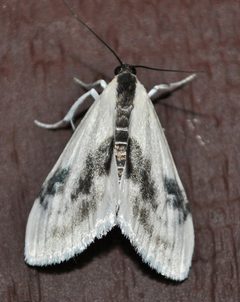
Eurrhypini is a tribe of grass moths within the Crambidae. Members of this tribe are small to medium-sized with narrow wings and slender bodies. They are associated with grassy and wetland , where their larvae feed on monocotyledonous plants. The tribe includes several distributed across temperate and tropical regions.


Pronunciation
How to pronounce Eurrhypini: /ɛ.ʊ.ˈrɪ.pɪ.ni/
These audio files are automatically generated. While they are not always 100% accurate, they are a good starting point.
Identification
Distinguished from other Crambidae tribes by genitalic characters, particularly male valvae structure and female signum . Externally, members resemble other grass moths but often show more pronounced wing venation and a somewhat more robust than related Crambinae. -level identification requires examination of genitalia or .
Images
Habitat
Primarily associated with grasslands, marshes, wetlands, and riparian zones. Larvae develop in stems, , or roots of grasses and sedges. are found in the same , often resting on grass stems during the day.
Distribution
Widespread across the Palearctic, Nearctic, Afrotropical, and Oriental regions. Present in North America, Europe, Asia, and Africa. Specific distribution varies by within the tribe.
Seasonality
activity generally occurs from late spring through autumn in temperate regions, with peak times varying by . Some species are ; others may have partial second in favorable conditions.
Diet
Larvae feed internally or externally on stems, leaves, or roots of Poaceae (grasses) and Cyperaceae (sedges). Some are known to mine grass blades or feed in seed .
Host Associations
- Poaceae - larval food plantPrimary ; larvae feed on stems, , or roots
- Cyperaceae - larval food plantSecondary , particularly in wetland
Life Cycle
Holometabolous. are laid on or near plants. Larvae feed on grasses or sedges, often concealed within stems or leaf . occurs in a silken cocoon, usually within the larval feeding site or in soil litter. are or .
Behavior
are generally , attracted to light. They rest with wings folded tightly against the body, aligned with grass stems for camouflage. Larvae are concealed feeders, reducing exposure to .
Ecological Role
Herbivores that contribute to nutrient cycling in grassland . Serve as prey for birds, bats, and predatory insects. Some may reach pest status in agricultural grasses, though most are benign.
Human Relevance
Generally of minor economic importance. A few have been reported as minor pests of cereal crops or pasture grasses, but significant damage is rare. Otherwise overlooked due to small size and cryptic habits.
Similar Taxa
- CrambiniAnother tribe in Crambidae with similar grass moth ; distinguished by genitalic structure and larval feeding habits on different grass parts
- Schoenobiinae of Crambidae with wetland-associated ; distinguished by broader wings and different wing venation patterns