
Pseudoschinia
Munroe, 1961
Species Guides
1- Pseudoschinia elautalis(Desert Bantam)
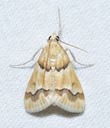
Pseudoschinia is a of crambid established by Munroe in 1961. The sole , Pseudoschinia elautalis, is a herbivore of cacti in the southwestern United States and northern Mexico. are small moths with distinctive pale yellow forewings and white hindwings. The genus is notable for its narrow ecological association with columnar and cholla cacti.
Pronunciation
How to pronounce Pseudoschinia: /ˌsjuːdəʊˈskɪniə/
These audio files are automatically generated. While they are not always 100% accurate, they are a good starting point.
Identification
The single Pseudoschinia elautalis can be recognized by its small size (forewing length 10–13 mm), pale ochreous yellow forewings, and contrasting white hindwings. These coloration features, combined with its restricted range in the southwestern United States, help distinguish it from related crambid . No other species are currently assigned to this genus.
Images
Habitat
Arid and semi-arid regions of the southwestern United States, specifically areas supporting of columnar cacti (Ferocactus ) and chollas (Cylindropuntia and Opuntia species). include desert scrub, Sonoran Desert, and Chihuahuan Desert .
Distribution
North America: recorded from Arizona, California, Nevada, New Mexico, and Texas in the United States. The distribution corresponds to the range of its cactus plants in the southwestern United States.
Seasonality
have been recorded on wing from March to August, indicating a spring-to-summer period.
Diet
Larvae feed on Ferocactus cylindraceus, Ferocactus wislizeni, and of Opuntia and Cylindropuntia. feeding habits have not been documented.
Host Associations
- Ferocactus cylindraceus - larval food plantcolumnar cactus
- Ferocactus wislizeni - larval food plantbarrel cactus
- Opuntia - larval food plantprickly pear cacti
- Cylindropuntia - larval food plantcholla cacti
Ecological Role
herbivore of desert cacti. The larvae function as primary consumers in desert , potentially contributing to nutrient cycling and serving as prey for other desert arthropods and vertebrates.
Similar Taxa
- SchiniaSimilar name and superficial resemblance in some ; distinguished by wing pattern details and genitalia . Pseudoschinia was established separately based on distinct structural characteristics.
More Details
Taxonomic History
The was erected by Munroe in 1961 to accommodate previously associated with related genera but possessing distinct morphological features, particularly in genitalia structure.