
Pseudoschinia elautalis
Grote, 1881
Desert Bantam
Pseudoschinia elautalis, commonly known as the Desert Bantam, is a small in the Crambidae. It is the sole member of its , making the genus . The is restricted to arid regions of the southwestern United States and northern Mexico. are active during warmer months and are associated with desert .
Pronunciation
How to pronounce Pseudoschinia elautalis: //ˌsuːdoʊˈskiːniə ˌɛlaʊˈteɪlɪs//
These audio files are automatically generated. While they are not always 100% accurate, they are a good starting point.
Identification
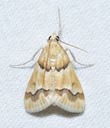
The Desert Bantam can be recognized by its small size, narrow wings, and plain brown coloration with minimal patterning. It lacks the bold stripes or spots seen in many related crambid . The combination of (desert regions of the southwestern US) and understated wing pattern helps distinguish it from superficially similar in the Odontiinae. Examination of genitalia may be required for definitive identification.
Images
Appearance
A small crambid with relatively narrow, elongated forewings. The wings are pale to medium brown with subtle patterning, often with faint darker markings or lines. The body is slender and matches the general wing coloration. Overall coloration provides camouflage against dry soil and vegetation.
Habitat
Arid and semi-arid environments including desert scrub, dry grasslands, and sandy washes. Associated with creosote bush scrub and other vegetation . Elevation range appears restricted to lower and middle elevations in desert basins.
Distribution
Southwestern United States (Arizona, California, Nevada, New Mexico, Texas) and adjacent northern Mexico. Records are concentrated in the Mojave, Sonoran, and Chihuahuan Desert regions.
Seasonality
have been recorded primarily from late spring through early fall, with peak activity during summer months. Activity patterns likely correspond to monsoon rainfall and associated vegetation response in desert regions.
Behavior
are and attracted to light. activity is likely to nocturnal. Specific behavioral details regarding mating, oviposition, or larval habits remain undocumented in available sources.
Ecological Role
As a primary consumer in larval stages ( plant unknown) and as prey for as . Specific ecological contributions have not been quantified.
Human Relevance
No documented economic or agricultural significance. Occasionally encountered by entomologists and naturalists in desert regions. Not considered a pest .
Similar Taxa
- Other Odontiinae speciesSimilar small size and general body plan, but most have more distinct wing patterns, stripes, or spots. P. elautalis is distinguished by its plain coloration and desert specificity.
- Fissicrambus spp.Share narrow wing shape and grassland/desert associations, but typically show more pronounced wing venation and patterning.
More Details
Taxonomic Note
The Pseudoschinia was erected to accommodate this , which was previously placed in Schinia. The separation was based on morphological differences, and the genus remains .
Conservation Status
Not formally assessed. Appears secure given broad distribution across extensive desert , though specific trends are unknown.