
Crambus
Fabricius, 1798
sod webworm moth, crambid snout moth
Species Guides
34- Crambus agitatellus(double-banded grass-veneer moth)
- Crambus ainslieellus
- Crambus albellus(small white grass-veneer)
- Crambus alienellus
- Crambus angulatus
- Crambus awemellus(Aweme Grass-veneer)
- Crambus bidens(forked grass-veneer)
- Crambus braunellus(Braun's Grass-veneer)
- Crambus cypridalis
Crambus is a of approximately 155 of crambid distributed globally. are small snout moths with elongated labial palps, while larvae are known as sod webworms—significant pests of turfgrass and pasture grasses. The genus exhibits considerable variation in strategies, with some species and others . Larval feeding damage is most pronounced during drought conditions and in closely mown turf.
Pronunciation
How to pronounce Crambus: //ˈkræm.bəs//
These audio files are automatically generated. While they are not always 100% accurate, they are a good starting point.
Identification
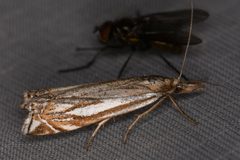
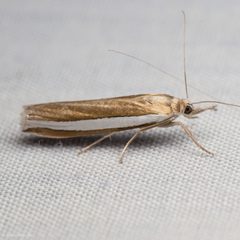
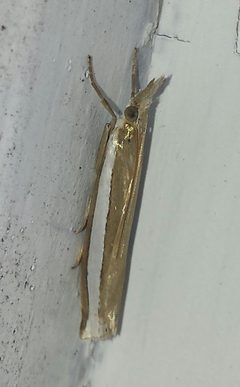
are distinguished from other small by the combination of elongated labial palps projecting forward like a snout, narrow wings held flat and tight against the body at rest, and the overall slender, cylindrical silhouette. Larvae are recognized by their association with silken tunnels in turfgrass thatch, dark circular body spots, and the characteristic capsule color change from black in early instars to light brown with black sculpturing in later instars.
Images
Habitat
Primarily associated with grassland including lawns, golf courses, pastures, meadows, and agricultural fields. Larvae inhabit the thatch layer and upper soil profile of turfgrass systems.
Distribution
Global distribution with records from North America, Europe, Asia, and other regions. Specific distribution varies by .
Seasonality
Activity patterns vary by and latitude. species show periods in late spring to early summer (May–June) and mid-summer to early fall (July–August), with some species producing a second under favorable conditions. species such as Crambus tutillus exhibit adult concentrated in mid-May through June.
Diet
Larvae feed primarily on grasses (Poaceae). Documented plants include cool-season turfgrasses, maize, wheat, rye, oats, and timothy-grass. Damage is concentrated on foliage rather than crown tissues.
Host Associations
- cool-season turfgrasses - primary most damage
- maize -
- wheat -
- rye -
- oats -
- timothy-grass -
Life Cycle
Complete with four stages: , larva, pupa, and . Eggs are dry, nonadhesive, oval to elliptical, initially white to creamy white, turning orange to red, measuring 0.3–0.6 mm. Larvae pass through multiple instars (typically 8–9), with capsule widths increasing from 0.19–0.23 mm (first instar) to 1.23–2.21 mm (final instar), and body lengths from 9–13 mm to 24–28 mm. occurs in silken cocoons incorporating soil particles and debris, with pupae measuring 8–10 mm by 2.5 mm. occurs as larvae in final or instar within thatch or soil. Some exhibit facultative regulated by and temperature.
Behavior
Larvae are feeders, remaining in silk-lined burrows within the thatch during daylight hours. are generally or nocturnal. Larvae construct silken tunnels in turfgrass thatch.
Ecological Role
Herbivore and agricultural pest. Larval feeding alters turfgrass structure and may facilitate nutrient cycling through thatch decomposition. Serves as prey for birds, ground beetles, robber flies, predatory , and parasitic . Susceptible to fungi including bassiana and microsporidian including Nosema .
Human Relevance
Significant economic pest of managed turfgrass, particularly lawns, golf courses, and sod farms. Damage manifests as yellow to brown patches of foliage; severity increases during drought and in closely mown turf. Threshold for treatment: 12 larvae per 0.1 m². Management emphasizes through conservation of natural enemies and application of (Steinernema carpocapsae, Heterorhabditis heliothidis) rather than chemical intervention.
Similar Taxa
- HerpetogrammaLarvae also called sod webworms and share grass-feeding habits; distinguished by and larval capsule characteristics
- AgriphilaCongeneric in Crambinae and similar in appearance; distinguished by genitalia and larval associations
- PyralidaeFormerly confused -level grouping; Crambidae distinguished by wing venation and tympanal organ structure