
Crambus agitatellus
Clemens, 1860
double-banded grass-veneer moth, Double-banded Grass-veneer
A small crambid of eastern North America, recognized by its distinctive wing pattern and slender resting posture. are active during mid-summer months. The was first described by J.B. Clemens in 1860 and remains common in open grassy .
Pronunciation
How to pronounce Crambus agitatellus: //ˈkræm.bəs ˌæ.d͡ʒɪ.təˈtɛl.ləs//
These audio files are automatically generated. While they are not always 100% accurate, they are a good starting point.
Identification
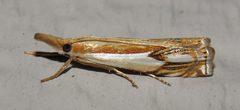
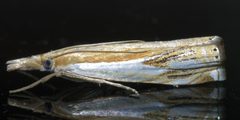
The combination of the broad white forewing stripe with converging black lines and yellow-orange terminal line distinguishes this from other Crambus. The resting posture—forewings tightly rolled—is characteristic of grass-veneers but the specific pattern elements separate it from . The faint yellow bisection of the white stripe, when present, provides additional confirmation.
Images
Appearance
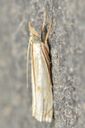
have a wingspan of 17–22 mm. At rest, the forewings are rolled tightly over the hindwings, creating a long, slender cylindrical profile. The forewings display a broad white stripe tapered at both ends; some individuals show this stripe bisected by a faint yellow line. Four or five black lines extend from the end of the white stripe and converge with a yellow-orange horizontal line near the wing apex. Hindwings are pale gray or brown and unmarked.
Habitat
Open grassy areas including fields, lawns, and other maintained or natural grasslands.
Distribution
Eastern two-thirds of the United States and south-eastern Canada. Documented from Manitoba, Vermont, and throughout the core eastern range.
Seasonality
on wing from June to August.
Diet
Larvae feed on various grasses and other low-growing plants.
Behavior
rest with forewings tightly rolled over hindwings, a posture typical of the grass-veneer group.
Ecological Role
Larval herbivory on grasses contributes to nutrient cycling in grassland .
Human Relevance
Occasionally encountered in lawns and managed turf, but not considered a significant pest.
Similar Taxa
- Other Crambus speciesShare the rolled-wing resting posture and grassland , but differ in forewing pattern details—particularly the configuration of stripes and lines.