
Parapoynx
Hübner, 1825
China-mark moths
Species Guides
7- Parapoynx allionealis(Watermilfoil Leafcutter Moth)
- Parapoynx badiusalis(Chestnut-marked Pondweed Moth)
- Parapoynx curviferalis
- Parapoynx diminutalis(Hydrilla leafcutter moth)
- Parapoynx maculalis(polymorphic pondweed moth)
- Parapoynx obscuralis(obscure pondweed moth)
- Parapoynx seminealis(floating-heart waterlily moth)
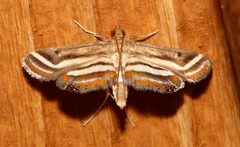
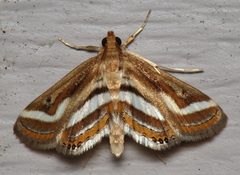
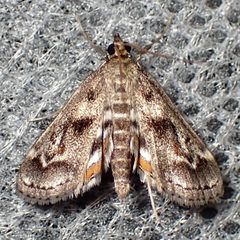
Parapoynx is a of aquatic in the Crambidae, Acentropinae, established by Jacob Hübner in 1825. The genus contains approximately 60 described distributed across Asia, Africa, Europe, and the Americas. Many species have aquatic or semi-aquatic larvae that feed on submerged aquatic plants. Several species are of economic importance as pests of rice and other aquatic crops, while others have been investigated as potential agents for aquatic weeds such as hydrilla.
Pronunciation
How to pronounce Parapoynx: //ˌpærəˈpɔɪnɪks//
These audio files are automatically generated. While they are not always 100% accurate, they are a good starting point.
Identification
-level identification within Parapoynx requires examination of genitalia and wing pattern details. The is characterized by aquatic or semi-aquatic larvae with adaptations for underwater life, including branched gills in some species. are small to medium-sized crambid with relatively broad wings. Larvae construct protective cases by cutting leaf discs from plants, a that distinguishes them from many other aquatic Lepidoptera.
Images
Habitat
Aquatic and semi-aquatic environments including rice paddies, river backwaters, lakes, ponds, and marshes. Larvae are associated with submerged or floating aquatic vegetation.
Distribution
Widespread distribution spanning Asia (India, Pakistan, China, Japan, Southeast Asia), Africa (sub-Saharan and North Africa), Europe (Mediterranean region), and the Americas (North, Central, and South America). Several are outside their native ranges.
Life Cycle
Larvae are aquatic and possess adaptations for underwater respiration, including branched gills visible in some . Larval development occurs within protective cases constructed from cut leaf portions. occurs within the case or in aquatic substrates.
Behavior
Larvae construct portable protective cases by cutting circular or oval discs from plant leaves and sandwiching themselves between the disc and the underside of the leaf. Case construction minimizes exposure to aquatic such as fish. Larvae show selective in choosing young, tender leaves for case construction, which reduces time exposed to predators during case-building.
Ecological Role
Herbivores of aquatic vegetation. Some function as pests of rice and other aquatic crops. Others have been evaluated for of aquatic plants, though feeding habits have limited their utility for this purpose. Larvae serve as for aquatic including ichneumonid wasps.
Human Relevance
Several are agricultural pests, particularly of rice (Parapoynx stagnalis, known as the rice case bearer). Parapoynx diminutalis was investigated as a agent for the aquatic weed Hydrilla verticillata but was deemed unsuitable due to feeding habits; it subsequently became in Florida and Panama. The has also been used as a model system for studying aquatic insect adaptations and -prey interactions.
Similar Taxa
- NymphulaAlso aquatic crambid with leaf-cutting larvae; distinguished by genitalia and specific larval case construction details
- AcentropusAquatic crambid with similar preferences; and larvae require detailed morphological examination for separation
- ElophilaAquatic crambid with overlapping distribution and ; distinguished by wing venation and larval gill structure
More Details
Aquatic Adaptations
Parapoynx represents one of several lineages of Lepidoptera that have independently evolved aquatic larval stages. The branched gills observed in some are a key for underwater respiration.
Taxonomic History
have been variously placed in Pyralidae or Crambidae depending on classification system used; currently treated as Crambidae: Acentropinae.
Notable Species
Parapoynx stagnalis (rice case bearer) is a major rice pest in Asia and Africa. Parapoynx stratiotata (ringed china-mark) is a widespread Palearctic . Parapoynx diminutalis has established in North America despite intentional non-release for .
Sources and further reading
- BugGuide
- Wikipedia
- GBIF taxonomy match
- iNaturalist taxon
- NCBI Taxonomy
- Catalogue of Life
- Parapoynx stagnalis . [Distribution map].
- Hydrilla leafcutter moth (unofficial common name); Parapoynx diminutalis Snellen (Insecta: Lepidoptera: Crambidae)
- Laboratory Biology of an Immigrant Asian Moth, Parapoynx diminutalis (Lepidoptera: Pyralidae), on Hydrilla verticillata (Hydrocharitaceae)
- The Parapoynx stagnalis Nucleopolyhedrovirus (PastNPV), a Divergent Member of the Alphabaculovirus Group I Clade, Encodes a Homolog of Ran GTPase
- Developmental biology and host range ofParapoynx fluctuosalisandP. diminutalisricefield caseworms
- Laboratory Host Range of Parapoynx diminutalis (Lepidoptera: Pyralidae), an Asian Aquatic Moth Adventive in Florida and Panama on Hydrilla verticillata (Hydrocharitaceae)
- Predation and avoidance of tough leaves by aquatic larvae of the moth Parapoynx rugosalis (Lepidoptera: Pyralidae)
- Host searching behavior and potential of an aquatic ichneumonid pupal parasitoid of rice caseworm(Parapoynx stagnalis)in an upland rice paddy agro-ecosystem of the Western Ghats, India
- Seasonal dynamics and spatial distribution pattern of Parapoynx crisonalis (Lepidoptera: Crambidae) on water chestnuts