
Parapoynx diminutalis
Snellen, 1880
Hydrilla leafcutter moth
Parapoynx diminutalis is an Asian aquatic in the Crambidae, first described from southeast Asia in 1880. The has established in North America (first recorded Florida 1976), Central America (Panama), Africa, and Europe (United Kingdom). Larvae are aquatic and feed on submerged macrophytes, with documented development on Hydrilla verticillata, Chara vulgaris, Ottelia alismoides, Blyxa auberti, and Cyperus rotundus. Despite early interest as a agent for hydrilla, its feeding habits precluded intentional release.
Pronunciation
How to pronounce Parapoynx diminutalis: /ˌpærəˈpɔɪnks dɪˌmɪnjuːˈtælɪs/
These audio files are automatically generated. While they are not always 100% accurate, they are a good starting point.
Identification
Distinguished from Parapoynx fluctuosalis by range and developmental performance; P. diminutalis completes on Chara vulgaris, Ottelia alismoides, Blyxa auberti, and Cyperus rotundus, whereas P. fluctuosalis develops on Cyperus brevifolius, Commelina diffusa, Leptochloa chinensis, and Paspalum conjugatum. Both show optimal development on Hydrilla verticillata. Smaller male wingspan (11–14 mm vs. 16–23 mm for females) provides additional diagnostic character. Aquatic larvae with visible branched gills and silken feeding shelters distinguish this species from terrestrial crambid larvae.
Images
Appearance
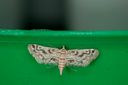
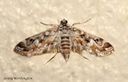
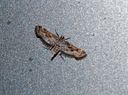
Small with wingspan 11–14 mm in males and 16–23 mm in females. Aquatic larvae possess branched gills visible during development. Early instars (2–7) are white; later instars turn yellow approaching . Pupation occurs in silken cocoons attached to plants or debris.
Habitat
Freshwater aquatic environments including river backwaters, lakes, ponds, and ricefields. Associated with submerged aquatic vegetation in standing or slow-moving water.
Distribution
Native to southeast Asia (India, Pakistan, Philippines, and broader region). in: North America (United States: Florida since 1976, Louisiana, Texas); Central America (Panama); Africa (Egypt, Sudan, Ethiopia, Kenya, Uganda, Tanzania, Zambia, Zimbabwe, Malawi, South Africa, Botswana, Angola, Republic of the Congo, Nigeria, Madagascar); Europe (United Kingdom); Australia (Northern Territory, Queensland, New South Wales).
Diet
Larvae feed on aquatic macrophytes. Documented include Hydrilla verticillata (optimal development), Chara vulgaris, Ottelia alismoides, Blyxa auberti, and Cyperus rotundus. Laboratory rearing confirms herbivory on Hydrilla verticillata.
Host Associations
- Hydrilla verticillata - primary - optimal larval developmentHydrocharitaceae; aquatic weed in North America
- Chara vulgaris - supports complete Characeae
- Ottelia alismoides - supports complete Hydrocharitaceae
- Blyxa auberti - supports complete Hydrocharitaceae
- Cyperus rotundus - supports complete Cyperaceae
Life Cycle
Complete : , larva, pupa, . Eggs laid on leaf surfaces of plants. Larval instars 2–7 are white with visible branched gills; later instars turn yellow prior to . Pupation in silken cocoons attached to host vegetation or debris. Laboratory studies confirm development from egg to adult on multiple host .
Behavior
Aquatic larval stage with specialized adaptations including branched gills for underwater respiration. Larvae construct silken feeding tubes or shelters on plants. Accidental introduction to North America via unknown , method, or timing.
Ecological Role
herbivore of aquatic macrophytes. Potential suppressor of Hydrilla verticillata where established, though generalist feeding limits effectiveness as agent. Functions as ricefield pest in native Asian range.
Human Relevance
Subject of research for hydrilla management; rejected for intentional release due to range. Accidentally established in Florida (1976) and subsequently spread in southeastern United States. Presence complicates hydrilla management programs.
Similar Taxa
- Parapoynx fluctuosalis with overlapping distribution and similar ; distinguished by alternative range (Cyperus brevifolius, Commelina diffusa, Leptochloa chinensis, Paspalum conjugatum) versus P. diminutalis hosts (Chara vulgaris, Ottelia alismoides, Blyxa auberti, Cyperus rotundus). Both develop optimally on Hydrilla verticillata.
Sources and further reading
- BugGuide
- Wikipedia
- Catalogue of Life
- Hydrilla leafcutter moth (unofficial common name); Parapoynx diminutalis Snellen (Insecta: Lepidoptera: Crambidae)
- Laboratory Biology of an Immigrant Asian Moth, Parapoynx diminutalis (Lepidoptera: Pyralidae), on Hydrilla verticillata (Hydrocharitaceae)
- Developmental biology and host range ofParapoynx fluctuosalisandP. diminutalisricefield caseworms
- Laboratory Host Range of Parapoynx diminutalis (Lepidoptera: Pyralidae), an Asian Aquatic Moth Adventive in Florida and Panama on Hydrilla verticillata (Hydrocharitaceae)