
Elophila
Hübner, 1822
China-mark moths
Species Guides
9- Elophila atlantica
- Elophila ekthlipsis(Nymphula Moth)
- Elophila faulalis
- Elophila gyralis(Waterlily Borer Moth)
- Elophila icciusalis(pondside pyralid moth)
- Elophila nebulosalis(Nebulous Munroessa Moth)
- Elophila obliteralis(Waterlily Leafcutter Moth)
- Elophila occidentalis
- Elophila tinealis(Black Duckweed Moth)
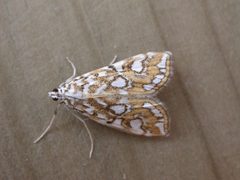
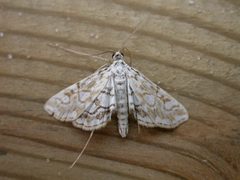
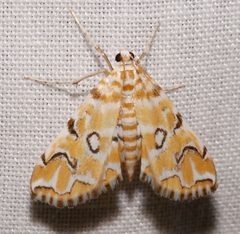
Elophila is a of aquatic in the Crambidae, comprising approximately 50 described distributed across Europe, Asia, and North America. The genus is notable for its aquatic or semi-aquatic larvae, which represent a secondary evolutionary acquisition of aquatic lifestyle within Lepidoptera. Larvae construct portable cases from cut leaf fragments of aquatic plants, feeding on submerged vegetation. Several species have been studied as potential agents for aquatic plants.
Pronunciation
How to pronounce Elophila: /ɛˈloʊfɪlə/
These audio files are automatically generated. While they are not always 100% accurate, they are a good starting point.
Identification
are small to medium-sized crambid with wingspans typically 15-25 mm. The is distinguished from other Acentropinae by genitalic characters and wing pattern; however, -level identification often requires examination of genitalia. Larvae are recognized by their distinctive case-building , constructing mobile shelters from two oval leaf fragments cut from aquatic plants and bound with silk.
Images
Habitat
Aquatic and semi-aquatic environments including ponds, lakes, slow-moving canals, ditches, wetlands, and bogs. Larvae are associated with floating-leaved and submerged aquatic vegetation. Some occupy damp muddy areas adjacent to water bodies.
Distribution
Widespread across the Palaearctic region from Europe to eastern Russia; present in East Asia including Japan, Korea, and China; native to eastern North America with some extending to other regions. Records from Scandinavia (Denmark, Norway, Sweden) and the northeastern United States (Vermont).
Seasonality
Most have one per year. typically active in June and July. Larvae feed through autumn, overwinter, and resume feeding in spring before .
Diet
Larvae feed on aquatic plants. Elophila nymphaeata consumes Hydrocharis and Potamogeton; in Italy has been recorded as a pest of rice plants. Elophila obliteralis feeds on Nymphoides peltata foliage. Elophila turbata larvae are parasitized by Microgaster godzilla, indicating aquatic plant consumption.
Host Associations
- Hydrocharis - food plantlarval for E. nymphaeata
- Potamogeton - food plantlarval for E. nymphaeata
- Nymphoides peltata - food plantlarval for E. obliteralis; plant in US
- Oryza sativa - food plantrice plants; E. nymphaeata recorded as pest in Italy
- Microgaster godzilla - braconid that parasitizes E. turbata larvae underwater
Life Cycle
laid on underside of aquatic plant leaves. Larvae initially feed in leaf mines before constructing portable cases from two oval leaf fragments cut from plants, spun together with silk. Cases provide protection and camouflage while larvae feed and move. Larvae feed through autumn, overwinter, and resume feeding in spring. brief; emerge in early summer.
Behavior
Larvae construct mobile cases from cut plant fragments, carrying them while feeding and moving. This case-building is a defining characteristic of the . Some show -dependent feeding rates, with higher larval densities causing greater plant damage.
Ecological Role
Herbivores of aquatic vegetation; may influence macrophyte structure through consumption of floating-leaved plants. Elophila obliteralis identified as potential agent for Nymphoides peltata, which forms dense mats that shade out native macrophytes. Serve as for specialized including the aquatic braconid Microgaster godzilla.
Human Relevance
Some have potential as agents for aquatic plants. Elophila nymphaeata occasionally damages rice crops in Italy. Subject of genomic research due to aquatic adaptations, with sequenced for E. nymphaeata (734.1 Mb assembly).
Similar Taxa
- NymphulaAlso aquatic crambid with case-building larvae; distinguished by genitalic and wing venation patterns
- ParapoynxAquatic Acentropinae with superficially similar larvae; requires genital dissection for reliable separation
More Details
Aquatic adaptations
Elophila represents one of few Lepidoptera lineages with secondary evolution of aquatic larval lifestyle. Genomic studies of E. nymphaeata and E. obliteralis reveal similarities with Trichoptera (caddisflies) in composition of major silk genes, potentially reflecting convergent adaptations for underwater case construction.
Taxonomic history
Originally described by Jacob Hübner in 1822. Previously placed in Nymphulinae; now classified in Acentropinae. Contains approximately 50 described with ongoing taxonomic revisions, particularly in Asia.
Sources and further reading
- BugGuide
- Wikipedia
- GBIF taxonomy match
- iNaturalist taxon
- NCBI Taxonomy
- Catalogue of Life
- Death from below: the first video of a parasitic wasp attacking caterpillar underwater | Blog
- parasitic behavior | Blog
- An Aquatic Moths, Elophila turbata (Butler, 1881) (Lepidoptera, Crambidae, Nymphulinae) in Korea, with New Host Plants
- The potential of Elophila obliteralis larvae (waterlily leafcutter moth) as a biological control for the invasive aquatic plant Nymphoides peltata (yellow floating heart)
- The genome sequence of the Brown China-mark moth, Elophila nymphaeata (Linnaeus, 1758).
- Genomic resources of aquatic Lepidoptera, Elophila obliteralis and Hyposmocoma kahamanoa, reveal similarities with Trichoptera in amino acid composition of major silk genes.