
Parapoynx maculalis
Clemens, 1860
polymorphic pondweed moth
Parapoynx maculalis, commonly known as the polymorphic pondweed , is a small aquatic moth in the Crambidae. It inhabits freshwater environments across eastern North America, from Florida and Texas north to Canada. The is distinguished by its small size, white forewings with fuscous markings, and fully aquatic larval stage that feeds on submerged plants.
Pronunciation
How to pronounce Parapoynx maculalis: /ˌpæɹəˈpɔɪnks ˌmækjʊˈlælɪs/
These audio files are automatically generated. While they are not always 100% accurate, they are a good starting point.
Identification
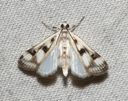
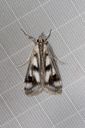
Distinguished from similar aquatic crambids by the combination of white hindwings (pure, without markings) and the specific pattern of fuscous dusting and spot placement on the forewings. The small size and association with ponds and streams further aid identification. Larval identification relies on association and the characteristic light yellowish-brown body with dark .
Images
Appearance
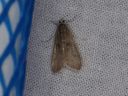
Small with wingspan 18–22 mm. Forewings white, dusted with fuscous along the base, with a distinct fuscous spot at the base of the fold. Hindwings pure white without markings. Larvae are light yellowish brown when young, with a dark yellowish-brown .
Habitat
Freshwater aquatic environments including ponds and streams. Larvae are fully aquatic, living among submerged vegetation.
Distribution
Eastern North America. Recorded from: United States (Alabama, Florida, Georgia, Illinois, Indiana, Louisiana, Maine, Maryland, Massachusetts, Michigan, Minnesota, Mississippi, New Hampshire, New Jersey, North Carolina, North Dakota, Pennsylvania, South Carolina, Tennessee, Texas, Vermont, Wisconsin), Canada (Alberta, Manitoba, New Brunswick, Newfoundland, Nova Scotia, Ontario, Quebec, Saskatchewan).
Diet
Larvae feed on various aquatic plants. Specific plant not documented in available sources.
Life Cycle
Larvae are aquatic and develop among submerged vegetation. are aerial. Detailed stages and timing not documented.
Behavior
Larvae are aquatic, living and feeding underwater among pondweed and other submerged vegetation. are presumably or , typical of the .
Ecological Role
Herbivore in freshwater aquatic ; larvae consume submerged aquatic vegetation, potentially contributing to nutrient cycling and serving as prey for aquatic .
Human Relevance
No documented economic or medical significance. Occasionally encountered by aquatic biologists and collectors.
Similar Taxa
- Other Parapoynx speciesShare aquatic and general appearance; distinguished by wing pattern details, particularly the pure white hindwings and specific fuscous forewing markings of P. maculalis
- Other Acentropinae (aquatic crambid moths)Similar aquatic larvae and small size; identification requires examination of wing pattern and genitalia
More Details
Taxonomic history
Described by James Brackenridge Clemens in 1860. The epithet 'maculalis' refers to the spotted (maculate) forewing pattern.
Aquatic adaptation
Like other Acentropinae, larvae possess adaptations for underwater life including the ability to extract oxygen from water, though specific physiological mechanisms for this are not documented.