
Acentria
Stephens, 1829
watermilfoil moth, water veneer
Species Guides
1- Acentria ephemerella(Water Veneer)
Acentria is a in the Crambidae containing a single , Acentria ephemerella. The genus is notable for extreme in wing development and for having the only known fully aquatic female moths. Most females are flightless with wings and spend their entire lives underwater, while males are fully winged and terrestrial. The species is native to Europe and has been introduced to North America.
Pronunciation
How to pronounce Acentria: /eɪˈsɛn.tri.ə/
These audio files are automatically generated. While they are not always 100% accurate, they are a good starting point.
Identification
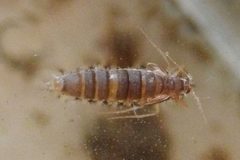
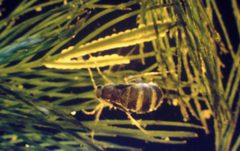
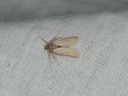
Distinguished from other Crambidae by the combination of aquatic and extreme female wing dimorphism. Males resemble small white pyralid moths but are identified by association with water and swarming at lights. Flightless females are unique among : small white insects found on or just below water surface with stubby non-functional wings. Winged females larger than males. Larvae recognized by aquatic habitat, light olive-green color, and case-building behavior in late instars.
Images
Appearance
males are small white with wingspan approximately 12 mm; forewings whitish with obscure brownish and , hindwings whitish. Females exhibit pronounced wing dimorphism: most are brachypterous with non-functional wings and remain aquatic, while a minority possess longer wings up to 23 mm and are capable of . Aquatic females possess swimming hairs on second and third legs and modified structure adapted for underwater vision. Larvae are light olive-green with light brown .
Habitat
Freshwater lentic including ponds, lakes, and marshes. Larvae inhabit submerged aquatic macrophytes. occur at water surface or in terrestrial environment depending on sex and female morph.
Distribution
Native to Europe where widespread; introduced to North America with established in northeastern United States and Canada. Documented in New York State lakes, including Cayuga Lake and Seneca Lake.
Seasonality
males active in summer, attracted to light and capable of swarming in thousands on warm humid nights. Larval stage lasts approximately 42 weeks with and in summer. Larvae overwinter in cocoons on macrophytes.
Diet
Larvae feed on aquatic macrophytes including pondweeds (Potamogeton spp.), Canadian waterweed (Elodea canadensis), and Eurasian watermilfoil (Myriophyllum spicatum). Not a feeder; laboratory studies demonstrate consumption of wide variety of submerged macrophytes.
Host Associations
- Myriophyllum spicatum - primary for and feeding closely tied through use of tips for summer and stems for winter refuge; preferred over other plants
- Potamogeton spp. - plant for feeding and oviposition
- Elodea canadensis - plant for feeding and oviposition
Life Cycle
masses laid on aquatic plants by females diving from surface. Larvae emerge and bore into plant stems, constructing shelters from glued plant material. Late instars build cases. Larvae girdle stems while feeding, causing plant damage. occurs inside underwater cocoons filled with air. emerge and swim to surface; males and flighted females fly away, flightless females remain aquatic.
Behavior
males live 1-2 days solely for breeding, mate with aquatic females at water surface. Males strongly attracted to light, forming large swarms on warm humid nights. Aquatic females possess swimming hairs on legs for underwater locomotion. Larvae construct protective shelters and cases from plant material. Cryptic habits make detection difficult.
Ecological Role
Herbivore of aquatic macrophytes. Contributes to decline of Eurasian watermilfoil , with associated increase in native macrophyte abundance. Used as agent, though lacks specificity and will attack native plant .
Human Relevance
Employed as biocontrol agent against Eurasian watermilfoil (Myriophyllum spicatum), but requires careful management due to non-specific range. Potential to reduce watermilfoil in northeastern United States documented.
Similar Taxa
- Nymphula nitidulataBoth are aquatic crambid with semi-aquatic larvae; distinguished by N. nitidulata larvae living on wetland plants above water line rather than fully submerged, and by lack of extreme female wing dimorphism
- Bellura spp.Both have aquatic caterpillars; Bellura larvae breathe by periodic surfacing and lack the extreme and fully aquatic females of Acentria
More Details
Genomic characteristics
assembly of Acentria ephemerella comprises 340.8 Mb distributed across 31 with 17,748 protein-coding genes. Specimen for sequencing collected from Wytham Woods, Oxfordshire, UK.
Evolutionary significance
One of approximately 800 aquatic but unique in having fully aquatic females. Represents evolutionary to freshwater with modification of respiratory, locomotory, and sensory systems in aquatic female morph.
Population densities
Summer larval densities estimated at 27-100 m⁻² in Cayuga Lake, New York; hibernating larvae reach mean densities of 500 m⁻² in late fall in Seneca Lake.
Sources and further reading
- BugGuide
- Wikipedia
- GBIF taxonomy match
- iNaturalist taxon
- NCBI Taxonomy
- Catalogue of Life
- Comparative Cytogenetics | Blog - Part 2
- The Lepidopteran Life Aquatic
- Decline of the invasive submersed macrophyte Myriophyllum spicatum (Haloragaceae) associated with herbivory by larvae of Acentria ephemerella (Lepidoptera)
- The genome sequence of the Water Veneer, Acentria ephemerella (Denis & Schiffermüller, 1775).