
Acentria ephemerella
(Denis & Schiffermüller, 1775)
Water Veneer, watermilfoil moth
Acentria ephemerella is an aquatic in the Crambidae, notable as the only moth with females that remain fully aquatic throughout their entire lives. The exhibits extreme : most females are brachypterous (short-winged and flightless) with swimming adaptations including additional hairs on their legs, while males have fully developed wings and live only 1-2 days solely for breeding. Native to Europe and now established in North America, this species has gained attention as a agent for aquatic plants, particularly Eurasian watermilfoil (Myriophyllum spicatum).
Pronunciation
How to pronounce Acentria ephemerella: /əˈsɛn.tri.ə ˌɛ.fə.mɛˈrɛl.lə/
These audio files are automatically generated. While they are not always 100% accurate, they are a good starting point.
Identification
Distinguished from other aquatic by the unique combination of permanently aquatic females with brachyptery and leg swimming hairs. Males can be identified by their attraction to light in large swarms on warm humid nights. Larvae are cryptic and difficult to detect; case-building in late instars helps distinguish from some other aquatic caterpillars.
Images
Appearance
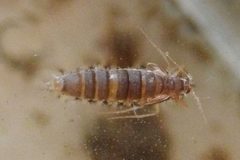
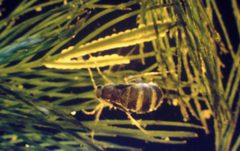
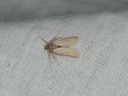
females typically have underdeveloped, non-functional wings and spend their entire lives underwater with additional swimming hairs on the second and third legs. A rare winged terrestrial female morph exists with fully developed wings. Males have normal wings and are fully terrestrial. All adults possess an under-developed . Larvae are aquatic and case-building in late instars.
Habitat
Lentic freshwater including ponds, lakes, and marshes. Closely associated with submersed macrophytes, particularly Myriophyllum spicatum. Larvae use tips of macrophytes as summer and stems as winter refuges for hibernation.
Distribution
Native to Europe where widespread; established in North America with confirmed in New York State lakes including Cayuga Lake (first observed 1991) and Seneca Lake. Present in 25 of 26 surveyed lakes in New York State.
Seasonality
males active on warm humid nights, attracted to light and capable of swarming in thousands. Larvae reach high densities (27-100 m⁻²) in summer; hibernate in stems at densities up to 500 m⁻² in late fall.
Diet
Larvae are herbivorous, feeding on aquatic plants including pondweeds (Potamogeton spp.), Canadian waterweed (Elodea canadensis), and Eurasian watermilfoil (Myriophyllum spicatum). Laboratory studies indicate ability to consume various macrophytes, though field show strong association with M. spicatum.
Host Associations
- Myriophyllum spicatum - primary plantEurasian watermilfoil; larvae use tips for summer and stems for winter hibernation. Preferred over native in field settings.
- Potamogeton spp. - food plantpondweeds
- Elodea canadensis - food plantCanadian waterweed
Life Cycle
Aquatic larvae with terrestrial . Larvae are case-building in late instars and generally overwinter in cocoons on macrophytes. Hibernation occurs in milfoil stems during late fall and winter. and adult timing not explicitly documented in sources.
Behavior
males live 1-2 days solely to breed, mating with aquatic females at the water's surface. Females remain underwater throughout their entire adult lives—a unique among . Larvae exhibit cryptic habits making them difficult to detect. High- grazing causes severe damage to meristems of plants.
Ecological Role
Significant herbivore of submersed macrophytes. Acts as a biocontrol agent contributing to decline of Eurasian watermilfoil; larval herbivory associated with marked decrease in M. spicatum and concurrent increase in native macrophyte abundance. At high densities, can substantially alter aquatic plant composition.
Human Relevance
Used as an agent of biological pest control against Eurasian watermilfoil (Myriophyllum spicatum), a noxious aquatic plant. Valued by some anglers as trout prey, though many anglers remain unaware of its significance. Males attracted to light in large numbers can be a nuisance near water bodies.
Similar Taxa
- Nymphula nitidulataBoth are aquatic crambid with aquatic larvae, but N. nitidulata has fully winged of both sexes that are terrestrial, and larvae are semi-aquatic living on wetland plants above the water line rather than fully submerged.
- Bellura melanopygaBoth have aquatic larvae feeding on water lilies, but B. melanopyga larvae breathe by periodic surfacing through specialized and are fully winged and terrestrial.
- Hyposmocoma spp.Some Hawaiian have aquatic or amphibious larvae, but are fully winged and terrestrial; no brachypterous aquatic female morph exists.
More Details
Genome
sequenced at 340.8 Mb with 31 and 17,748 protein-coding genes.
Evolutionary note
The permanently aquatic female represents a remarkable evolutionary reversal, effectively returning to the aquatic environment from which insects' crustacean ancestors emerged.
Sources and further reading
- BugGuide
- GBIF taxonomy match
- iNaturalist taxon
- NCBI Taxonomy
- The Lepidopteran Life Aquatic
- Comparative Cytogenetics | Blog - Part 2
- Decline of the invasive submersed macrophyte Myriophyllum spicatum (Haloragaceae) associated with herbivory by larvae of Acentria ephemerella (Lepidoptera)
- The genome sequence of the Water Veneer, Acentria ephemerella (Denis & Schiffermüller, 1775).