
Cercyonis oetus
Boisduval, 1869
Small Wood-Nymph, Dark Wood-Nymph
Cercyonis oetus is a of western North America, commonly known as the Small Wood-Nymph or Dark Wood-Nymph. It is a medium-sized satyrine with a wingspan of 32–45 mm. fly in a single from June to August. The has four recognized distributed across its range.
Pronunciation
How to pronounce Cercyonis oetus: //sɜrˈsaɪənɪs ˈoʊtəs//
These audio files are automatically generated. While they are not always 100% accurate, they are a good starting point.
Identification
Distinguished from the Common Wood-Nymph (Cercyonis pegala) by smaller size (32–45 mm vs. 45–60 mm), darker coloration, and more restricted western distribution. C. pegala has two or more in most of its range, while C. oetus has only one. The two overlap in some areas; examination of size and timing aids separation. From other western satyrs, C. oetus lacks the orange-brown tones of Oeneis species and the more prominent banding of some Hipparchia.
Images
Appearance
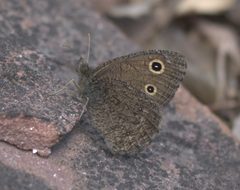
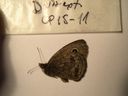
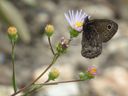
Medium-sized with wingspan 32–45 mm. Upper wing surfaces brown with eyespots; underwing pattern characteristic of the Cercyonis with dark, irregular lines and small eyespots. Sexes similar in coloration. Overall darker and smaller than the related Common Wood-Nymph (Cercyonis pegala).
Habitat
Grasslands, meadows, open woodlands, and forest edges in western North America. Associated with grassy areas where larval plants grow. Occurs from low elevations to montane zones, with occupying different elevational and geographic zones.
Distribution
Western North America from southern Canada (Alberta, Saskatchewan) through the western United States. have more restricted ranges: C. o. oetus in the Great Basin and Rocky Mountain regions; C. o. charon in California; C. o. silvestris in the Pacific Northwest; C. o. pallescens in the southern Rocky Mountains and southwestern states.
Seasonality
fly from June to August in a single . period varies with elevation and latitude, with lower elevations and southern emerging earlier.
Diet
Larvae feed on various grasses (Poaceae). Specific grass vary by region and have not been comprehensively documented. nectar at flowers.
Host Associations
- Poaceae - larval various grasses
Life Cycle
Single brooded (). laid on or near grasses. Larvae feed on grasses, in larval stage. in spring, with in early summer. No in adult stage.
Behavior
fly in grassy areas, often staying close to vegetation. Males patrol for females. Adults may bask with wings open or rest with wings closed, showing cryptic underwings. Not known to migrate.
Ecological Role
Larval herbivore on grasses; contributes to nutrient cycling in grassland . serves as . Prey for birds, spiders, and other .
Human Relevance
Subject of watching and photography. Used as for grassland quality in western North America. Not of agricultural significance.
Similar Taxa
- Cercyonis pegalaLarger size (45–60 mm), paler coloration, multiple in most of range, more widespread across eastern and central North America
- Cercyonis stheneleRestricted to California, generally paler with more contrasting pattern
- Oeneis chryxusArctic-alpine distribution, orange-brown coloration, different wing shape
More Details
Fire vulnerability
Like other non-migratory butterflies with weak capabilities, C. oetus are vulnerable to large- destruction from wildfires. Recovery depends on recolonization from unburned source populations and vegetation .
Subspecies variation
Four recognized, differing in size, coloration, and distribution: oetus (nominate), charon (California), silvestris (Pacific Northwest), and pallescens (southern Rocky Mountains/southwest). The latter was described by Emmel & Emmel in 1971.