
Cercyonis pegala
Fabricius, 1775
Common Wood-Nymph, Wood-Nymph, Grayling, Blue-Eyed Grayling, Goggle Eye
Cercyonis pegala is a widespread North American satyrine commonly known as the Common Wood-Nymph. It occupies diverse open including grasslands, meadows, and woodland edges across much of the continent. The exhibits notable variation in wing pattern across its range, with coastal and interior showing consistent differences in eyespot size and number. Unlike some , it remains common and broadly distributed, though habitat loss affects local populations.

Pronunciation
How to pronounce Cercyonis pegala: //sɛrˈsaɪ.ənɪs pəˈɡeɪ.lə//
These audio files are automatically generated. While they are not always 100% accurate, they are a good starting point.
Identification
Distinguished from Cercyonis sthenele (Small Wood-Nymph) by larger size and presence of two prominent forewing eyespots (sthenele usually has one). Separated from Cercyonis oetus (Dark Wood-Nymph) by paler ground color and more distinct eyespot pattern. Cercyonis incognita (Bald Hills Satyr) occurs only in restricted North Coast Range localities and shows reduced eyespot development. style slow and bouncing, typical of satyrines, with frequent perching on vegetation.
Images
Appearance
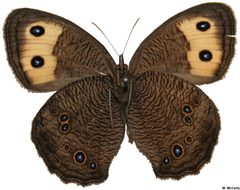
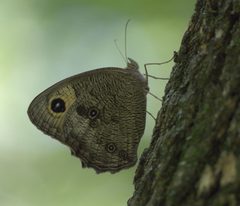
Medium-sized with wingspan 45–70 mm. wing surface brown to tan with variable pattern of eyespots; forewing typically bears two large eyespots with yellow or blue pupils, hindwing with zero to several smaller eyespots depending on . surface cryptically colored in muted browns and grays, aiding concealment when wings are closed at rest. clubbed with pale tips. Sexes similar, though females average larger with more rounded wing margins.
Habitat
Open grassy areas including meadows, prairies, savannas, woodland clearings, and coastal dunes. Tolerates disturbed such as roadsides and old fields. Elevational range from sea level to montane zones, though generally absent from dense forest interiors and true alpine tundra. Larval plants are grasses (Poaceae), so persistence depends on availability of native or naturalized grass cover.
Distribution
Transcontinental in North America, from southern Canada (Alberta, Saskatchewan, Manitoba, southern Ontario, southern Quebec, Maritime provinces) south through most of the contiguous United States to northern Mexico. Absent from the Florida peninsula, southern Texas desert regions, and most of the arid Southwest. Western extend to the Pacific Coast; eastern populations reach the Atlantic seaboard.
Seasonality
Single brooded throughout most of range, with active primarily June through September depending on latitude and elevation. Southern may have partial second with extended period into October. timing varies with snowmelt in montane areas and with seasonal progression in lowlands.
Diet
feed on nectar from flowers and on rotting fruit, tree sap, and . Larvae feed on various grasses (Poaceae), including both native and introduced .
Host Associations
- Poaceae - larval plantvarious grass
Life Cycle
laid singly on grass leaves or stems. Larvae feed nocturnally, hiding in grass litter by day, and overwinter as half-grown caterpillars. occurs in spring in loose silk cocoon among grass stems or leaf litter. emerge in early to mid-summer. No in egg or pupal stage; winter survival dependent on larval cold hardiness.
Behavior
fly low and erratically over grass cover, frequently perching with wings closed on grass stems. When disturbed, may flush briefly then resettle nearby. Males patrol for females in open areas; courtship involves hovering and release. Both sexes visit flowers for nectar, with preference for composites (Asteraceae) and other accessible blooms. Adults roost in tall grass or low shrubs overnight.
Ecological Role
of wildflowers during nectar feeding. Larvae serve as herbivores converting grass to insect tissue, available to and . Adults and larvae provide food for birds, spiders, and insect predators. As a widespread herbivore, contributes to nutrient cycling in grassland without exerting strong top-down control on vegetation.
Human Relevance
Common subject of watching and photography due to approachable and widespread occurrence. Larvae occasionally considered minor pests in ornamental grass plantings, though damage rarely significant. Used in ecological studies of butterfly and fragmentation. Not commercially exploited.
Similar Taxa
- Cercyonis stheneleSmaller size, usually single forewing eyespot, more western distribution in dry
- Cercyonis oetusDarker ground color, reduced or absent eyespots, Rocky Mountain and Great Basin distribution
- Cercyonis incognitaRestricted to North Coast Range of California, reduced eyespots, historically confused with C. pegala
More Details
Population Variation
Coastal from New England to Washington typically have reduced hindwing eyespots (often none) compared to interior populations which may display two to four distinct eyespots. This clinal variation has been subject to study regarding avoidance and genetic differentiation.
Fire Response
Unlike the narrowly Cercyonis incognita, which faced potential extinction from 2020 California wildfires, C. pegala generally recover from fire through recolonization due to broad distribution and mobility. Recovery depends on grass plant re-establishment.