
Dione juno
Cramer, 1779
Juno Silverspot, Juno Longwing, Juno Heliconian
Species Guides
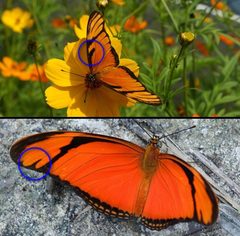
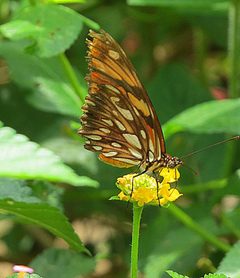
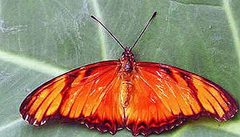
1Dione juno is a heliconiine ( Heliconiinae) distributed from the southern United States through Central and South America. The is a significant agricultural pest of passion fruit (Passiflora spp.), particularly Passiflora edulis, where caterpillars can completely defoliate plants at high densities. are characterized by orange and black wing patterns with distinctive silver spots on the wing surfaces. The species has been extensively studied in Brazil and Central America for its role in agroecosystems and its diverse complex of natural enemies.
Pronunciation
How to pronounce Dione juno: //ˈdaɪ.oʊ.ni ˈdʒuː.noʊ//
These audio files are automatically generated. While they are not always 100% accurate, they are a good starting point.
Identification
can be distinguished from similar orange and black heliconiines by the combination of silver spots on the wing surfaces and specific wing shape. The resembles the Mexican Silverspot (Dione moneta) and the Gulf Fritillary (Agraulis vanillae), but differs in spot pattern and wing venation. Caterpillars are black with spiny projections. Ventral silver spotting is a key diagnostic feature separating Dione from Agraulis, which lacks such markings.
Images
Habitat
Associated with Passiflora plants in diverse environments including tropical and subtropical woodlands, agricultural settings, and rupestrian fields. In Brazil, documented at elevations of 1,090–1,387 meters. suitability is directly tied to presence of passion fruit vines.
Distribution
Range extends from southern United States through Mexico, Central America, and South America to Argentina. Documented in Colombia (Betulia, Floridablanca, Ibagué, Leticia, Manizales, Montería, Piedecuesta, Tona, Villavicencio), Brazil (Minas Gerais, Pará, Rio de Janeiro, Santa Catarina, São Paulo), Panama, Rica, and throughout the Neotropics including Antilles, Guiana, Surinam, French Guiana, Trinidad, Venezuela, Ecuador, Peru, Bolivia, Paraguay, and Uruguay.
Seasonality
High densities reported in winter and summer months in Brazilian agroecosystems. observed year-round in tropical portions of range; in temperate regions, activity corresponds with warm seasons. Biological cycle from to adult approximately 30 days.
Diet
Larval stage feeds exclusively on Passiflora (Passifloraceae), particularly Passiflora edulis. nectar on flowers; specific nectar sources not documented in available sources.
Host Associations
- Passiflora edulis - larval plantprimary agricultural ; complete defoliation possible
- Passiflora alata - larval plantdocumented in Brazil
- Passiflora serrato-digitata - larval plantdocumented in Brazil
- Passiflora foetida - larval plantdocumented in Brazil
- Palmistichus elaeisis - Hymenoptera: Eulophidae; emerges from pupae
- Moreiria maura - Diptera: Tachinidae; first record Brazil 2021
- Chetogena scutellaris - Diptera: Tachinidae; Rica and Brazil
- Chetogena aff. scutellaris - first South American record from Minas Gerais
- Lespesia archippivora - Diptera: Tachinidae; Panama
- Brachymeria koehleri - hyperparasitoidHymenoptera: Chalcididae; parasitizes Chetogena through D. juno pupae
- Conura spp. - Hymenoptera: Chalcididae; Pernambuco
- Podisus nigrispinus - Hemiptera: Pentatomidae; of larvae
- Mormidea notulata - Hemiptera: Pentatomidae; Panama
- Polistes satan - Hymenoptera: Vespidae
- Polistes carnifex - Hymenoptera: Vespidae; Pernambuco
- Polistes versicolor - Hymenoptera: Vespidae; Pernambuco
- Agelaia pallipes - Hymenoptera: Vespidae; Pernambuco
- Parachartergus pseudapicalis - Hymenoptera: Vespidae; Pernambuco
- Polybia rejecta - Hymenoptera: Vespidae; Pernambuco
- Mischocyttarus angulatus - Hymenoptera: Vespidae; Panama
- Solenopsis geminata - Hymenoptera: Formicidae; Panama
Life Cycle
Complete with four stages: , larva (caterpillar), pupa, and . Egg to adult development approximately 30 days. Caterpillars are black and spiny. occurs on or near plants. Pupal stage is parasitized by multiple tachinid flies and .
Behavior
Caterpillars feed gregariously at high densities, capable of completely defoliating passion fruit plants. exhibit typical heliconiine patterns with slow, fluttering movement. Larval feeding can cause significant agricultural damage, with in winter and summer months in Brazilian .
Ecological Role
Primary herbivore of Passiflora in Neotropical ; significant agricultural pest in passion fruit . Serves as for diverse and , including at least 15 documented species of Hymenoptera and Diptera parasitoids, making it an important component of tritrophic interactions in agroecosystems. Hyperparasitism documented through Brachymeria koehleri parasitizing primary tachinid parasitoids.
Human Relevance
Major economic pest of passion fruit (Passiflora edulis) in Brazil and Central America. Defoliation by caterpillars reduces crop productivity. Subject of research including evaluation of Podisus nigrispinus and various . Viral biocontrol agent Dione juno (DijuNPV) has been isolated and sequenced for potential pest management applications. Chemical remain primary management method, with increasing emphasis on integrated biological control.
Similar Taxa
- Dione monetaMexican Silverspot; similar orange and black pattern with silver spots, but differs in wing shape and spot arrangement; normal range Mexico to Brazil with rare strays to southwestern United States
- Agraulis vanillaeGulf Fritillary; similar orange and black coloration but lacks silver spots on wing surfaces; more widespread in North America and has different plant preferences within Passifloraceae
More Details
Viral Pathogens
Dione juno (DijuNPV) is a Group I alphabaculovirus with a 122,075 circular ; first alphabaculovirus completely sequenced from a nymphalid , showing close relationship to Orgyia pseudotsugata MNPV.
Tritrophic Interactions
plant significantly affects development. Caterpillars reared on Passiflora edulis f. flavicarpa 'Seleção de Jaboticabal' supported better development of Podisus nigrispinus than those reared on 'Sul Brasil' or 'Maguary FB-100' cultivars, demonstrating plant-mediated effects on efficacy.
Sources and further reading
- BugGuide
- GBIF taxonomy match
- iNaturalist taxon
- NCBI Taxonomy
- Catalogue of Life
- A 'Firecracker of a Surprise' in Davis: Who Knew? | Bug Squad
- A Close Call | Bug Squad
- Mary Louise Flint's Article in The Acorn: 'Butterflies in Decline' | Bug Squad
- What do insects do in winter? Migrants in the DMV: Common Buckeye, Junonia coenia, Variegated Fritillary, Euptoieta Claudia, Painted Lady, Vanessa cardui, Large Milkweed bug, Oncopeltus fasciatus — Bug of the Week
- Bug Eric: Breaking: Mexican Silverspot Butterfly Sighted in Colorado
- 🪲 Entomologizing w/ the WGNSS Entomology Group at Hughes Mountain Natural Area — 11 Oct 2025 | Beetles In The Bush
- Moreiria maura (Diptera: Tachinidae), parasitoid of Dione juno juno (Lepidoptera: Nymphalidae) in Brazil
- Brachymeria koehleri (Hymenoptera: Chalcididae): first record as hyperparasitoid in Dione juno juno (Lepidoptera: Nymphalidae) pupae
- Palmistichus elaeisis Delvare & LaSalle (Hymenoptera, Eulophidae): a new parasitoid of Dione juno juno (Cramer) (Lepidoptera, Nymphalidae)
- A Nymphalid-Infecting Group I Alphabaculovirus Isolated from the Major Passion Fruit Caterpillar Pest Dione juno juno (Lepidoptera: Nymphalidae)
- Biologia de Imaturos e Adultos de Podisus nigrispinus (Dallas) (Hemiptera: Pentatomidae) Alimentados com Lagartas de Dione juno juno (Cramer) (Lepidoptera: Nymphalidae), criadas em Diferentes Genótipos de Maracujazeiro
- ENEMIGOS NATURALES DE Dione juno (Cramer, 1779) (LEPIDOPTERA: NYMPHALIDAE) EN CULTIVO DE Passiflora edulis Sims, J. (1818) CENTRO REGIONAL UNIVERSITARIO DE COCLE, UNIVERSIDAD DE PANAMÁ