
Dione moneta
Hübner
Mexican silverspot
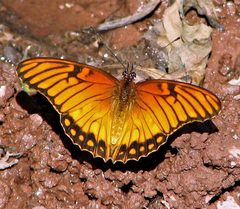
Dione moneta, commonly known as the Mexican , is a in the Nymphalidae, Heliconiinae. Its normal range extends from Mexico through Central America to Brazil, with occasional strays northward into the southern United States. The is named after the Roman goddess Moneta, representing fortune and wealth. A notable vagrant record occurred in Colorado in April 2017, representing a significant northward extension of its documented range.


Pronunciation
How to pronounce Dione moneta: //ˈdi.oʊ.neɪ moʊˈniːtə//
These audio files are automatically generated. While they are not always 100% accurate, they are a good starting point.
Identification
The Mexican can be distinguished from similar fritillary butterflies by its orange upperside with brown wing bases and thick, dark . The most diagnostic feature is the underside of the hind wing, which is brown and covered with large, conspicuous silver spots—unlike the Variegated Fritillary (Euptoieta claudia), which lacks such prominent silver spotting beneath. The wingspan measures 3 to 3¼ inches (approximately 76–83 mm). The overall wing shape is somewhat angular compared to the more rounded wings of the Gulf Fritillary (Agraulis vanillae).
Images
Habitat
In its core range, the inhabits mid-elevation tropical woodlands. It has been reported to breed sporadically in the lower Rio Grande Valley of Texas. The Colorado vagrant individual was observed in a mosaic of shortgrass prairie with sandstone bluffs, ponderosa pine forest, and riparian areas with wild plum (Prunus americana) in bloom.
Distribution
Native range extends from Mexico through Central America to Brazil. In the United States, it strays to south Texas and rarely to the southwest and Big Bend region of Texas. Vagrant records include Roosevelt County, New Mexico (May 8, 2005) and Colorado Springs, Colorado (April 18, 2017)—the latter representing what appears to be the first documented record for Colorado. GBIF records indicate presence in Colombia in the Andean cordilleras between 1500–2000 meters elevation.
Seasonality
Recorded from late spring to late fall in its northern range, with multiple in Mexico. The Colorado observation occurred on April 18.
Diet
Larval foodplants are passion vines (Passiflora ), which do not occur naturally in Colorado. have been observed nectaring on wild plum (Prunus americana) blossoms.
Behavior
are known to gather at flowering plants to nectar. The exhibits vagrant , occasionally straying far north of its core breeding range, as evidenced by records in New Mexico and Colorado. Multiple occur annually in Mexico.
Human Relevance
The holds significance for lepidopterists and naturalists due to its striking appearance and rarity as a vagrant in the United States. The 2017 Colorado record generated considerable interest in the regional entomological and was documented through citizen science observation and expert verification. The species name references Roman mythology, reflecting historical naming conventions in lepidopterology.
Similar Taxa
- Agraulis vanillae (Gulf Fritillary)Similar orange and brown coloration, but lacks the large silver spots on the hind wing underside that distinguish D. moneta; also has more rounded wing shape
- Euptoieta claudia (Variegated Fritillary)Overlaps in range and general appearance, but underside of hind wing lacks the prominent silver spotting characteristic of D. moneta; more commonly encountered in the southwestern United States
Sources and further reading
- BugGuide
- Wikipedia
- GBIF taxonomy match
- iNaturalist taxon
- NCBI Taxonomy
- Catalogue of Life
- Bug Eric: Breaking: Mexican Silverspot Butterfly Sighted in Colorado
- One Ecosystem calls for papers that report ecosystem accounts | Blog
- ecosystem accounting | Blog
- Study reveals community perceptions of ecosystem services
- Bug Eric: No Good Deed....