
Solenopsis geminata
(Fabricius, 1804)
tropical fire ant, Geminata-group fire ant
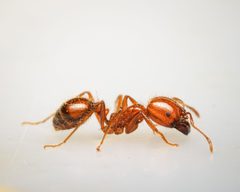
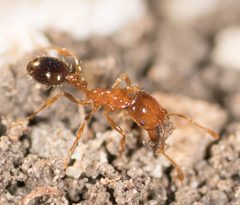
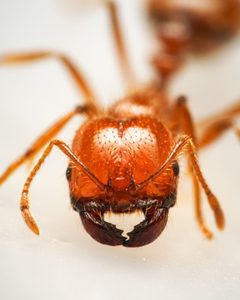
Solenopsis geminata, the tropical fire , is a native New World with a broad distribution spanning the southern United States through Central and South America, and introduced across Asia, the Pacific Islands, and Africa. The species exhibits a foraging strategy tradeoff between discovery and competitive territorial dominance compared to its S. xyloni, with S. geminata being less efficient at resource discovery but superior in competitive encounters. populations demonstrate adaptive strategies to overcome inbreeding costs, including pleometrosis (cooperative colony founding by multiple queens) and execution of male larvae. The species serves as to Pseudacteon phorid fly .
Pronunciation
How to pronounce Solenopsis geminata: /səˌlɛ.nəpˈsɪs dʒɛ.mɪˈnɑː.tə/
These audio files are automatically generated. While they are not always 100% accurate, they are a good starting point.
Identification
Distinguishing S. geminata from the () requires careful examination; both share the Solenopsis characteristics of small to medium size, reddish-brown coloration, and two-segmented petiole. S. geminata tends to occupy different zones than S. invicta where their ranges overlap, with S. geminata favoring more mesic conditions compared to S. invicta's broader disturbance . Winged reproductive females are larger than males and possess elbowed , while males have reduced, non-elbowed antennae and disproportionately small relative to their body size.
Images
Habitat
Mesic-adapted; occupies with moderate moisture conditions. In northern Florida, distribution patterns relate to habitat type and disturbance level, often occurring in areas distinct from those dominated by S. invicta.
Distribution
Native range: southern United States (Texas, Florida, Louisiana, Alabama, Mississippi, Arizona, South Carolina, North Carolina, California, Georgia, New Mexico), Mexico, Central America, and South America. Introduced range: Asia (including China, India, Indonesia, Philippines, Vietnam, Malaysia), Africa (Liberia, Mauritius), Pacific Islands (Hawaii, Galápagos Islands, Tahiti, Tonga, Samoa, New Caledonia, Mariana Islands), and Australia (Queensland). Present on Easter Island and Christmas Island.
Diet
; has been observed to damage citrus, avocado, and other fruit trees through girdling; destroys seeds and seedlings, notably tobacco.
Life Cycle
Colony founding occurs through single-mated queens (monandry) that may engage in pleometrosis (cooperative founding with 1-5 queens). Produces males in 13-100% of colonies; queens execute diploid male larvae in 43.5% of diploid male-producing colonies, potentially redirecting nutrients to . Winged reproductives () include sexually dimorphic males and females.
Behavior
Exhibits particle-use during foraging on sidewalks. Demonstrates strong territorial competitive dominance in laboratory trials, outperforming S. xyloni in following competition despite inferior resource discovery . show intermediate competitive performance in hybrid colonies (S. geminata × S. xyloni).
Ecological Role
Acts as for Pseudacteon phorid flies (Diptera), which are decapitating . may impact native through competitive interactions; hybridization with S. xyloni may extend range limits and alter competitive dynamics in overlap zones.
Human Relevance
Agricultural pest: damages fruit trees by girdling and destroys crop seedlings. Subject to research using Pseudacteon phorid flies. Listed in distribution databases as aggressive with economic impacts on agriculture.
Similar Taxa
- Solenopsis invictaOverlapping distribution and similar ; S. geminata distinguished by mesic preference and different competitive-foraging strategy tradeoff
- Solenopsis xyloniHybridizes with S. geminata in overlap zones; S. xyloni is desert-adapted with superior foraging discovery but inferior competitive dominance
More Details
Inbreeding compensation strategies
with low genetic diversity produce sterile males; colonies compensate through pleometrosis and larval , with cooperative founding significantly increasing colony size and diploid male execution allowing nutrient reallocation to production.
Foraging strategy tradeoff
Part of a discovery-dominance tradeoff axis: S. geminata prioritizes competitive territorial dominance over rapid resource discovery, opposite to S. xyloni's strategy, with hybrids showing intermediate phenotypes.
Sources and further reading
- BugGuide
- GBIF taxonomy match
- iNaturalist taxon
- NCBI Taxonomy
- Catalogue of Life
- Oh, oh, oh, I'm on fire - Red Imported fire ant, Solenopsis invicata — Bug of the Week
- In a warming world, here comes the red imported fire ant, Solenopsis invicata — Bug of the Week
- Fire ant winged reproductives: male and female | Beetles In The Bush
- How Entomologists are Battling Invasive Ants to Protect a Texas Cave Ecosystem
- Non-Repellent Insecticide Prevents Fire Ant Infestations in Nursery Plant Root Balls
- How Ticks Hide in Plain Sight From Predatory Fire Ants
- Solenopsis geminata . [Distribution map].
- Confrontation Behavior between Solenopsis invicta and S. geminata, and Competitiveness of Certain Florida Ant Species against S. invicta
- Notes on the Biology of the Fire Ant Solenopsis geminata (F.) in Florida and Georgia
- Environmental filtering of foraging strategies mediates patterns of coexistence in the fire ants Solenopsis geminata and Solenopsis xyloni , and their interspecific hybrids
- Strategies of the invasive tropical fire ant (Solenopsis geminata) to minimize inbreeding costs
- Ants foraging in sidewalks: particle-use behavior of the fire ant Solenopsis geminata Fabricius (Hymenoptera: Formicidae)
- Distribution of the Fire Ants Solenopsis invicta and S. geminata (Hymenoptera: Formicidae) in Northern Florida in Relation to Habitat and Disturbance
- New species and records of Pseudacteon Coquillett, 1907 (Diptera, Phoridae), parasitoids of the fire ant Solenopsis geminata group (Hymenoptera, Formicidae)