
Solenopsis invicta
Buren, 1972
Red Imported Fire Ant, RIFA
is a highly native to South America that has spread to multiple continents, causing significant ecological and economic damage. It forms large, aggressive colonies that dominate disturbed and displace native ant species through competition and . The species exhibits flexible colony through both and colony , with some containing multiple queens. Its painful sting and tendency to swarm when disturbed make it a serious public health and agricultural pest.
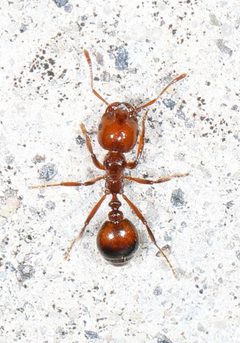
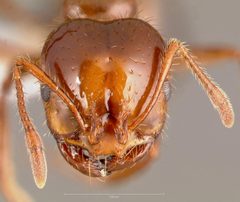
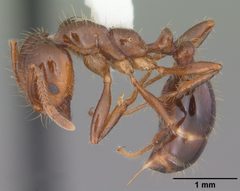
Pronunciation
How to pronounce Solenopsis invicta: //ˌsoʊ.lɪˈnɒp.sɪs ɪnˈvɪk.tə//
These audio files are automatically generated. While they are not always 100% accurate, they are a good starting point.
Identification
are small reddish-brown ants, typically 2-6 mm in length, with a two-segmented petiole and a characteristic sting at the tip of the . are polymorphic, ranging from minor to major workers. The can be distinguished from native Solenopsis species by its aggressive swarming when disturbed and its tendency to form large, conspicuous soil mounds, particularly in open, sunny areas.
Images
Habitat
Thrives in disturbed with open and reduced shade, including roadsides, agricultural fields, pastures, and urban areas. In Texas, occupies subtropical thorn scrub and coastal plains. Avoids densely forested or heavily shaded environments. Colonies construct dome-shaped soil mounds that regulate temperature and moisture.
Distribution
Native to South America (Brazil, Argentina, Paraguay). Introduced and established in the United States (primarily southeastern states from Texas to Virginia, with isolated in California and other states), Mexico, Central America, Caribbean islands, Australia (Queensland), China (multiple provinces including Fujian, Guangdong, Guangxi, Hong Kong, Hunan, Taiwan), and New Zealand.
Diet
omnivore. Preys on other arthropods including insects and arachnids. Consumes seeds, honeydew from hemipterans, and vertebrate carrion. Will accept protein-rich baits including meat and insect carcasses. In laboratory and field studies, has been observed to ignore live ticks (all life stages) unless the body is punctured and internal fluids are exposed.
Life Cycle
Polymorphic colonies with - system. Colonies reproduce sexually via with mating , after which newly mated queens found new colonies. Some exhibit (multiple queens per colony), facilitating rapid local spread. Also capable of colony (fission), where new colonies form by splitting from parent colonies with workers accompanying queens to new nest sites.
Behavior
Highly aggressive territorial defense with rapid recruitment to food resources and disturbances. Forms large, coordinated attacks on perceived threats. Foraging activity includes both individual and mass recruitment to food sources. In response to flooding, colonies form living rafts by linking together to transport and queens to dry ground. Ignores chemically defended prey such as metastriate ticks unless physical damage exposes internal tissues.
Ecological Role
that reduces native diversity through competitive displacement and direct . Alters composition as both and competitor. Acts as engineer by modifying soil structure through mound construction. Disrupts by reducing of small vertebrates that serve as prey for other , indirectly affecting populations by removing .
Human Relevance
Delivers painful stings that can cause severe allergic reactions in sensitive individuals. Causes over $8 billion annually in economic damage in the United States through impacts on agriculture, infrastructure, and medical costs. Infests electrical equipment causing short circuits and equipment failure. Subject to Federal Imported Fire restricting movement of plants and materials from infested areas. Controlled through broadcast baits, mound treatments, and agents including phorid flies and .
Similar Taxa
- Solenopsis geminataNative fire in the same ; distinguished by S. invicta's more aggressive , preference for disturbed open , and characteristic mound-building in sunny areas
- Solenopsis richteriBlack imported fire ant, historically confused with S. invicta; distinguished by darker coloration and more limited distribution in the United States
- Wasmannia auropunctataLittle fire ant, another ; distinguished by smaller size, preference for shaded , and less conspicuous nesting
Misconceptions
Widely assumed to prey on ticks based on their predatory and the observation that decline in fire -infested areas. Research has demonstrated that S. invicta ignores all life stages of metastriate ticks (, larvae, nymphs, ) unless the tick body is physically punctured. The observed negative correlation between fire ant and tick populations is instead attributed to fire ants displacing small mammal that ticks require for development.
More Details
Chemical Communication and Prey Detection
Research indicates that metastriate ticks evade detection by S. invicta through chemical camouflage. Metastriate ticks possess glands that secrete an oily substance containing squalene, a compound also present in . This shared chemistry appears to mask ticks from recognition as prey or threats, even when ants physically contact life stages.
Control Methods in Sensitive Habitats
In Texas cave systems where S. invicta threatens endangered , containerized toxic stations (Ants-No-More) containing hydramethylnon or indoxacarb have proven effective, achieving 90% colony elimination within 7 weeks and 70% reduction within a 6-meter . These stations protect non-target by restricting access to the .
Non-Repellent Insecticide Applications
Dinotefuran, a non-repellent , has shown 99.99% reduction in fire when applied to nursery plant root balls, with -level control lasting up to six months. This approach addresses the primary of human-mediated spread through horticultural trade.
Sources and further reading
- BugGuide
- GBIF taxonomy match
- iNaturalist taxon
- NCBI Taxonomy
- Catalogue of Life
- Know Your Ants | Bug Squad
- Insects that feed on twigs and branches - AgriLife Extension Entomology
- Tiger Beetles Show Potential for Biocontrol of Red Imported Fire Ants
- How Entomologists are Battling Invasive Ants to Protect a Texas Cave Ecosystem
- Non-Repellent Insecticide Prevents Fire Ant Infestations in Nursery Plant Root Balls
- How Ticks Hide in Plain Sight From Predatory Fire Ants
- Field evaluation of Solenopsis invicta virus 3 against its host Solenopsis invicta
- Solenopsis invicta virus 3 infection alters foraging behavior in its host Solenopsis invicta
- Solenopsis invicta and Ant Community Ecology
- Solenopsis invicta . [Distribution map].
- Geographic distribution suggests that Solenopsis invicta is the host of predilection for Solenopsis invicta virus 1
- Confrontation Behavior between Solenopsis invicta and S. geminata, and Competitiveness of Certain Florida Ant Species against S. invicta
- Exploitation of a high genomic mutation rate in Solenopsis invicta virus 1 to infer demographic information about its host, Solenopsis invicta
- Isolation, characterization, and host specificity of Solenopsis invicta virus 6 (Cripavirus porteri), a dicistrovirus from the red imported fire ant, Solenopsis invicta
- Octenol acts as a fumigant for Solenopsis invicta, disrupting cuticular fatty acid synthesis and behavioral pathways
- Feeding Preferences for Sugars and Amino Acids in the Red Imported Fire Ant, Solenopsis invicta Buren.