
Solenopsis richteri
Forel, 1909
Black Imported Fire Ant, BIFA
Solenopsis richteri, the black imported fire , is a South American native fire ant that has been introduced to North America. Once considered a or color variant of , it is now recognized as a distinct species with demonstrably different range and ecological preferences. It appears more cold-tolerant and less than the . In its native Argentina, it is attacked by six species of Pseudacteon phorid flies that significantly reduce its foraging activity. The species hybridizes with S. invicta where their ranges overlap, particularly in Tennessee. In Eritrea, it has been documented as a serious agricultural pest of crops and grazing areas.
Pronunciation
How to pronounce Solenopsis richteri: //səˈliːnəpˌsɪs ˈrɪktəraɪ//
These audio files are automatically generated. While they are not always 100% accurate, they are a good starting point.
Identification
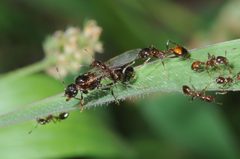
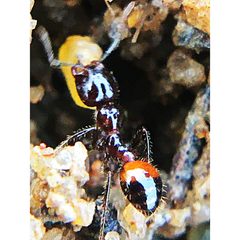
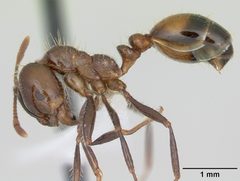
Dark blackish coloration distinguishes S. richteri from the reddish-brown S. invicta. are variable in size, ranging from very small to moderately sized (approximately 1/16 to 1/4 inch). Nests are constructed underground with bare soil areas of 30–60 m² surrounding the mound entrance. In areas of sympatry with S. invicta, hybrid identification requires molecular or biochemical analysis due to introgressive hybridization producing intermediate phenotypes.
Images
Habitat
Constructs underground nests in open grassland and agricultural fields devoid of trees and shrubs. In its native South American range, found in Argentina. In introduced North American range, occurs in Tennessee and potentially other southeastern states. In Eritrea, occupies crop fields and grazing areas with nests distributed approximately 25 meters apart.
Distribution
Native to South America: Argentina (Las Flores and other regions), with records from Brazil (Mato Grosso do Sul, Paraná, Rondônia, Rio Grande do Sul) and Paraguay. Introduced to North America: Tennessee (documented co-occurrence and hybridization with S. invicta), with potential broader distribution in southeastern United States. Also present in Eritrea (Hamelmalo sub-zone) where it is an established pest.
Diet
In Eritrea, preferred are grass seeds and crops, followed by small animals including , , worms, and seeds of some weed . Specific dietary details from native South American range are not documented in available sources.
Life Cycle
Exhibits typical fire colony structure with multiple queens in mature colonies. Virgin queens are capable of in queenless colonies. Winged reproductive males and females participate in mating ; males aggregate at mating sites.
Behavior
Forages primarily during cold periods of the day and at night when temperatures are cool. Exhibits risk-adjusted foraging in response to phorid pressure, reducing activity proportionally regardless of food resource size. engage in nest cleaning and patrolling behaviors. When attacked by Pseudacteon phorid flies, foraging activity is significantly reduced and worker size distribution of foragers shifts downward. Males aggregate at specific locations for mating.
Ecological Role
In native Argentina, serves as for six Pseudacteon phorid that regulate . In introduced Eritrea, acts as a significant agricultural pest causing yield losses of 24–32 quintals per hectare and reducing livestock forage availability. Hybridizes with S. invicta in zones of co-occurrence, potentially affecting dynamics.
Human Relevance
Serious agricultural pest in Eritrea, causing substantial crop yield losses and reducing grazing capacity. Subject to research using phorid flies in Argentina. Hybridizes with the more widespread S. invicta, complicating management efforts. Less and potentially more cold-tolerant than S. invicta, which may influence future range expansion under climate change.
Similar Taxa
- Solenopsis invictaOverlaps in distribution and hybridizes with S. richteri; distinguished by reddish-brown versus black coloration, with S. invicta being more and aggressive. Molecular analysis often required for definitive identification in hybrid zones.
- Solenopsis geminataShares fire characteristics and geographic range in some areas; distinguished by morphological and behavioral differences, though specific distinguishing features not detailed in available sources.
Sources and further reading
- BugGuide
- GBIF taxonomy match
- iNaturalist taxon
- NCBI Taxonomy
- Catalogue of Life
- Know Your Ants | Bug Squad
- Oh, oh, oh, I'm on fire - Red Imported fire ant, Solenopsis invicata — Bug of the Week
- In a warming world, here comes the red imported fire ant, Solenopsis invicata — Bug of the Week
- Fire ant winged reproductives: male and female | Beetles In The Bush
- How Entomologists are Battling Invasive Ants to Protect a Texas Cave Ecosystem
- Non-Repellent Insecticide Prevents Fire Ant Infestations in Nursery Plant Root Balls
- Worker Size, Geographical Distribution, and Introgressive Hybridization of Invasive Solenopsis invicta and Solenopsis richteri (Hymenoptera: Formicidae) in Tennessee
- Disruption of gene expression in hybrids of the fire ants Solenopsis invicta and Solenopsis richteri
- Ecology, behaviour and management of black harvester ant Solenopsis richteri (Forel) in Hamelmalo, Eritrea
- Reproduction by virgin queen fire ants in queenless colonies: Comparative study of three taxa (Solenopsis richteri, hybridS. invicta/richteri, S. geminata) (Hymenoptera: Formicidae)
- Environmental data sets matter in ecological niche modelling: an example with Solenopsis invicta and Solenopsis richteri
- Male Aggregation by Solenopsis richteri Forel (Hymenoptera: Formicidae) and Associated Mating Behavior in Argentina
- Parasitoid-Host Matching between the Little Decapitating Fly Pseudacteon curvatus from Las Flores, Argentina and the Black Fire Ant Solenopsis richteri
- Phorid parasitoids affect foraging activity of Solenopsis richteri under different availability of food in Argentina
- Biochemical and behavioral evidence foe hybridization between fire ants,Solenopsis invicta andSolenopsis richteri (Hymenoptera: Formicidae)