
Solenopsis xyloni
McCook, 1879
Southern Fire Ant, Californian Fire Ant, Cotton Ant
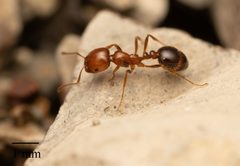
Solenopsis xyloni, the southern fire , is a native North American fire ant found in the southern United States. It is a stinging ant with similar to the (S. invicta), though its sting is less painful. The species is desert-adapted and exhibits a foraging strategy emphasizing resource discovery over territorial competitive dominance. It hybridizes with S. geminata in zones of sympatry, with hybrids showing intermediate traits that may facilitate range expansion.

Pronunciation
How to pronounce Solenopsis xyloni: //ˌsoʊlɪˈnɒpsɪs zaɪˈloʊnaɪ//
These audio files are automatically generated. While they are not always 100% accurate, they are a good starting point.
Identification
Distinguished from the () by native range and less painful sting. Morphological separation from S. geminata and other Solenopsis requires examination of specific characters not detailed in available sources. In zones of overlap with S. geminata, hybrids may be identified by intermediate foraging and competitive traits.
Images
Habitat
Desert and arid environments in its western range; occurs in mesic where it coexists with S. geminata in eastern portions of its range. Constructs nests in soil.
Distribution
Native to southern United States. Western range includes desert regions; eastern range extends into areas of sympatry with S. geminata. Documented from California and other southwestern states eastward.
Diet
Broad and opportunistic omnivore. Collects and stores seeds in nests. Consumes honeydew excreted by sap-feeding insects. Preys on small and scavenges.
Behavior
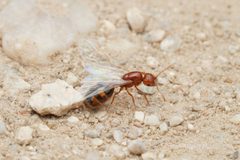
Exhibits a foraging strategy prioritizing efficient resource discovery over territorial competitive dominance, contrasting with S. geminata. are less effective at territory defense but more efficient at locating and retrieving resources. Colonies produce winged reproductives. Aggressive when disturbed, delivering stings to defend the colony.
Ecological Role
Seed disperser through seed storage . Honeydew consumer, potentially mediating relationships with sap-feeding insects. Prey for specialized including phorid flies in the Pseudacteon.
Human Relevance
Stinging pest in agricultural and urban settings. Less medically significant than S. invicta due to less painful sting, but capable of defending colonies aggressively. Subject of research involving entomopathogens and flies.
Similar Taxa
- Solenopsis invictaSimilar appearance and ; distinguished by status, more painful sting, and different native range (South America)
- Solenopsis geminataCo-occurs in eastern range; differs in foraging strategy emphasizing competitive dominance over discovery ; hybrids occur in overlap zone
More Details
Hybridization with S. geminata
Interspecific hybridization occurs in zones of sympatry. Hybrids show intermediate foraging and competitive traits. S. xyloni colonies with hybrid may gain competitive advantages enabling persistence with S. geminata, potentially explaining hybridogenetic social structure in some .
Foraging strategy tradeoff
Research demonstrates S. xyloni occupies the 'discovery' end of a discovery-dominance tradeoff axis, being more efficient at locating resources but less effective at territorial defense compared to S. geminata. This trait combination is consistent with desert .
Sources and further reading
- BugGuide
- GBIF taxonomy match
- iNaturalist taxon
- NCBI Taxonomy
- Catalogue of Life
- Ants and Moths: Think Noon and Night! | Bug Squad
- Insect Pests of Seeds and Roots - AgriLife Extension Entomology
- Oh, oh, oh, I'm on fire - Red Imported fire ant, Solenopsis invicata — Bug of the Week
- In a warming world, here comes the red imported fire ant, Solenopsis invicata — Bug of the Week
- Fire ant winged reproductives: male and female | Beetles In The Bush
- How Entomologists are Battling Invasive Ants to Protect a Texas Cave Ecosystem
- Environmental filtering of foraging strategies mediates patterns of coexistence in the fire ants Solenopsis geminata and Solenopsis xyloni , and their interspecific hybrids