
Satyrium
Scudder, 1876
Satyrid Hairstreaks
Species Guides
18- Satyrium acadicum(Acadian Hairstreak)
- Satyrium auretorum(Gold-hunter's Hairstreak)
- Satyrium behrii(Behr's Hairstreak)
- Satyrium calanus(Banded Hairstreak)
- Satyrium californicum(California Hairstreak)
- Satyrium caryaevorus(Hickory Hairstreak)
- Satyrium edwardsii(Edwards' Hairstreak)
- Satyrium favonius(Oak Hairstreak)
- Satyrium fuliginosum(sooty hairstreak)
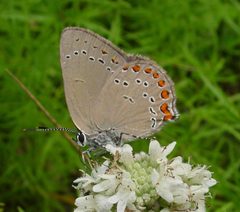
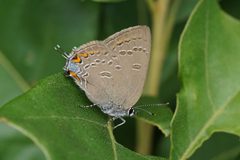
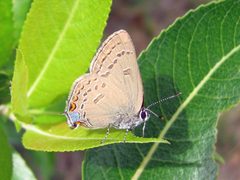
Satyrium is a of butterflies in the Lycaenidae, commonly known as satyrid hairstreaks. in this genus are distributed across the Holarctic ecozone. Many species exhibit specialized ecological associations, including larval dependencies on particular oak species and mutualistic relationships with ants. Several species have been the focus of conservation concern due to specificity and perceived rarity.
Pronunciation
How to pronounce Satyrium: /sæˈtɪriəm/
These audio files are automatically generated. While they are not always 100% accurate, they are a good starting point.
Images
Habitat
Oak woodlands and forests; specific associations with young oak trees (Quercus spp.) for oviposition and larval development. Some occupy vertically stratified positions within forest , with of certain species residing primarily in tree crowns.
Distribution
Holarctic ecozone; North America including eastern United States, Great Plains, Rocky Mountains, and Canada; Eurasia.
Seasonality
active during summer months; specific periods vary by and latitude.
Diet
feed on non-nectar sources including honeydew from aphids, , treehoppers, scale insects, and whiteflies; exudates from oak galls (specifically cynipid galls of Callirhytis balanacea); floral nectar may be used secondarily when primary sources are unavailable.
Host Associations
- Quercus - larval Specific oak vary by Satyrium species; includes white oak (Quercus alba), post oak, scrub oak (Q. ilicifolia), and Turkey oak (Q. cerris)
- Lasius ponderosae - mutualistAttends larvae of Satyrium curiosolus; larvae provide honeydew, ants provide protection from and and in galleries
- Lupinus argenteus - larval Exclusive larval for Satyrium curiosolus
Life Cycle
deposited on or near plants, often on oak . Larvae feed on host plant foliage and may be tended by ants. occurs on or near host plants. emerge and may ascend to forest .
Behavior
of some spend majority of lives in forest , descending to ground level infrequently. When disturbed, some species ascend into canopy while others remain near ground. Larvae of some species retreat into galleries when disturbed or during high temperatures.
Ecological Role
Larvae serve as trophobionts for ants, exchanging honeydew for protection. may contribute to nutrient cycling through consumption of honeydew and gall exudates.
Human Relevance
Subject of conservation concern; some listed as endangered or critically endangered in regional jurisdictions. Perceived rarity of some species may reflect -dwelling rather than actual status. Climate change studies use Satyrium species as models for range shift predictions.
Similar Taxa
- Other Theclinae generaSatyrium distinguished by specific associations, oak specificity, and -dwelling in many ; other may use different host plants or exhibit different behaviors
Misconceptions
Perceived rarity of such as Satyrium favonius ontario may be artifact of detection due to -dwelling rather than actual low numbers.
More Details
Genomic studies
Satyrium curiosolus recognized as distinct based on whole- sequencing showing low genetic diversity and high historical inbreeding, isolated for approximately 40,000 years from S. semiluna .
Conservation status
Satyrium ilicis listed as critically endangered in Baden-Württemberg, Germany. Satyrium kingi subject of assessment surveys in Maryland. Multiple subject to climate change distribution modeling.
Sources and further reading
- BugGuide
- Wikipedia
- iNaturalist taxon
- NCBI Taxonomy
- Catalogue of Life
- Curious isolation: new butterfly species discovered | Blog
- "Rare" Butterfly Feeds on Oak Galls and Other Non-Nectar Sources
- Comparative analysis of root-associated fungal diversity and community composition of two Satyrium species
- Ecological Study of a Medicinal Orchid (Satyrium Nepalense) in an Alpine Meadow
- Life history notes on Satyrium sylvinus dryope Edwards (Lycaenidae: Theclinae)
- Predicting the Potential Distribution of Endangered and Rare Satyrium Species in China under Climate Change
- Potential distribution of the rare and endangered Satyrium Species in China under climate change
- Analyse der Larvalhabitate des Braunen Eichen-Zipfelfalters Satyrium ilicis im Landkreis Heidenheim und mögliche Maßnahmen zu seinem Schutz
- Survey and Habitat Assessment of King's Hairstreak (Satyrium kingi) in Maryland Coastal Plain Forests
- A Multi-Evidence Approach to the Systematics of the Genus Satyrium Sw. Based on Time-Calibrated Phylogeny, Morphology, and Biogeography.