
Theclinae
hairstreaks, elfins
Tribe Guides
2Theclinae is a of Lycaenidae butterflies comprising hairstreaks, elfins, and related groups. Members are characterized by small to medium size, often with tail-like projections on the hindwings and intricate underside patterns. Many exhibit myrmecophilous relationships with ants, and larvae possess a specialized gland (Newcomer's gland) that secretes sugary fluids to attract protectors. The group shows high diversity in tropical regions, particularly the Neotropics and Southeast Asia, with fewer migratory species compared to other groups.
Pronunciation
How to pronounce Theclinae: /ˈθɛklɪniː/
These audio files are automatically generated. While they are not always 100% accurate, they are a good starting point.
Identification
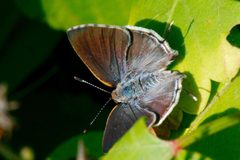
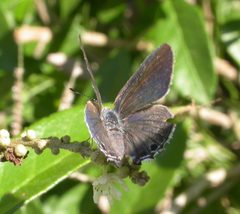
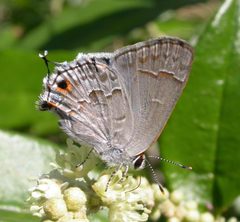
Hairstreaks are recognized by the presence of thin, hair-like tail projections on the hindwings (though not all have these), often accompanied by eyespot patterns near the tail base that form a 'false ' deflecting attacks. The combination of these tails with contrasting spot patterns on the wing underside distinguishes them from blues and coppers within Lycaenidae. Tropical species frequently display iridescent blue coloration from structural wing , while North American species tend toward brown uppersides.
Images
Habitat
Found across diverse environments from tropical rainforests to temperate oak woodlands and scrublands. Many occupy forest edges, clearings, and levels. Specific associations vary by tribe and species: some favor protea savanna in southern Africa, others montane forests in the Neotropics, and North American species often occur in oak-dominated habitats.
Distribution
distribution excluding Antarctica. Highest diversity in the Neotropics and Southeast Asia. Present throughout North America, Europe, Africa, Asia, and Australia. Individual ranges vary from highly restricted endemics to widespread .
Seasonality
periods vary by and latitude. Temperate species typically fly during summer months; some North American species produce multiple (up to three or four annually in southern regions) with flight periods extending from early spring through autumn. Tropical species may fly year-round with peaks tied to wet seasons.
Diet
feed on nectar from diverse flowering plants, with some showing extreme polyphagy. Certain species supplement or replace nectar feeding with non-floral sources including honeydew from sap-sucking insects (aphids, scale insects, treehoppers), fermenting tree sap, and exudates from cynipid galls. Larvae feed on leaves, buds, flowers, or seed pods of plants, with host associations ranging from highly specialized to broadly .
Life Cycle
are disc-shaped with finely reticulated surfaces; varies between and has taxonomic value. Larvae are typically -shaped, yellow-green with short downy hairs, often bearing dark longitudinal stripes and oblique bars, turning reddish-brown before . Many possess the Newcomer's gland on the seventh abdominal segment for association. Pupae are dark brown and cryptic, attached by silken girdle and or lying free in leaf litter or soil; pupal duration approximately ten days in summer.
Behavior
commonly exhibit 'false ' defense, where hindwing tails and eyespot patterns mimic a head to divert strikes away from vital body parts. Many engage in , with males flying to elevated terrain to establish territories or for mate location. Males of numerous species defend perches on shrubs, trees, or rocks. Strong myrmecophilous associations characterize the : larvae secrete sugary, -rich fluids from the Newcomer's gland to attract ants, which provide protection from predators and . In some highly specialized species, larvae are integrated into colonies and feed on ant .
Ecological Role
Larvae serve as significant mutualistic partners with ants, contributing to nutrition through secretions while receiving protection. Some function as social within ant colonies. may contribute to pollination during nectar feeding, though this role is likely secondary given their small size and often non-floral feeding habits. As prey, they form part of for birds, spiders, and other .
Human Relevance
Some are economically significant as crop pests (e.g., gray hairstreak larvae damage bean, corn, and cotton). Several species serve as state or regional symbols, such as the Colorado Hairstreak as Colorado's state insect. The attracts substantial interest from watchers and photographers due to identification challenges and behavioral complexity. Research on Theclinae associations contributes to understanding of mutualism, , and .
Similar Taxa
- Polyommatinae (blues)Both are of Lycaenidae with small size and often iridescent coloration; blues lack hindwing tails and false patterns, and typically show more uniform wing undersides without the complex spot arrangements of hairstreaks.
- Lycaeninae (coppers)Share characteristics of small size and clubbed ; coppers are generally orange or -colored above, lack hindwing tails, and have simpler wing patterns without the hairstreaks' characteristic false .
- AphnaeinaeFormerly treated as a tribe within Theclinae, now elevated to ; separation based on morphological and phylogenetic distinctions, though detailed differentiating characters require expert examination.
Sources and further reading
- BugGuide
- Wikipedia
- iNaturalist taxon
- NCBI Taxonomy
- Catalogue of Life
- Gray Hairstreak | Bug Squad
- A 'Butterfly Open House' at the Bohart Museum on March 19 | Bug Squad
- "Rare" Butterfly Feeds on Oak Galls and Other Non-Nectar Sources
- Bug Eric: Colorado's State Insect: Colorado Hairstreak Butterfly
- Guest Blogger: Dogbane for Dinner | Beetles In The Bush
- Bug Eric: Hilltopping
- Papilionoidea: Lycaenidae: Aphnaeinae, Lycaeninae, Miletinae, Polyommatinae, Poritiinae, Theclinae
- The status and distribution of Pennington’s Protea butterfly Capys penningtoni (Lepidoptera: Lycaenidae: Theclinae)
- New data on distribution of Eumaeini hairstreaks (Lepidoptera: Lycaenidae: Theclinae) in Iran
- A new Iolaus species (Lycaenidae: Theclinae) from the highlands of central Angola
- White M hairstreak, Parrhasius m-album (Boisduval & LeConte) (Insecta: Lepidoptera: Lycaenidae: Theclinae)
- A note on the rediscovery of the Redspot butterfly Zesius chrysomallus Hübner, 1819 (Lepidoptera: Lycaenidae: Theclinae) from Uttar Pradesh State, with a new larval host plant record for India
- First Host Plant Record forThaeides muela(Lepidoptera, Lycaenidae: Theclinae: Eumaeini)
- Descriptions of seven new <i>Pilodeudorix<i. Druce, 1891 from equatorial Africa (Lepidoptera: Lycaenidae: Theclinae)
- Phylogeny and taxonomy of the Neotropical Thepytus (Lepidoptera: Lycaenidae: Theclinae)
- Life history notes on Satyrium sylvinus dryope Edwards (Lycaenidae: Theclinae)