
Strymon melinus
Hübner, 1818
Gray Hairstreak
Strymon melinus, the Gray , is a small lycaenid widespread across North America. Males exhibit -dependent mating tactics, defending perches on hilltops at low densities and switching to patrolling when intruder numbers increase. The thrives in weedy, disturbed and urban environments, with a notably long season from February to November at low elevations. It is considered stable or increasing in parts of its range, including California's Central Valley.
Pronunciation
How to pronounce Strymon melinus: //ˈstraɪmɒn mɛˈlaɪnəs//
These audio files are automatically generated. While they are not always 100% accurate, they are a good starting point.
Identification
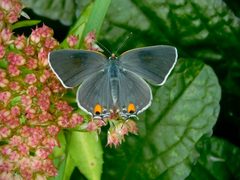
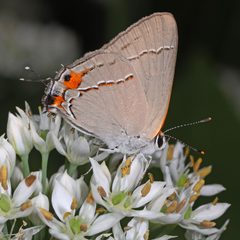
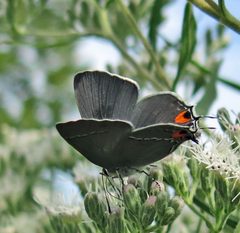
Distinguished from other hairstreaks by uniform gray coloration and single prominent orange spot on hindwing. Similar to other Strymon but lacks additional spotting or blue iridescence seen in relatives. Tail-like projection smaller than in some other .
Images
Appearance
Small with gray upperwings and distinctive orange marginal spot on hindwing. Underside gray with fine streaks and small tail-like projection on hindwing with eyespot near base. Wingspan approximately 2.5–3.5 cm.
Habitat
Weedy and disturbed at low elevation; oak-hickory forests, glades, shortgrass prairie with sandstone bluffs, urban and suburban environments including lawns and gardens. Hilltops used as mating stations in suitable terrain.
Distribution
North America from southern Canada (Alberta, Manitoba, Saskatchewan) through United States to Mexico. Present throughout western, central, and eastern United States. Vagrant or stray records in Colorado.
Seasonality
February to November at sea level; rarely seen before June in mountainous areas where it does not appear to overwinter. Multiple brooded with extended season.
Diet
nectar at flowers including guara, Mexican sunflower, and wild plum blossoms. Larvae feed on mallows (Malva ), legumes including Spanish Lotus, bird's-foot trefoil, white clover, alfalfa, and turkey mullein.
Host Associations
- Malva - larval weedy
- Lotus purshianus - larval Spanish Lotus
- Lotus corniculatus - larval bird's-foot trefoil
- Trifolium repens - larval white clover in lawns
- Medicago sativa - larval alfalfa
- Eremocarpus setigerus - larval turkey mullein
- Croton setigerus - larval turkey mullein, alternate name
Life Cycle
Multiple brooded. Overwinters as pupa or larva at low elevations; does not appear to overwinter in mountains.
Behavior
Males are territorial hilltoppers in suitable terrain, defending perches on elevated features such as boulders, shrubs, or trees. When increases, males abandon territoriality and switch to non-aggressive patrolling about preferred landmark trees. Both sexes visit flowers for nectar. Males have been observed chasing birds in apparent territorial defense.
Ecological Role
. Larval herbivore on weedy plants and agricultural legumes. Serves as prey for various at hilltop mating .
Human Relevance
Common in urban and suburban gardens. Used in long-term monitoring studies, notably Art Shapiro's 40+ year Central California transect. Considered a doing well in parts of its range despite overall butterfly declines. Occasionally minor pest in alfalfa and clover fields.
Similar Taxa
- Strymon rufofuscaSimilar size and gray coloration but lacks distinct orange hindwing spot and has different range
- Strymon bazochii with tail projection but different wing pattern and more southern distribution
- Satyrium speciesOther hairstreaks with tails but typically have more complex spotting patterns and different associations
More Details
Mating system
Research in central Arizona documented that males employ two alternative tactics: territorial perching versus non-territorial patrolling, with tactic choice determined by local male rather than individual condition.
Population trends
Listed as a doing well in California's Central Valley monitoring program, in contrast to many declining species in the same region.
Urban adaptation
Notable success in towns and cities of the Central Valley, exploiting weedy plants in lawns and disturbed areas.
Sources and further reading
- BugGuide
- GBIF taxonomy match
- iNaturalist taxon
- NCBI Taxonomy
- Catalogue of Life
- Mary Louise Flint's Article in The Acorn: 'Butterflies in Decline' | Bug Squad
- A Close Call | Bug Squad
- A Streak of Gray | Bug Squad
- Bug Eric: Breaking: Mexican Silverspot Butterfly Sighted in Colorado
- Bug Eric: Hilltopping
- Bug Eric: City Nature Challenge 2023 Recap
- Density‐dependent mating tactics in the Grey hairstreak, Strymon melinus (Lepidoptera: Lycaenidae)