
Strymon
Hübner, 1818
Scrub-Hairstreaks
Species Guides
12- Strymon acis(Bartram's scrub-hairstreak)
- Strymon albata(White Scrub-Hairstreak)
- Strymon alea(Lacey's Scrub-Hairstreak)
- Strymon avalona(Avalon Scrub-Hairstreak)
- Strymon bazochii(Lantana Scrub-Hairstreak)
- Strymon bebrycia(Red-lined Scrub-Hairstreak)
- Strymon istapa(Mallow Scrub-Hairstreak)
- Strymon martialis(Martial Scrub-Hairstreak)
- Strymon melinus(Gray Hairstreak)
Strymon is a of scrub butterflies in the Lycaenidae, comprising small, delicate butterflies found primarily in the Nearctic and . The genus was historically treated as its own tribe (Strymonini) due to its distinct evolutionary lineage within the Eumaeini. such as the Gray Hairstreak (Strymon melinus) are among the most widespread and commonly encountered members of this group in North America.
Pronunciation
How to pronounce Strymon: /ˈstrɪmɒn/
These audio files are automatically generated. While they are not always 100% accurate, they are a good starting point.
Identification
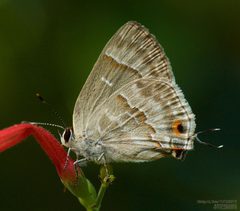
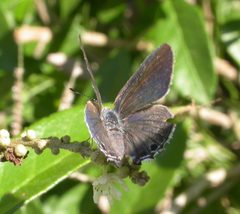
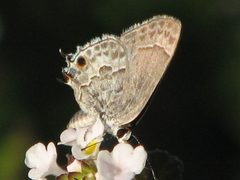
Strymon are small butterflies with the characteristic "" : slender bodies, relatively short wings, and typically one or more thin tail-like projections on the hindwings. The undersides of the wings usually display fine, hair-like streaks or lines. The can be distinguished from other hairstreak genera by specific wing pattern elements and structural features, though species-level identification often requires close examination of hindwing spot patterns, streak configurations, and the precise shape of tail projections.
Images
Habitat
Strymon occupy diverse including scrublands, open woodlands, forest edges, meadows, and urban and suburban areas. The Gray Hairstreak (Strymon melinus) is notably adaptable and can be found in disturbed habitats, agricultural fields, and gardens. Many species are associated with specific plants for larval development, which influences their distribution within suitable habitat patches.
Distribution
The Strymon is distributed across the Nearctic and , ranging from North America through Central America to South America. Individual vary in range: Strymon melinus occurs throughout much of North America, while other species have more restricted distributions. Strymon acis is to the pine rocklands of southern Florida.
Diet
Strymon butterflies feed on nectar from a variety of flowers. Larvae feed on specific plants; for Strymon melinus, recorded hosts include plants in the Malvaceae, Fabaceae, and others. Strymon acis larvae feed on pineland croton (Croton linearis) in Florida pine rocklands.
Host Associations
- Croton linearis - larval For Strymon acis in Florida pine rocklands
Life Cycle
Strymon butterflies undergo complete with , larva (caterpillar), pupa (chrysalis), and stages. Multiple per year are typical for many in favorable climates. The Gray Hairstreak (Strymon melinus) is known to have several annually across much of its range.
Behavior
Male Strymon butterflies exhibit , flying to elevated terrain features such as ridges or hilltops to establish territories and seek mates. Males of some defend specific perches on vegetation or rocks from which they survey for approaching females, driving away competing males. This territorial behavior has been documented in Strymon melinus and related species.
Ecological Role
As , Strymon butterflies contribute to plant through nectar feeding. Larvae serve as herbivores, consuming leaves and other plant parts of their . Both life stages provide food resources for and , including birds, spiders, and . The is part of diverse in their respective .
Human Relevance
The Gray Hairstreak (Strymon melinus) is one of the most frequently observed butterflies in North American gardens and urban areas, making it a familiar for watchers and photographers. Strymon acis is critically endangered due to loss in Florida pine rocklands. The serves as a subject for ecological and behavioral research, particularly regarding and territoriality in butterflies.
Similar Taxa
- MinistrymonBoth are of butterflies in the tribe Eumaeini with similar overall ; Ministrymon (ministreaks) are generally smaller with different wing pattern elements
- SatyriumAnother in Lycaenidae; Satyrium typically have different plant associations and lack some of the distinctive structural features of Strymon
- CallophrysGreen hairstreaks in the same but distinguished by greenish upperwing coloration in most and different ecological preferences
More Details
Taxonomic History
Strymon was at one time treated as a tribe Strymonini due to its highly distinct lineage, though it is now classified within the tribe Eumaeini.
Conservation Status
Strymon acis (Bartram's Scrub-hairstreak) is critically endangered and found only in the imperiled pine rocklands of southern Florida, where destruction poses severe threats to its survival.
Sources and further reading
- BugGuide
- Wikipedia
- GBIF taxonomy match
- iNaturalist taxon
- NCBI Taxonomy
- Catalogue of Life
- Mary Louise Flint's Article in The Acorn: 'Butterflies in Decline' | Bug Squad
- Bug Eric: Breaking: Mexican Silverspot Butterfly Sighted in Colorado
- Bug Eric: Hilltopping
- Bug Eric: City Nature Challenge 2023 Recap
- Bug Eric: Losing the Pine Rocklands
- Bug Eric: September 2010