
Strymon albata
Felder & Felder, 1865
White Scrub-Hairstreak, white hairstreak
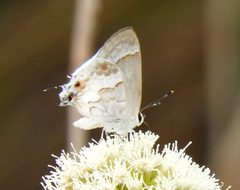
Strymon albata, the white or white scrub-hairstreak, is a small lycaenid distributed from southern Texas through Central America to northern South America. are active year-round in tropical regions and from June to December in southern Texas. The inhabits second growth and shrubby fields in seasonally dry tropical lowlands. Larvae feed specifically on flower buds and young fruits of Abutilon incanum, while adults nectar on various flowers including blue boneset.


Pronunciation
How to pronounce Strymon albata: //ˈstrɪmɒn ælˈbeɪtə//
These audio files are automatically generated. While they are not always 100% accurate, they are a good starting point.
Identification
Distinguished from other Strymon hairstreaks by its predominantly white to pale gray wing coloration. Most similar (e.g., Strymon melinus, the gray ) exhibit darker gray or brown tones. The combination of small size, pale color, and presence of hindwing tail separates it from other white or pale lycaenids in its range. In southern Texas, occurs sympatrically with other hairstreaks but differs in coloration and .
Images
Habitat
Second growth vegetation and shrubby fields in seasonally dry tropical lowlands. In southern Texas, occupies similar disturbed or successional with plant availability.
Distribution
Southern Texas (USA) south through Mexico to Rica, plus Colombia, Venezuela, and Trinidad.
Seasonality
Two annually in southern Texas with active June to December. Adults active year-round in tropical portions of range.
Diet
Larvae feed on flower buds and young fruits of Abutilon incanum (Malvaceae). feed on nectar of various flowers, with documented use of blue boneset.
Host Associations
- Abutilon incanum - larval food plantLarvae feed on flower buds and young fruits
Life Cycle
Complete with two annually in temperate portion of range (southern Texas). laid on plant. Larvae feed on reproductive structures (buds, young fruits). presumably occurs on or near host plant. emerge and seek nectar sources.
Behavior
visit flowers for nectar. has been documented in related Strymon (S. melinus), but not specifically recorded for S. albata.
Ecological Role
functions as when nectaring. Larval herbivore on Abutilon incanum. Serves as prey for various including birds, spiders, and .
Human Relevance
No significant direct economic importance. Subject of interest for watchers and naturalists in southern Texas and tropical regions. Contributes to local biodiversity.
Similar Taxa
- Strymon melinusGray overlaps in range and ; distinguished by darker gray-brown coloration rather than white/pale gray
- Other Strymon speciesMost darker in coloration; require close examination of wing pattern and color for separation
More Details
Taxonomic history
Originally described as Thecla albata by Felder & Felder in 1865; later transferred to Strymon.
Sources and further reading
- BugGuide
- Wikipedia
- GBIF taxonomy match
- iNaturalist taxon
- NCBI Taxonomy
- Mary Louise Flint's Article in The Acorn: 'Butterflies in Decline' | Bug Squad
- Bug Eric: Breaking: Mexican Silverspot Butterfly Sighted in Colorado
- Bug Eric: Hilltopping
- Bug Eric: City Nature Challenge 2023 Recap
- Bug Eric: Losing the Pine Rocklands
- Bug Eric: September 2010