
Strymon acis
(Drury, 1773)
Bartram's scrub-hairstreak, Caribbean Scrub-Hairstreak
Strymon acis is a small lycaenid with a wingspan of 22–29 mm, occurring in southern Florida and the West Indies. The S. a. bartrami, restricted to southern Florida, is federally listed as Endangered under the United States Act. The is tightly associated with pine rockland and depends on Croton linearis as its larval plant.
Pronunciation
How to pronounce Strymon acis: //ˈstraɪmɒn ˈeɪsɪs//
These audio files are automatically generated. While they are not always 100% accurate, they are a good starting point.
Identification
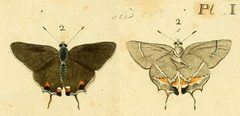
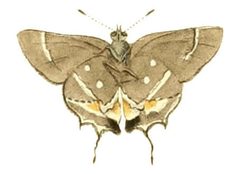
Distinguished from other hairstreaks by the combination of dark gray upperside, pale gray underside with white and black linear markings, and the distinctive hindwing tails (one long, one short). The two white spots near the wing base on the underside are additional diagnostic characters. The Florida S. a. bartrami is geographically isolated from other Strymon in the region.
Images
Habitat
Openings in pine woods, specifically pine rockland in Florida. These depend on regular fire events for maintenance. The bartrami is restricted to the imperiled pine rocklands of southern Florida.
Distribution
Southern Florida (United States) and the West Indies (including Cuba). The nominate S. a. acis occurs in the West Indies; S. a. bartrami is to southern Florida; S. a. casasi occurs in Cuba; S. a. mars has a broader distribution.
Seasonality
In Florida, are active from February through November with three to four periods () during this span.
Diet
Larvae feed on flower buds and young fruits of Croton linearis (narrow-leafed croton). feed on nectar from flowers of narrow-leafed croton and shepherd's needle (Scandix pecten-veneris).
Host Associations
- Croton linearis - larval plantLarvae feed on flower buds and young fruits; young caterpillars also consume upper leaf surfaces, flowers, and fruit
- Scandix pecten-veneris - nectar source
- Trichogramma sp. - Documented specifically for S. a. bartrami
Life Cycle
are laid singly on flower stalks of plants. Young caterpillars feed on upper leaf surfaces, flowers, and fruit. Older caterpillars feed exclusively on leaves. Multiple per year in Florida (three to four ).
Behavior
Males of related Strymon (including S. melinus) exhibit , flying to elevated terrain to defend perches and seek females. This mating strategy may occur in S. acis but has not been specifically documented.
Ecological Role
of native plants including its larval Croton linearis. Serves as host for in the Trichogrammatidae. A herbivore tightly linked to pine rockland dynamics.
Human Relevance
The Florida S. a. bartrami is federally listed as Endangered, making it a focus of conservation efforts. loss from development (including the 2017 Walmart/Coral Reef Commons controversy in Miami-Dade County) poses severe threats. The is an indicator of intact pine rockland .
Similar Taxa
- Strymon melinusGray shares gray coloration and tailed hindwings, but has broader distribution, different plant associations, and lacks the specific wing pattern of two basal white spots
- Strymon rufofuscaOther hairstreaks in the may overlap in range but differ in wing pattern details and associations
More Details
Conservation status
S. a. bartrami was listed as Endangered in 2014. Critical designation and ongoing legal battles (including 2017 litigation by Center for Biological Diversity) reflect severe habitat fragmentation in Miami-Dade County.
Fire dependence
The pine rockland requires periodic fire for maintenance; suppression or alteration of fire regimes threatens both the and its plant.
Sources and further reading
- BugGuide
- Wikipedia
- GBIF taxonomy match
- iNaturalist taxon
- NCBI Taxonomy
- Mary Louise Flint's Article in The Acorn: 'Butterflies in Decline' | Bug Squad
- Bug Eric: Losing the Pine Rocklands
- Bug Eric: Breaking: Mexican Silverspot Butterfly Sighted in Colorado
- Bug Eric: Hilltopping
- Bug Eric: City Nature Challenge 2023 Recap
- Trichogramma SP. (Hymenoptera: Trichogrammatidae) an Egg Parasitoid of Strymon acis bartrami (Lycaenidae)
- Notes on the Status and Ecology ofStrymon acis bartrami(Lycaenidae) in Everglades National Park
- Distribution ofCroton linearisin Miami-Dade County Preserves with Potential for Supporting the Federally Endangered ButterfliesStrymon acis bartramiandAnaea troglodyta floridalis