
Strymon bazochii
(Godart, 1824)
Lantana Scrub-Hairstreak, Smaller Lantana Butterfly
Strymon bazochii is a small lycaenid native to the Neotropics, ranging from Paraguay through Central America and the Caribbean to southern Texas. It was deliberately introduced to Hawaii in 1902 as a agent for , but failed to establish effective control. The species exhibits in wing pattern and has a documented association with Lippia and Lantana plants.


Pronunciation
How to pronounce Strymon bazochii: //ˈstraɪmən bəˈzoʊki.aɪ//
These audio files are automatically generated. While they are not always 100% accurate, they are a good starting point.
Identification
Distinguished from similar hairstreaks (Strymon ) by the combination of metallic brown wings with blue speckling and, in males, the presence of horizontal white wing lines. Females lack white lines and appear more uniformly patterned. The small size and grey provide additional distinguishing features from .
Images
Appearance
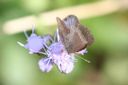
Small with wingspan of 22–25 mm. Wings are metallic brown with speckled blue hues. are grey. Males display distinct horizontal white lines on the wings; females lack this pattern.
Habitat
Associated with open, disturbed where plants grow. In Texas, found in areas supporting Lippia alba and Lippia graveolens. In Hawaii, occupies urban and suburban environments where occur. The species shows adaptability to anthropogenic landscapes.
Distribution
Native range extends from Paraguay northward through Central America, the West Indies, and Mexico to southern Texas, USA. Introduced to Hawaii in 1902. Present in the Caribbean, Middle America, North America (southern USA), and Oceania (Hawaiian Islands).
Seasonality
are active from May to December. Two to three occur per year.
Diet
Larvae feed on Lippia alba and Lippia graveolens in Texas; in Hawaii, they feed on and basil (Ocimum species). feed on nectar from various flowers including Bidens alba, Lantana species, and Stachytarpheta jamaicensis.
Host Associations
- Lippia alba - larval food plantTexas
- Lippia graveolens - larval food plantTexas
- Lantana urticoides - oviposition site deposited on this
- Lantana species - larval food plantHawaii ; introduced range
- Ocimum species - larval food plantHawaii ; basil
Life Cycle
are deposited on urticoides. Larval development averages approximately 31 days before . The chrysalis hardens and turns dark brown prior to . Multiple per year (two to three).
Behavior
have been observed typical of many Lycaenidae, with males defending perches on elevated terrain to intercept females. Both sexes visit flowers for nectar.
Ecological Role
of various flowering plants through nectar-feeding. Larvae function as herbivores on plants. Failed as a agent for in Hawaii, indicating limited regulatory impact on host plants.
Human Relevance
Subject of an unsuccessful introduction to Hawaii in 1902 intended to suppress . The failure illustrates limitations of for complex weed problems. No significant economic or agricultural impact documented.
Similar Taxa
- Strymon melinusGray Hairstreak is similar in size and general appearance but lacks the metallic brown coloration with blue speckling; males have different wing pattern elements
- Strymon acisBartram's Scrub-Hairstreak is a related with different plant associations and geographic restriction to Florida pine rocklands
- Strymon rufofuscaRed-tailed is larger and has distinctive red marginal markings on hindwings
More Details
Biological Control History
Introduction to Hawaii in 1902 represents one of the earliest documented attempts at for a weed . The failure to control has been attributed to factors including insufficient pressure, alternative use, and ecological complexities of the target weed system.
Taxonomic Note
Originally described as Polyommatus bazochii by Godart in 1824, later transferred to Strymon.
Sources and further reading
- BugGuide
- Wikipedia
- GBIF taxonomy match
- iNaturalist taxon
- NCBI Taxonomy
- Catalogue of Life
- Mary Louise Flint's Article in The Acorn: 'Butterflies in Decline' | Bug Squad
- Bug Eric: Breaking: Mexican Silverspot Butterfly Sighted in Colorado
- Bug Eric: Hilltopping
- Bug Eric: City Nature Challenge 2023 Recap
- Bug Eric: Losing the Pine Rocklands
- Bug Eric: September 2010