
Hypaurotis crysalus
(Edwards, 1873)
Colorado Hairstreak
Hypaurotis crysalus, the Colorado , is a montane and the sole member of its . It was designated Colorado's state insect in 1996 following advocacy by a fourth-grade class in Aurora, Colorado. The is , with peaking in July and August. It exhibits distinctive purple upper wing surfaces and cryptic gray undersides, and has specialized feeding habits that rarely include flower nectar.
Pronunciation
How to pronounce Hypaurotis crysalus: /haɪˈpɔːrɒtɪs ˈkrɪsələs/
These audio files are automatically generated. While they are not always 100% accurate, they are a good starting point.
Identification
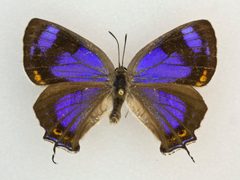
The combination of vivid purple wings with black margins and orange marginal spots distinguishes from other North American hairstreaks. The gray surface with white and brown striping provides camouflage when wings are closed at rest. The is larger than most lycaenids. Males are territorial on oak trees, a that can aid detection.
Images
Appearance
Wingspan 32–38 mm. wing surface vivid purple with black margins, a black patch or band on the forewing, bright orange marginal spots, and delicate tail-like projections on the hindwings. surface dull gray with white and brown longitudinal stripes, small orange and blue accents. Larva yellowish-green, slug-like, and highly cryptic.
Habitat
Montane oak scrubland dominated by Gambel's Oak (Quercus gambelii). Occurs at elevations approximately 6,500–7,500 ft. Butterflies favor healthy oak trees with minimal gall damage or other signs of weakness. South-facing slopes appear to be preferred.
Distribution
Southwestern United States: Colorado, Utah, Arizona, New Mexico, southeastern Wyoming, and extreme eastern Nevada. Also recorded in northern Mexico. collected at Palmer Lake, El Paso County, Colorado, in 1873.
Seasonality
recorded from May to November, with peak abundance in July and August. One annually (). laid in late summer and fall overwinter on oak branches; larvae hatch to feed on new spring foliage.
Diet
rarely visit flowers for nectar. Instead feed on: fermenting sap from tree wounds, exudates from developing acorns, and honeydew secreted by aphids and scale insects. Larvae feed exclusively on foliage of Gambel's Oak (Quercus gambelii).
Host Associations
- Quercus gambelii - plantLarval food source; laid on branches and twigs
Life Cycle
. laid individually on oak branches and twigs in late summer and fall, where they overwinter. Larvae emerge in spring to consume new oak foliage. details not documented in available sources. emerge primarily July–August.
Behavior
Males are territorial and defend individual oak trees from rival males, with chases observed on south-facing slopes. normally rest with wings closed, revealing cryptic undersides. Bask with wings open to expose purple surface. Active even on cloudy days and until dusk; observed flying after thunderstorms.
Ecological Role
Larval herbivore on Gambel's Oak. may contribute to nutrient cycling through consumption of honeydew and sap exudates. Specific functions beyond herbivory not documented.
Human Relevance
Designated official state insect of Colorado in 1996. Sought after by watchers; described as elusive and difficult to locate despite locally abundant plants. Subject of biological study regarding and . historically significant to Colorado entomology.
Similar Taxa
- Other Lycaenidae hairstreaksSmaller size, different coloration (not vivid purple with black margins and orange spots), lack of territorial defense of oak trees
- Other purple butterflies (e.g., some fritillaries, brush-footed butterflies)Different wing shape, lack of tail-like hindwing projections, different association with oak scrubland, flower-visiting
More Details
Conservation and detection
Despite widespread plant availability, the is considered elusive by observers. Preference for healthy, gall-free oaks may explain patchy distribution within suitable . Activity in cloudy conditions and at dusk extends potential observation windows.
Historical significance
The was described by W.H. Edwards in 1873 from Palmer Lake, Colorado, establishing the ' taxonomic foundation. The 1996 state insect designation followed lobbying by schoolchildren, representing an early example of citizen science influence on state symbol selection.