
Satyrium caryaevorus
(McDunnough, 1942)
Hickory Hairstreak
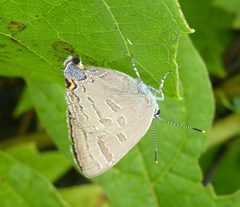
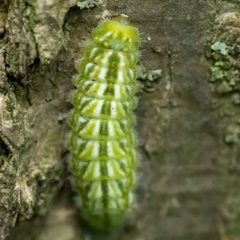
Satyrium caryaevorus, the hickory , is a small in the Lycaenidae. It is found in eastern North America, where are active during summer months. The has one per year and overwinters as an . Larvae feed primarily on hickory and related tree species, while adults visit flowers for nectar.
Pronunciation
How to pronounce Satyrium caryaevorus: //sæˈtɪəriəm kæɹˈjaɪeɪˌvɔrəs//
These audio files are automatically generated. While they are not always 100% accurate, they are a good starting point.
Identification
Distinguished from the banded hairstreak (Satyrium calanus) by having only one hindwing tail versus two. Smaller than the oak hairstreak (Satyrium favonius). The grayish-brown underside with black spots helps separate it from similar . Best identified by plant association when larvae are present.
Images
Appearance
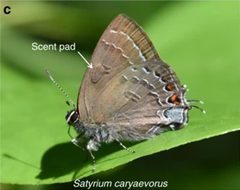
Small with wingspan of 22–35 mm. Hindwing bears a single tail. Upper wing surfaces brown; undersides grayish-brown with black spots. The single tail on the hindwing distinguishes it from some other that possess two tails.
Habitat
Deciduous woodlands and forest edges, particularly areas with hickory, walnut, oak, ash, and hawthorn. Associated with mature hardwood forests and their margins.
Distribution
Eastern North America: southern Ontario west to Minnesota and Iowa, south through the Appalachian Mountains to eastern Tennessee.
Seasonality
active from June to August. One per year. Overwinters as .
Diet
Larvae feed on leaves of bitternut hickory (Carya cordiformis), butternut (Juglans cinerea), red oak (Quercus rubra), white ash (Fraxinus americana), and hawthorn (Crataegus ). feed on nectar of common milkweed, dogbane, New Jersey tea, staghorn sumac, and white sweet clover.
Host Associations
- Carya cordiformis - larval food plantprimary
- Juglans cinerea - larval food plant
- Quercus rubra - larval food plant
- Fraxinus americana - larval food plant
- Crataegus - larval food plantmultiple
Life Cycle
One per year. laid on plants and overwinter. Larvae feed on host leaves in spring. occurs in early summer. emerge June through August.
Behavior
visit flowers for nectar. Larval feeding occurs on tree foliage. Specific behavioral observations for this are limited in the available literature.
Ecological Role
of various flowering plants during stage. Larvae serve as herbivores on hardwood tree foliage, contributing to nutrient cycling in forest .
Human Relevance
Subject of watching and photography. Not considered economically significant. MONA/Hodges number 4283.
Similar Taxa
- Satyrium calanusBanded hairstreak has two hindwing tails; S. caryaevorus has one.
- Satyrium favoniusOak hairstreak is larger and associated with oak ; S. caryaevorus is smaller and uses different plants.
More Details
Taxonomic Note
GBIF lists this as a synonym under Strymon caryaevorus, while NCBI and iNaturalist maintain it in Satyrium. The placement has been subject to revision.
Wingspan Variation
Sources report conflicting wingspan ranges: 22–28 mm and 29–35 mm. This variation may reflect measurement differences, variation, or .