
Satyrium favonius
(Smith, 1797)
Oak Hairstreak, Southern Hairstreak
Species Guides
3- Satyrium favonius autolycus(Texas Oak Hairstreak)
- Satyrium favonius favonius(Southern Oak Hairstreak)
- Satyrium favonius ontario(Northern Oak Hairstreak)
Satyrium favonius, commonly known as the Oak or Southern Hairstreak, is a small in the Lycaenidae with a wingspan of 22–38 mm. The is distributed across the eastern and central United States, from southern New England and the Atlantic Coast south to peninsular Florida and west to central Illinois, southeastern Colorado, and the Gulf Coast. The larvae feed on Quercus (oak) species, consuming leaves, buds, and male catkins. The species overwinters as an .
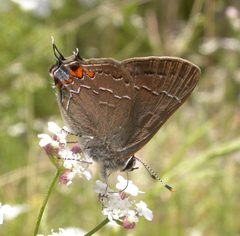
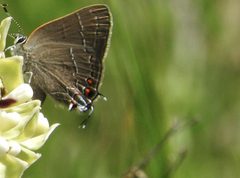

Pronunciation
How to pronounce Satyrium favonius: //səˈtɪɹ.i.əm fəˈvoʊ.ni.əs//
These audio files are automatically generated. While they are not always 100% accurate, they are a good starting point.
Identification
The can be distinguished from similar Satyrium hairstreaks by its association with oak and geographic distribution. The northern (S. f. ontario) is particularly difficult to detect due to its canopy-dwelling , making ground-level sightings unreliable for assessment. Subspecies identification requires examination of morphological details and geographic location: S. f. favonius, S. f. autolycus, S. f. violae, and S. f. ontario represent recognized subspecies with overlapping but distinct ranges.
Images
Appearance
Small with wingspan of 22–38 mm. Wings are brown on the upper surface and grayish-brown with black spots on the underside.
Habitat
Oak-containing woodlands and forests. of the northern spend most of their time in the forest , particularly in the crowns of post oaks and white oaks, making them difficult to detect from the ground. The shows vertical stratification by oak species preference, with some associated with low-growing scrub oak and others with taller white oaks.
Distribution
United States: southern New England and Atlantic Coast south to peninsular Florida, west to central Illinois, southeastern Colorado, and the Gulf Coast. The S. f. ontario (Northern Oak Hairstreak) occurs from Georgia north through New England and west through the Great Plains.
Diet
Larvae feed on leaves, buds, and male catkins of Quercus (oak) . have been observed feeding on non-nectar sources including oak gall exudates (specifically from the cynipid Callirhytis balanacea) and honeydew from aphids, mealy , treehoppers, scale insects, and whiteflies. Adults may visit flowers when primary food sources are unavailable, such as after heavy rain washes away honeydew.
Host Associations
- Quercus - larval food plantleaves, buds, and male catkins consumed
- Quercus alba - tree for S. f. ontario larvaewhite oak, particularly important for northern
- Quercus ilicifolia - for associated bear or scrub oak, low-growing form
- Callirhytis balanacea - indirect food sourcecynipid ; feed on sugary exudates from pea-size oak pip galls
Life Cycle
Overwinters as an . Larval stage can be sampled using burlap bands wrapped around tree trunks, which is a more reliable method than sightings for the -dwelling northern .
Behavior
spend much of their lives in the forest , descending to ground level only sporadically. When disturbed, adults ascend into the canopy rather than remaining near the ground. This contributes to underestimation of abundance by observers focused on ground-level flower visitation.
Human Relevance
The northern (S. f. ontario) is listed as a of special concern under Massachusetts state legislation. Research on this subspecies has highlighted the importance of non-nectar sugar resources (honeydew, gall exudates) in forest and demonstrated that perceived rarity may reflect detection difficulties rather than true demographic scarcity. Conservation agencies have been advised to proceed guardedly with legal protection, as the species may be more common than previously thought.
Similar Taxa
- Satyrium edwardsiiSimilar oak-feeding ; occupies lower forest strata, feeding on scrub oak rather than white oaks; remains near ground when disturbed
- Satyrium semilunaHalf-moon Hairstreak; similar but distinct with different geographic range and plant associations
- Other Satyrium hairstreaksMultiple share similar size, coloration, and ; identification requires attention to stratum, plant, and geographic location
Misconceptions
The has been considered rare in the northeastern United States, particularly the S. f. ontario, but this perception appears to result from detection rather than true demographic rarity. watchers typically survey flowers near the ground and do not look upward into the where spend most of their time. Ground-level sightings are not indicative of actual numbers.
More Details
Subspecies
Four recognized: S. f. favonius, S. f. autolycus, S. f. violae, and S. f. ontario (Northern Oak Hairstreak). The subspecies show geographic differentiation in range and potentially in oak preferences.
Research significance
Studies of S. f. ontario at Great Blue Hill, Massachusetts represent the only location in New England where the northern can be found in most years. Research there documented the first recorded observation of a New World feeding at cynipid gall exudates.
Sources and further reading
- BugGuide
- Wikipedia
- GBIF taxonomy match
- iNaturalist taxon
- NCBI Taxonomy
- "Rare" Butterfly Feeds on Oak Galls and Other Non-Nectar Sources
- Curious isolation: new butterfly species discovered | Blog
- Species distribution model for the ‘Northern’ Oak hairstreak (Satyrium favonius ontario) with comments on its conservation status in the northeastern United States