
Satyrium favonius autolycus
(W.H. Edwards, 1871)
Texas Oak Hairstreak
Satyrium favonius autolycus is a of oak hairstreak commonly known as the Texas Oak Hairstreak. It is one of four recognized subspecies of Satyrium favonius, a ranging from southeastern Colorado to Michigan, east to Massachusetts, and south to Florida and Texas. The subspecies occurs in the southern portion of this range, including Texas. Like other oak hairstreaks, it is associated with oak woodlands and exhibits -dwelling that may obscure its true abundance from ground-level observation.

Pronunciation
How to pronounce Satyrium favonius autolycus: /səˈtɪəriəm fəˈvoʊniəs ɔˈtɒlɪkəs/
These audio files are automatically generated. While they are not always 100% accurate, they are a good starting point.
Identification
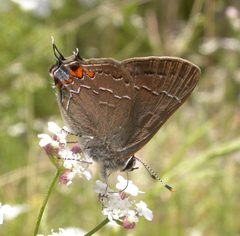
The Texas Oak Hairstreak can be distinguished from the nominate S. f. favonius and the northern S. f. ontario by geographic range. It may be separated from S. f. violae by distribution and potentially subtle morphological differences, though specific diagnostic characters for this subspecies are not well documented in available sources. are small butterflies with wingspans of approximately one inch. The undersides of the wings are grayish-brown with black spots; upper surfaces are brown.
Images
Habitat
Oak woodlands and forests, particularly those containing of Quercus. Based on observations of related , likely occupy the forest , with larvae associated with oak plants.
Distribution
Texas and adjacent southern regions of the oak hairstreak's range. The Satyrium favonius overall ranges from southeastern Colorado to Michigan, east to Massachusetts, and south to Florida and Texas; the autolycus occupies the southern portion of this distribution.
Diet
Larvae feed on oaks (Quercus ). have been observed feeding on non-nectar sources including oak gall exudates and honeydew from sap-feeding insects such as aphids, , treehoppers, scale insects, and whiteflies, based on studies of related . Adult flower visitation appears to be opportunistic rather than primary.
Host Associations
- Quercus - larval plantspecific oak not documented for this
Behavior
are -dwelling and rarely encountered at ground level. When disturbed, adults fly upward into the canopy rather than remaining near the ground. This contributes to underdetection by observers focused on ground-level flowering plants.
Ecological Role
Human Relevance
The perceived rarity of oak hairstreak may be partly an artifact of survey methods focused on ground-level nectar sources rather than . Conservation status assessments for this subspecies specifically have not been documented in available sources.
Similar Taxa
- Satyrium favonius ontarioNorthern with overlapping ; distinguished by geographic range (Ontario and northeastern North America versus Texas/south)
- Satyrium favonius favoniusNominate ; distinguished by geographic distribution
- Satyrium favonius violaeFourth of the same ; range and potential subtle morphological differences separate them
- Satyrium edwardsiiSympatric congeneric ; Edwards' hairstreak remains near ground level when disturbed and occupies lower forest strata
- Satyrium semilunaHalf-moon Hairstreak; similar size and coloration but occupies sagebrush steppe in western North America rather than oak woodlands