
Satyrium calanus
(Hübner)
Banded Hairstreak
Satyrium calanus, the banded , is a common North American in the Lycaenidae. It is widely distributed east of the Rocky Mountains and exhibits territorial . The has a single with active from early June to late August. Larvae develop on oaks, hickories, and walnuts.
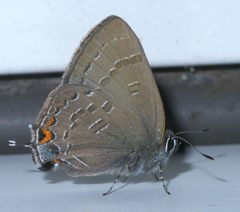
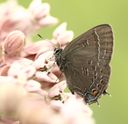
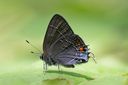
Pronunciation
How to pronounce Satyrium calanus: //səˈtɪriəm ˈkælənəs//
These audio files are automatically generated. While they are not always 100% accurate, they are a good starting point.
Identification
The banded is distinguished from similar Satyrium by its distribution and associations. Edwards' hairstreak (S. edwardsii) and hickory hairstreak (S. caryaevorum) are the most similar ; these require careful separation based on regional occurrence and subtle morphological differences. The species lacks the pronounced -dwelling observed in some related hairstreaks, remaining near ground level when disturbed.
Images
Habitat
Woodlands and forest edges with oak, hickory, or walnut present. Associated with tree distribution across eastern North America.
Distribution
Eastern North America, from the Rocky Mountains eastward. Recorded in Canadian provinces including Manitoba and Saskatchewan, and throughout the eastern United States including Vermont.
Seasonality
Single with period from early June to late August. laid on plants hatch the following spring.
Diet
feed on nectar from flowers. Larvae feed on oak (Quercus), hickory (Carya), and walnut (Juglans), with particular association with butternut.
Host Associations
- Quercus - larval oak
- Carya - larval hickory
- Juglans - larval walnut , especially butternut (J. cinerea)
Life Cycle
are laid singly on plant twigs in late summer. Eggs overwinter and hatch in spring. Larvae develop on host foliage and pupate. emerge in early summer. There is one per year.
Behavior
Territorial; males challenge other butterflies entering their territory. When disturbed, remain near ground level rather than ascending into . This contrasts with some such as the northern oak hairstreak.
Human Relevance
A common and widespread frequently encountered by watchers. Not considered threatened. Serves as a study subject for understanding and .
Similar Taxa
- Satyrium edwardsiiEdwards' overlaps in range and ; requires careful identification
- Satyrium caryaevorumHickory hairstreak is morphologically similar and shares plant associations
More Details
Subspecies
Four recognized: S. c. calanus (nominate), S. c. albidus Scott 1981, S. c. falacer (Godart [1824]), and S. c. godarti (Field 1938).