
Satyrium behrii
(W.H. Edwards, 1870)
Behr's Hairstreak
Satyrium behrii, the Behr's , is a small in the Lycaenidae found in western North America. have a wingspan of 24–32 mm and are active from June to July in a single . The inhabits dry slopes and canyons, where adults feed on flower nectar and larvae feed on specific plants in the Rosaceae family.
Pronunciation
How to pronounce Satyrium behrii: //sæˈtɪriəm ˈbɛəri//
These audio files are automatically generated. While they are not always 100% accurate, they are a good starting point.
Identification
Distinguished from other Satyrium by combination of geographic range (western North America), preference (dry slopes and canyons), and association with specific larval plants (Purshia and Cercocarpus species). The single in June–July helps separate it from sympatric species with different periods. S. b. columbia occurs in British Columbia, S. b. crossi in more southern areas.
Images
Appearance
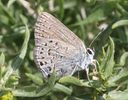
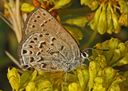
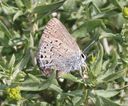
Small with wingspan 24–32 mm. Typical with thin, hair-like tail projections on the hindwings. Upper wing surfaces generally gray-brown with orange marginal spots on hindwings. Undersurfaces have fine striations and small spots characteristic of the .
Habitat
Dry slopes and canyons in western North America. Associated with pinyon-juniper woodland, sagebrush steppe, and open montane where larval plants occur. Found from low elevations to moderate mountain slopes.
Distribution
Western North America from western Texas north and west through New Mexico, Arizona, and southern California to British Columbia. Three recognized with somewhat discrete geographic ranges: S. b. behrii (southwestern), S. b. columbia (British Columbia), and S. b. crossi (intermediate areas).
Seasonality
active June to July. Single per year (). Larval stage occurs through late summer and winter, with in spring.
Diet
feed on flower nectar. Larvae are obligate feeders on Purshia tridentata (antelope bitterbrush), Purshia glandulosa (desert bitterbrush), and Cercocarpus montanus (alderleaf mountain mahogany)—all in Rosaceae.
Host Associations
- Purshia tridentata - larval Antelope bitterbrush; primary plant
- Purshia glandulosa - larval Desert bitterbrush; secondary
- Cercocarpus montanus - larval Alderleaf mountain mahogany; secondary
Life Cycle
Complete with single . laid on plant. Larvae feed on host foliage, likely as partially grown larvae or pupae. emerge in early summer (June–July), mate, and lay eggs to complete the cycle.
Behavior
have been observed visiting flowers of Hymenopappus filifolium (fineleaf woollywhite) in sand dune . Typical includes perching with wings closed, rubbing hindwings together to draw attention to false spots near the tail, and rapid, darting when disturbed.
Ecological Role
as ; herbivore as larva. Part of supporting and . plant specificity suggests potential role as for healthy stands of Purshia and Cercocarpus.
Human Relevance
Subject of watching and photography. No significant economic importance. Conservation concern in some areas due to loss and alteration of fire regimes affecting plant .
Similar Taxa
- Satyrium tetraOverlaps in range; distinguished by different plant associations and often pattern
- Callophrys gryneusJuniper hairstreak; similar size and but uses Juniperus as larval and has different wing pattern
- Other Satyrium speciesMany western Satyrium require close examination of genitalia or larval association for definitive identification
More Details
Subspecies
Three recognized: S. b. behrii (nominate, southwestern US), S. b. columbia McDunnough 1944 (British Columbia), and S. b. crossi Field 1938 (intermediate distribution). Subspecies differ subtly in size and coloration.
Conservation status
Not formally listed as threatened, but dependent on specific plant that are sensitive to fire suppression, grazing, and climate change. Local may be vulnerable where host plants decline.