
Pyrgus
Hübner, 1819
Grizzled Skippers, Checkered Skippers
Species Guides
4- Pyrgus centaureae(Northern Grizzled Skipper)
- Pyrgus ruralis(Two-banded Checkered-Skipper)
- Pyrgus scriptura(Small Checkered-Skipper)
- Pyrgus xanthus(Mountain Checkered-Skipper)
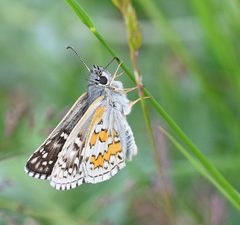
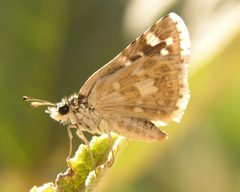
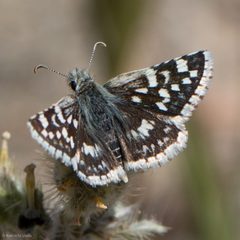
Pyrgus is a of skippers in the Hesperiidae, commonly known as grizzled skippers. The genus occurs primarily in the Holarctic region, with some extending into the Neotropics. Following a major taxonomic revision in 2019, most New World species were moved to other genera (Burnsius, Chirgus, Heliopetes), leaving only four Pyrgus species in the Americas: P. centaureae, P. ruralis, P. scriptura, and P. xanthus. The genus is characterized by small butterflies with checkered or grizzled wing patterns.
Pronunciation
How to pronounce Pyrgus: /ˈpɪr.ɡʊs/
These audio files are automatically generated. While they are not always 100% accurate, they are a good starting point.
Identification
Members of Pyrgus are small skippers with distinctive wing patterns featuring white or pale checkered or grizzled markings on a dark background. They can be difficult to distinguish from similar , particularly Carterocephalus (the true chequered skippers) and Burnsius. Specific identification to level often requires examination of subtle differences in spot patterns, particularly on the hindwing underside, and sometimes genitalia examination. The genus is distinguished from Carterocephalus by morphological and molecular characters, though have historically overlapped.
Images
Habitat
vary by but generally include open, sunny areas such as alpine meadows, rocky pastures, grasslands, scrubland, forest edges, and disturbed habitats. Many species occupy mid- to high-elevation environments, with some ranging from plains to over 2,400 m. They typically require areas with patchy vegetation and plants in the Rosaceae .
Distribution
Primarily Holarctic, distributed across Europe, Asia, and North America. Some extend into the Neotropics. Following the 2019 taxonomic revision, the has a reduced New World distribution, with only four species remaining in North and South America: Pyrgus centaureae, P. ruralis, P. scriptura, and P. xanthus. European species include P. malvae, P. malvoides, P. carlinae, P. cacaliae, and others.
Seasonality
periods vary by and latitude. Most species are with a single , typically flying from late spring to early autumn depending on elevation and climate. Some southern may produce two generations. For example, P. carlinae flies from late June to early August, while P. malvoides has one generation in central Europe (April-August) and two in the southern part of its range.
Diet
Larvae feed on plants in the Rosaceae . Documented plants include Potentilla (P. verna, P. reptans, P. hirta, P. tabernaemontani), Agrimonia eupatoria, Comarum palustre, Filipendula vulgaris, Fragaria vesca, Rubus species, and Sanguisorba minor. feed on nectar from various flowers.
Host Associations
- Potentilla - larval foodplantMultiple including P. verna, P. reptans, P. hirta, P. tabernaemontani
- Agrimonia eupatoria - larval foodplant
- Comarum palustre - larval foodplant
- Filipendula vulgaris - larval foodplant
- Fragaria vesca - larval foodplant
- Rubus - larval foodplant
- Sanguisorba minor - larval foodplant
Life Cycle
Most are . are typically laid singly on the underside of plant leaves. Larvae hatch and construct shelters by rolling or folding leaves with silk, enlarging these structures as they grow. Some species overwinter as eggs (e.g., P. carlinae, where larvae overwinter within eggshells), while others overwinter as pupae (e.g., P. malvoides). occurs in the larval shelter or in leaf litter.
Behavior
are rapid, darting fliers typical of skippers, with a characteristic skipping pattern. They are and often visit flowers for nectar. Larvae are concealed feeders, constructing and remaining within silk-bound leaf shelters. Some exhibit in wing spot patterns. Certain species, such as P. carlinae, are difficult to identify in the field due to close resemblance to .
Ecological Role
Larvae function as herbivores on Rosaceae plants. They serve as prey for , including such as Trichogramma, Dolichogenoidea, and Cotesia. contribute to pollination as nectar visitors. The genus is considered an indicator of traditional extensive grazing or mowing practices in alpine and grassland , with several of conservation concern due to loss from agricultural intensification and climate change.
Human Relevance
Several Pyrgus are of conservation interest in Europe due to declining from loss and agricultural intensification. They are popular subjects for watchers and photographers, though their small size and rapid make them challenging subjects. The has been extensively studied in and , with recent genomic research providing -level assemblies for multiple species. Some species serve as indicators of sustainable land management practices in grassland .
Similar Taxa
- CarterocephalusHistorically confused with Pyrgus; true chequered skippers with similar wing patterns but distinct morphologically and molecularly; strict use of 'chequered skipper' applies to Carterocephalus, not Pyrgus
- Burnsius established in 2019 to accommodate most New World formerly placed in Pyrgus; previously considered congeneric but now recognized as distinct based on molecular and morphological data
- ChirgusAnother established in 2019 for formerly in Pyrgus; contains New World species moved from Pyrgus during taxonomic revision
- Heliopetes that received some from Pyrgus in the 2019 revision; contains New World species previously classified in Pyrgus
More Details
Taxonomic History
The underwent significant revision in 2019, when most North, Central, and South American were transferred to Burnsius, Chirgus, and Heliopetes based on molecular phylogenetic studies. This reduced the New World representation of Pyrgus to four species: P. centaureae, P. ruralis, P. scriptura, and P. xanthus.
Genomic Resources
-level assemblies have been published for several including P. carlinae (808.07 Mb, 25 chromosomes), P. malvoides (746.71 Mb, 31 chromosomes), and P. cacaliae, providing resources for comparative and species identification.
Conservation Status
Multiple European are of conservation concern due to loss from agricultural intensification, abandonment of traditional grazing, and climate warming. P. carlinae is to the western Alps and threatened by changes in alpine land use.
Sources and further reading
- BugGuide
- Wikipedia
- iNaturalist taxon
- NCBI Taxonomy
- Catalogue of Life
- Nota Lepidopterologica goes advanced open access with Pensoft Publishers | Blog
- Bug Eric: White Prairie Clover: An Awesome Blossom
- Provisional checklist of European butterfly larval foodplants
- Bug Eric: March 2009
- Pensoft blog - Part 128
- Pensoft Editorial Team | Blog - Part 126
- The genome sequence of the Northern Grizzled Skipper, Pyrgus centaureae (Rambur, 1839) (Lepidoptera: Hesperiidae).
- The genome sequence of the Carline Skipper, Pyrgus carlinae (Rambur, 1839) (Lepidoptera: Hesperiidae).
- The genome sequence of the Southern Grizzled Skipper, Pyrgus malvoides (Elwes & Edwards, 1897) (Lepidoptera: Hesperiidae).
- The genome sequence of the Dusky Grizzled Skipper, Pyrgus cacaliae (Rambur, 1839) (Lepidoptera: Hesperiidae).