
Carterocephalus
Lederer, 1852
skipperlings, chequered skippers, Arctic skippers
Species Guides
2- Carterocephalus mandan(Arctic Skipper)
- Carterocephalus skada(Western Arctic Skipper)
Carterocephalus is a Holarctic of small (skipperlings) in the Hesperiidae. The genus contains approximately 20 described , with the majority to China. The most widely distributed species, C. palaemon (chequered skipper), has been the focus of conservation efforts in Europe following its extinction in England in 1976 and subsequent reintroduction from Belgium in 2018.
Pronunciation
How to pronounce Carterocephalus: /ˌkɑːr.tə.roʊˈsɛf.ə.ləs/
These audio files are automatically generated. While they are not always 100% accurate, they are a good starting point.
Identification
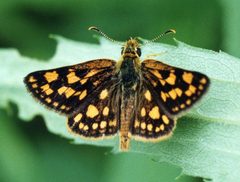
Wings display yellow, white, dark-brown and black coloration with spotted patterns. Hindwing upperside is dark with clear-cut rounded lighter spots. As a -level description, specific identification criteria require examination of individual .
Images
Habitat
Woodland , particularly areas with traditional coppice management and dense tussock-forming grasses. Microhabitat includes patches of bare ground or sparse vegetation used for basking. In Scotland, occupy grassland habitats within woodland matrices where larval foodplants occur.
Distribution
Holarctic distribution. Majority of to China. C. palaemon occurs across Europe including Scotland, Belgium, and formerly England (extinct 1976, reintroduced 2018). C. silvicola (northern chequered skipper) occurs in northern Europe. C. skada (Arctic skipper) occurs in North America including Vermont, USA.
Diet
Larvae feed on grasses. C. palaemon larvae specifically feed on purple moor-grass (Molinia caerulea) and have been observed notching grass blades before feeding, a that may maximize nutrient intake by reducing nutrient decline in the foodplant.
Host Associations
- Molinia caerulea - larval foodplantPurple moor-grass; primary for C. palaemon
- Poaceae - larval foodplant Larval foodplants are grasses; specific vary by region
Behavior
Larvae exhibit distinctive feeding : notching grass blades before consuming tissue above the notch, which maintains higher nutrient concentrations in the feeding zone. engage in basking behavior on bare ground or sparse vegetation patches for .
Ecological Role
Herbivore; larvae function as primary consumers in grassland and woodland edge . range and persistence are limited by foodplant quality and availability.
Human Relevance
C. palaemon (chequered skipper) was extinct in England from 1976 until a successful reintroduction from Belgium to Rockingham Forest in 2018. As of 2022, 128 individuals had been released and the established with increasing area of occupancy, though it had not yet become a functioning metapopulation. The reintroduction serves as a model for insect conservation and has been used to trial distribution modeling approaches for informing reintroduction site selection.
Similar Taxa
- HesperiaBoth are Hesperiidae with spotted wing patterns, but Hesperia are generally larger and lack the distinct rounded lighter spots on dark hindwing upperside characteristic of Carterocephalus
- ThymelicusSmall skipper with similar size range, but Thymelicus typically have plain orange-brown wings without the contrasting spotted pattern of Carterocephalus
More Details
Conservation genetics
The of C. palaemon has been sequenced (2024), providing resources for understanding structure and informing conservation .
Taxonomic notes
Formerly included C. plancus, now transferred to Ladda plancus. The shows high in China with many narrow endemics.
Sources and further reading
- BugGuide
- Wikipedia
- GBIF taxonomy match
- iNaturalist taxon
- NCBI Taxonomy
- Catalogue of Life
- Rising from the Ashes--Some Day | Bug Squad
- Provisional checklist of European butterfly larval foodplants
- Conservation Translocations: It’s Not Just Beavers - Buglife Blog - Buglife
- The Ecology of the Chequered Skipper Butterfly Carterocephalus palaemon in Scotland. I. Microhabitat
- The Ecology of the Chequered Skipper Butterfly Carterocephalus palaemon in Scotland. II. Foodplant Quality and Population Range
- The history, science and preliminary results from the reintroduction of the Chequered Skipper, Carterocephalus palaemon into Rockingham Forest, England
- The feeding behaviour of Carterocephalus palaemon (Lepidoptera: Hesperiidae) caterpillars: does it avoid host defences or maximize nutrient intake?
- Can species distribution models using remotely sensed variables inform reintroductions? Trialling methods with Carterocephalus palaemon the Chequered Skipper Butterfly
- The genome sequence of the Arctic Skipper, Carterocephalus palaemon (Pallas, 1771).