
Datana modesta
Beutenmüller, 1890
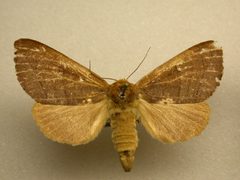
Datana modesta is a of prominent in the Notodontidae, first described by William Beutenmüller in 1890. It is native to North America and belongs to a whose larvae are known as feeders on woody plants. The species is part of a group of late-season defoliators that typically cause minor, aesthetic damage rather than significant tree health impacts.
Pronunciation
How to pronounce Datana modesta: //ˈdætənə moʊˈdɛstə//
These audio files are automatically generated. While they are not always 100% accurate, they are a good starting point.
Identification
Within the Datana, identification often requires examination of genitalia or detailed wing pattern analysis. D. modesta can be distinguished from such as D. integerrima (walnut caterpillar) and D. ministra (yellow-necked caterpillar) by subtle differences in forewing coloration and pattern, though precise field identification is challenging without specimen examination. Adults exhibit the characteristic robust body and relatively broad wings typical of the Notodontidae.
Images
Distribution
North America. Specific range details within this continent are not well documented in available sources.
Seasonality
are active during the warmer months; larvae are late-season feeders, typically observed in late summer and early fall.
Diet
Larvae feed on foliage of woody plants. Specific plant records for D. modesta are not documented in available sources, though in the Datana feed on a variety of trees and shrubs including walnut, hickory, oak, and sumac.
Life Cycle
Complete with , larva, pupa, and stages. Larvae are the primary feeding stage and are responsible for defoliation. occurs in soil. Detailed timing for this specific is not documented.
Behavior
Ecological Role
As a folivore, larvae contribute to nutrient cycling through defoliation. They serve as prey for various and , including thread-waisted wasps in the Ammophila. levels are typically regulated by natural enemies.
Human Relevance
Larvae may cause minor defoliation of ornamental and shade trees, but damage is generally aesthetic and does not threaten tree health. Management is rarely necessary; when warranted, mechanical removal or targeted applications may be used.
Similar Taxa
- Datana integerrimaWalnut caterpillar; similar larval appearance and gregarious feeding , but associated primarily with walnut and hickory.
- Datana ministraYellow-necked caterpillar; comparable and , distinguished by preferences and subtle wing patterns.
- Anisota senatoriaOrangestriped oakworm; similar late-season defoliator with gregarious larvae, but belongs to Saturniidae and has distinct coloration.
Sources and further reading
- BugGuide
- Wikipedia
- GBIF taxonomy match
- iNaturalist taxon
- NCBI Taxonomy
- Catalogue of Life
- Insects and mites that feed on leaves - AgriLife Extension Entomology
- Bug Eric: Wasp Wednesday: Ammophila procera
- Much Ado About Nothing? End-of-Summer Defoliation Heats Up
- Bug Eric: November 2010
- 2018 Arizona Insect Collecting Trip “iReport” | Beetles In The Bush