
Catocala judith
Strecker, 1874
Judith's Underwing
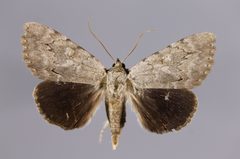
Catocala judith, or Judith's Underwing, is a in the Erebidae first described by Strecker in 1874. It belongs to the Catocala, commonly known as underwing moths, which are characterized by dull forewings that conceal brightly colored hindwings. The is found in eastern North America, ranging from southern Quebec and Ontario south to Georgia and west to Oklahoma and Iowa. Like other underwings, it employs a startle defense by flashing its concealed hindwings when disturbed.
Pronunciation
How to pronounce Catocala judith: //ˌkætəˈkeɪlə ˈdʒuːdɪθ//
These audio files are automatically generated. While they are not always 100% accurate, they are a good starting point.
Identification
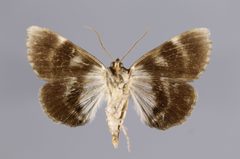
Distinguished from other Catocala by specific hindwing coloration and pattern; precise identification often requires examination of the hindwing markings and comparison with similar eastern underwings such as C. concumbens or C. ilia. Forewing pattern alone is insufficient for reliable identification. Genitalia examination may be necessary for definitive identification in some cases.
Images
Appearance
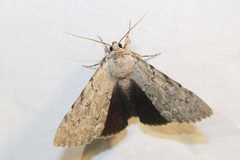
have cryptic, mottled gray-brown forewings that provide camouflage against tree bark when at rest. The hindwings are concealed at rest but display bold coloration when exposed—typically featuring bands of orange, red, black, or white. The exact hindwing pattern distinguishes it from similar underwing . Body is robust with a furry . Wingspan varies among individuals.
Habitat
Associated with deciduous woodlands and forest edges. are attracted to light sources at night. Larval plants include various hardwood trees, though specific associations for this require verification.
Distribution
Eastern North America: southern Quebec (rare) and Ontario through New Hampshire, Connecticut, New Jersey, south to North Carolina and Georgia, west to Oklahoma and Iowa, and north to Wisconsin. Vermont records confirmed.
Seasonality
active during summer months, with peak activity typically corresponding with National Week timing (late July). Exact period varies by latitude and local conditions.
Life Cycle
Complete with , larva, pupa, and stages. Larvae are caterpillars that feed on plant foliage. Specific details for this are not well documented in available sources.
Behavior
. exhibit the characteristic underwing defense : when disturbed, they rapidly spread their wings to expose the brightly colored hindwings, startling potential before taking . Attracted to artificial light sources and sugar baits.
Ecological Role
may contribute to pollination through incidental contact with flowers during activity. Larvae function as herbivores on hardwood trees. Serves as prey for various nocturnal including birds, bats, and predatory insects.
Human Relevance
Subject of interest among enthusiasts and citizen scientists, particularly during National Moth Week events. Documented in citizen science platforms such as iNaturalist. No significant economic or agricultural impacts reported.
Similar Taxa
- Catocala concumbensSimilar eastern underwing with overlapping range; distinguished by hindwing pattern details
- Catocala iliaAnother eastern underwing with cryptic forewings and brightly patterned hindwings; requires careful comparison of markings
- Catocala aholibahLarger underwing found in some overlapping areas; distinguished by size and hindwing coloration
More Details
Taxonomic Note
The Catocala (Greek: 'beautiful below') was formerly placed in Noctuidae but is now classified in Erebidae following molecular phylogenetic revisions.
Citizen Science
This is among those documented through National Week events, which have increased public awareness and recording of underwing moth diversity across North America.
Sources and further reading
- BugGuide
- GBIF taxonomy match
- iNaturalist taxon
- NCBI Taxonomy
- Catalogue of Life
- Storer Lecture: 'Why Cooperate? Mutualism in the Natural World' | Bug Squad
- A Gathering of Lepidopterists: Who's Who of the Butterfly, Moth Experts | Bug Squad
- Got Moths? Celebrate National Moth Week and Global Citizen Science
- Bug Eric: National Moth Week Recap, 2015
- Bug Eric: National Moth Week Recap for Colorado Springs
- Bug Eric: National Moth Week 2024 Recap from Kansas City