
Catocala ilia
Cramer, 1776
Ilia Underwing, Beloved Underwing, Wife Underwing
Species Guides
1- Catocala ilia zoe(Ilia Underwing)
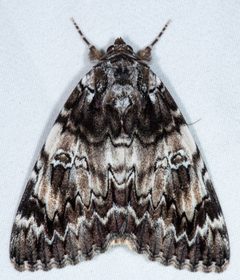
Catocala ilia is a in the Erebidae, first described by Pieter Cramer in 1776. The is notable for its highly variable forewing patterns and strikingly colored hindwings, which are typically concealed at rest. It occurs across eastern North America with a disjunct in the southwestern United States represented by a distinct .


Pronunciation
How to pronounce Catocala ilia: //ˌkætəˈkeɪlə ˈɪliə//
These audio files are automatically generated. While they are not always 100% accurate, they are a good starting point.
Identification
The white-circled spot on the forewing distinguishes Catocala ilia from other Catocala . The hindwing color ranges from pale orange to deep red, with some geographic variation. C. i. zoe in California and Arizona tends toward darker, more reddish hindwings. Forewing patterns are extremely variable and unreliable for identification without the spot character.
Images
Habitat
Deciduous and mixed forests with oak presence; woodlands, forest edges, and suburban areas with mature oak trees. Elevation range extends from lowlands to moderate elevations in mountainous regions.
Distribution
Eastern United States from approximately the Great Plains eastward, north to southern Canada (Manitoba, Saskatchewan, Ontario, Quebec, Maritime provinces). Disjunct western in California and Arizona ( C. i. zoe).
Seasonality
fly from June to September, with peak activity varying by latitude and local climate. In Colorado, has been recorded in late July.
Diet
Larvae feed on oak (Quercus), including black oak, bur oak, red oak, and white oak. feeding habits are not well documented; adults of related Catocala species have been observed feeding on tree sap and rotting fruit.
Host Associations
- Quercus - larval plantMultiple oak including black, bur, red, and white oaks
Life Cycle
Complete : , larva, pupa, . Larvae are solitary feeders on oak foliage. occurs in soil or leaf litter. Adults are and attracted to light. stage not explicitly documented in sources.
Behavior
are strongly attracted to artificial light sources. When at rest, forewings are folded over the body, concealing the brightly colored hindwings—an apparent anti- . Adults have been documented visiting stations with fermented fruit mixtures.
Ecological Role
Larval stage functions as a folivore on oak trees, contributing to nutrient cycling. may serve as prey for including bats and owls. The bright hindwing coloration, flashed when disturbed, may startle predators (startle display).
Human Relevance
Subject of citizen science monitoring through National Week events. Occasionally encountered at porch lights. Not an agricultural or forest pest; larval feeding on oaks is not considered damaging at observed densities.
Similar Taxa
- Catocala concumbensShares similar size and general underwing ; distinguished by different forewing spot pattern and hindwing coloration
- Catocala amestrisOverlapping range in some areas; distinguished by forewing pattern details and hindwing color
- Catocala delilahSimilar preferences; distinguished by forewing markings and geographic distribution
More Details
Subspecies
Two recognized: C. i. ilia (eastern North America) and C. i. zoe Behr, 1870 (California, Arizona). The western subspecies shows some differentiation in hindwing coloration.
Etymology
The specific epithet 'ilia' and 'beloved underwing' and 'wife underwing' suggest romantic connotations, though the origin is not explicitly documented in sources.
Sources and further reading
- BugGuide
- Wikipedia
- GBIF taxonomy match
- iNaturalist taxon
- NCBI Taxonomy
- Catalogue of Life
- A Gathering of Lepidopterists: Who's Who of the Butterfly, Moth Experts | Bug Squad
- Bug Eric: Remembering National Moth Week 2018
- Bug Eric: October 2018
- Bug Eric: National Moth Week Recap, 2015
- Lone Star Tick: Why Land Management (Not Just Climate Change) is Driving Boom
- Potential Range for Asian Longhorned Tick Covers Much of Eastern U.S.