
Catocala delilah
Strecker, 1874
Delilah Underwing, Delilah Underwing Moth
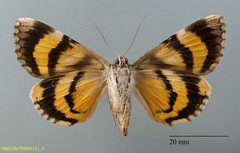
Catocala delilah is a medium-sized underwing in the Erebidae, native to the southern and midwestern United States. are active from May to June, with likely one per year. The is distinguished by its grayish-brown forewings with irregular black markings and bright yellowish-orange hindwings with complex black banding patterns. It belongs to a cryptic within the Catocala, and was previously considered with western now recognized as separate species.
Pronunciation
How to pronounce Catocala delilah: //kætəˈkeɪlə dəˈlaɪlə//
These audio files are automatically generated. While they are not always 100% accurate, they are a good starting point.
Identification
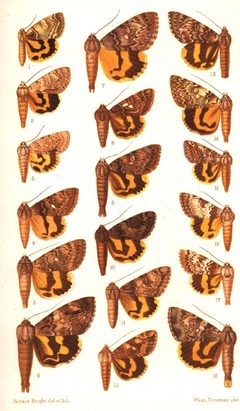
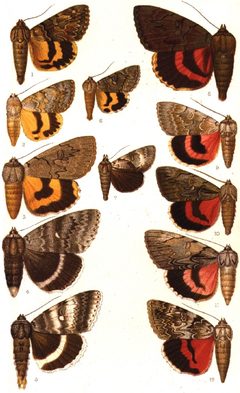
Distinguished from similar Catocala by the combination of: grayish-brown forewings with irregular black transverse lines; hindwings predominantly yellowish-orange (not red or pink) with two concentric black bands; large isolated orange-yellow spot separated from outer band; separate black tornal spot not connected to outer band. Foreleg tibial spine character (absent) useful for -level confirmation. Most similar to C. desdemona (now recognized as separate species), which occurs west of C. delilah range from Arizona/Utah to Honduras.
Images
Habitat
Associated with oak woodlands and riparian areas containing plants.
Distribution
Southern and midwestern United States: from Ohio south to Florida and west to Texas and Oklahoma.
Seasonality
on wing May to June, varying by location.
Diet
Caterpillars feed on bur oak (Quercus macrocarpa), Gambel oak (Quercus gambelii), and willows (Salix).
Host Associations
- Quercus macrocarpa - larval plantbur oak
- Quercus gambelii - larval plantGambel oak
- Salix - larval plantwillows
Life Cycle
Probably one per year.
Behavior
are . Like other underwing moths, typically rests with forewings folded over back, concealing brightly colored hindwings; when disturbed, may flash hindwings to startle before .
Ecological Role
Larval herbivore on oaks and willows; likely serves as prey for and possibly as .
Similar Taxa
- Catocala desdemonaFormerly treated as C. d. desdemona; now recognized as valid . Occurs west of C. delilah range from Arizona and Utah south through Mexico to Honduras. Geographic separation is primary distinction.
- Catocala amestrisAnother underwing with similar size and general appearance; distinguished by hindwing coloration and banding pattern differences.
- Catocala epioneSympatric underwing with yellow-orange hindwings; differs in specific pattern elements of black banding and spot placement.
More Details
Cryptic species complex
C. delilah is the best-known member of a cryptic within Catocala; some component have only recently been described. Taxonomic revisions have separated formerly included as distinct species.
Historical taxonomy
Former C. d. desdemona, C. d. utahensis, and supposed C. ixion plus forms swetti and umbra are now incorporated into C. desdemona.
Collection record
Documented as an unusual for southern Colorado when collected at Rock Creek Canyon in 2014, suggesting possible range extensions or underreporting in peripheral areas.
Sources and further reading
- BugGuide
- Wikipedia
- GBIF taxonomy match
- iNaturalist taxon
- NCBI Taxonomy
- Catalogue of Life
- A Gathering of Lepidopterists: Who's Who of the Butterfly, Moth Experts | Bug Squad
- Bug Eric: National Moth Week Recap, 2015
- Got Moths? Celebrate National Moth Week and Global Citizen Science
- Bug Eric: National Moth Week Recap for Colorado Springs
- Bug Eric: National Moth Week 2024 Recap from Kansas City
- Bug Eric: New Mexico Night Bugs